

Where does the time go? Hard to believe we’re already due for another Shoddy Goods, the newsletter from Meh about consumer culture. Jason Toon here with the rise and demise of the retrofitted quasi-genre of radio that was my savior many a time before my car had a tape player…
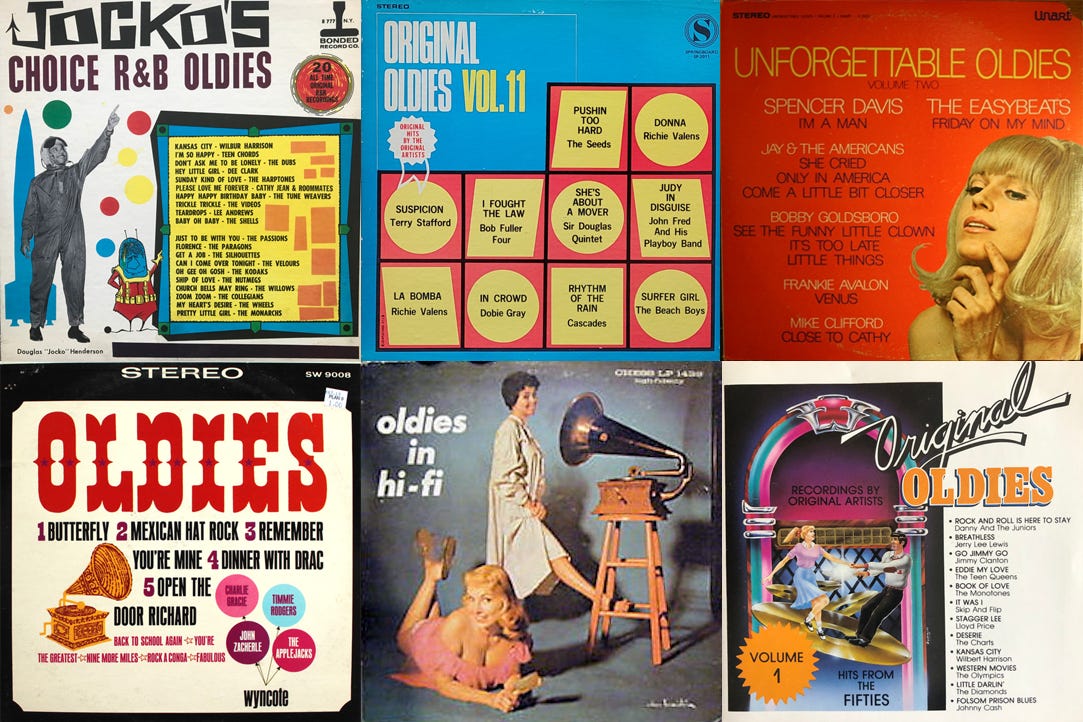
I am a sucker for those factoids that play on the telescoping nature of memory. Like the fact that Raiders of the Lost Ark is closer in time to The Wizard of Oz than the present day. Or that the first Strokes album is as old now as the first Ramones album was when that Strokes album came out. Or that The Office (US) is older, relative to my youngest daughter’s age, than Good Times was for me.
But even I am blown away by the fact that, if the first “Oldies” compilation album was released today, it would include songs from, like, 2023 and 2024. Even if the Internet went down forever starting right now, I have to think it would take longer than that for kids to need to be reminded of Chappell Roan and Shaboozey. But that was the timespan for the first ‘50s oldies to be labeled “oldies”.
Let’s take it all the way back to two years ago
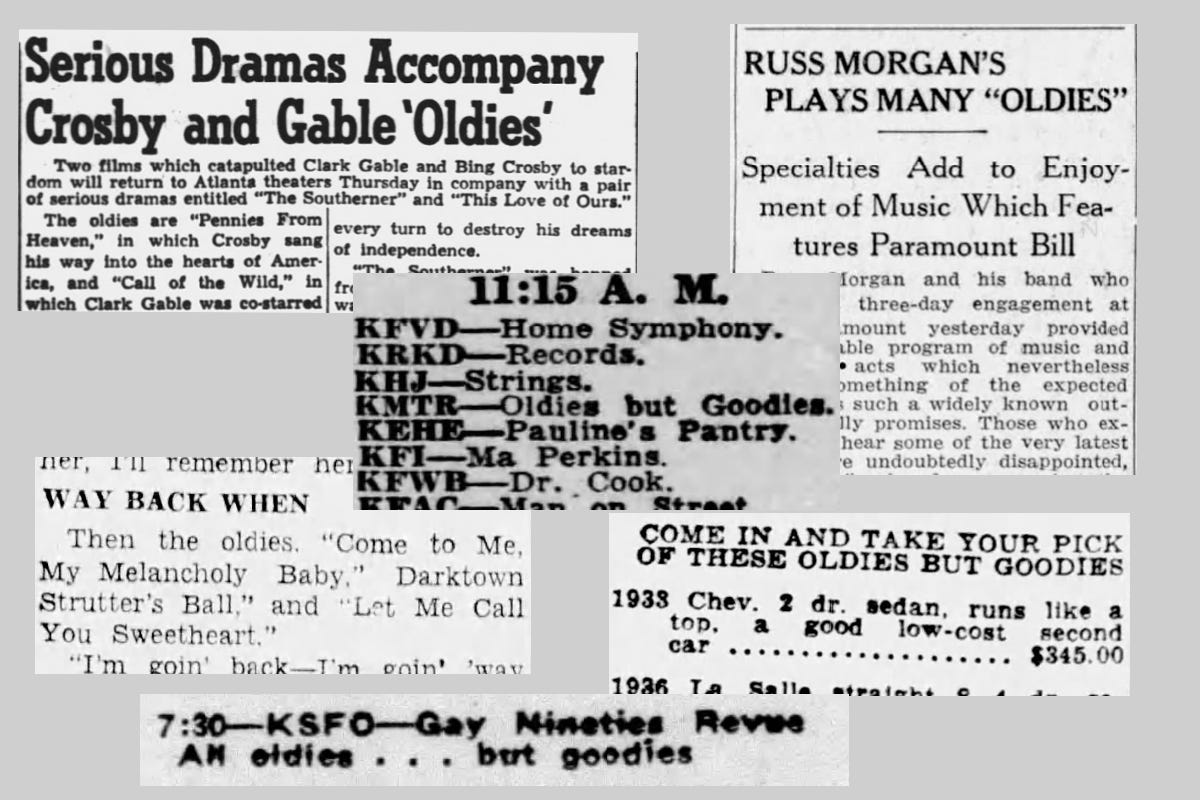
For almost as long as mass entertainment has existed, people have been using “oldies” to refer to songs, stage shows, or movies from days gone by. Radio listings from 1938 show KMTR in Los Angeles was playing not just “Oldies” but “Oldies but Goodies” - the first use I can find anywhere of that term. I just wish I could find out what songs they were playing; I’m imagining the kinds of classics that populate the Michigan J. Frog repertoire.
Why “oldies but goodies”? The implication that old songs would naturally be less desirable feels odd in an age when the entertainment industry shamelessly spins mega coin from hologram ABBA, Friends binges, and countless other decades-old properties. Imagine a time when the poobahs of showbiz actually felt pressure to come up with new stuff rather than endlessly recycling the old.
“Oldies but goodies” then starts popping up regularly in newspapers in the early 1940s, to describe everything from a Gay ‘90s Revue to used cars to an old-timers baseball team. Since the earliest mentions are all in Southern California, I have to assume KMTR propagated it.
A teenager named Arthur Egnoian was listening raptly. After moving to Los Angeles with his family in 1938, Egnoian fell in love with radio. He’d get his first job in the industry in 1943, while still serving in the Navy. Now self-rechristened Art Laboe - “catchier” and “more American” - he started taking phone requests from listeners, maybe the first radio DJ to ever do so. Some of them wanted to hear the latest hits. But a surprising number asked for songs that had already fallen off the hit parade.
By 1959, now at KPOP in Los Angeles, Laboe had taken enough of these requests that he saw an untapped goldmine in the record industry’s dusty old castoffs. And “old” is a very relative term here. When Laboe’s Original Sounds label released his first Oldies but Goodies compilation LP that year, yoinking the name from KMTR, most of its r&b and doo-wop chestnuts were three years old or less. The oldest, “The Letter” by the Medallions, dated all the way back to 1954, while the newest, the Mello Kings’ “Tonite Tonite”, had only come out in 1957.
So nostalgia for the ‘50s started in the ‘50s. That’s how fast pop trends moved in those days. Once a song wasn’t on the radio, you had to buy the record to hear it. And if it wasn’t hot anymore, the record company would let the record go out of print, so you couldn’t buy it.
Art Laboe moved fast, too. He trademarked “Oldies but Goodies”, correctly assuming nobody would remember KMTR came up with it 20 years prior. With more compilations soon to follow, and a bigger platform on LA radio giant KRLA (also home to the likes of Casey Kasem and Bob Eubanks), Laboe was well-positioned for the coming day when rock ‘n’ roll memories became big business. He’d go on to a long career as a promoter and syndicated radio host.
“Rough, direct music”
It wasn’t just cranky senior citizens who were disoriented by the post-Beatles cultural upheaval. The teenagers who’d first screamed at Elvis would’ve been born around 1940, so by the Summer of Love, they were well into buttoned-down adulthood. They were happy to trade magic swirling ships and long beautiful hair for milkshakes and sock hops.
“Rock ‘n’ roll revival” shows started touring the UK in 1967 and 1968, before hitting the US the following year. Elvis’s black-leather comeback special was a sign of the times. The other original stars, discarded by the industry earlier in the decade, played to slightly more sedate but still rapturous crowds. “Bill Haley and the Comets made their first appearance in New York for eight years and they rocked the place,” said the New York Daily World of an October 1969 rock oldies revue. “You better believe the Big Beat is back and you better believe it still swings.”
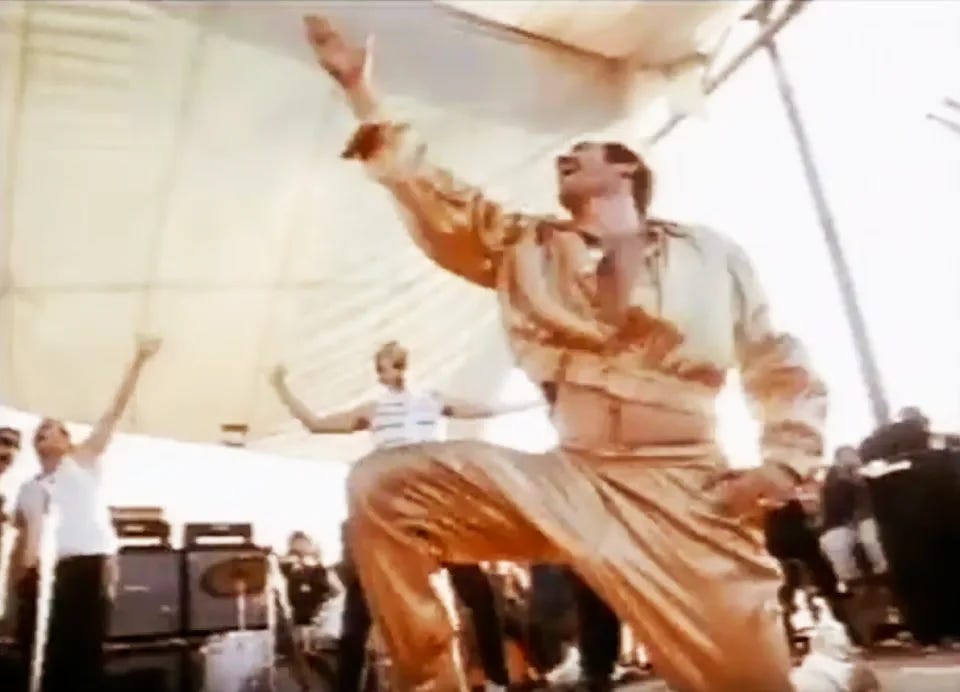
Also on that bill were Chuck Berry, the Shirelles, the Coasters, the Platters - and Sha Na Na, the only act that hadn’t been around the first time. A few months earlier, they’d played the next-to-last set at no less a hippie watershed moment than Woodstock, followed only by Jimi Hendrix. Amidst the mud, nudity, and brown acid, Sha Na Na’s gold-lame street gang costumes and throwback takes on “At the Hop” and “Get a Job” were their own kind of avant-garde novelty.
“One of the most interesting parts of the audience is the large element of 30-year-olds still clinging to the 1950s style,” wrote Billboard in a 1972 article about rock ‘n’ roll revival package tours. As the post-hippie progressive rock of the moment “is experimenting in all directions,” the piece says, “some of the exploratory rock is overly dry and cerebral. This leaves a void for rough, direct music” to be filled by the likes of Little Richard, Fats Domino, and the Five Satins, who “hadn’t even seen each other for five years” before their recent reunion.
The following year, George Lucas’s American Graffiti would tap that vein of boomer nostalgia to the tune of $140 million at the box office. Thence came the onslaught. Happy Days and Sha Na Na on TV. Endless compilations of cheap-to-license oldies - or even cheaper anonymous cover versions of those oldies. And on the radio, the Oldies format.
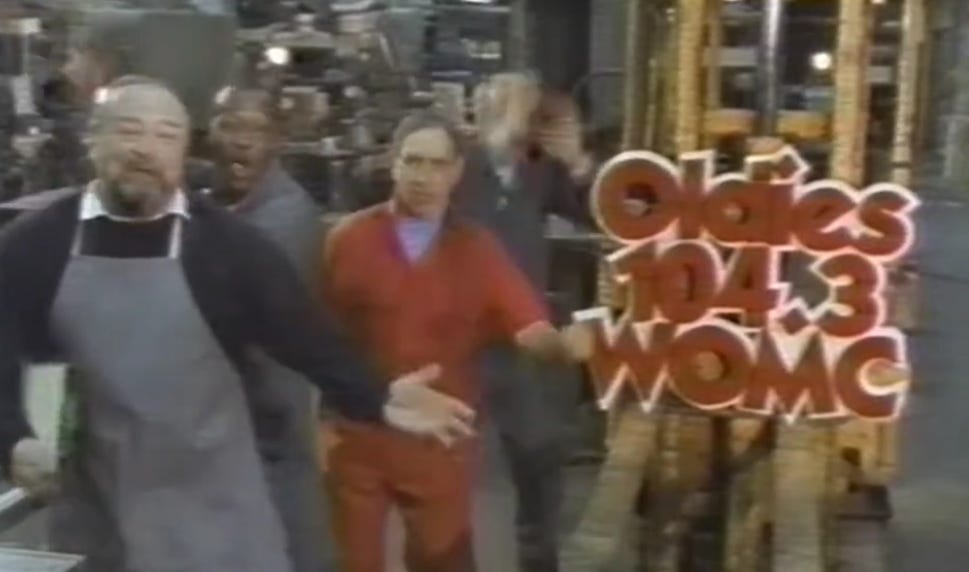
By the early ‘80s, every major market had at least one oldies station, pitching themselves as the “station you sing along to” that goes down easy in the kitchen or the office. The “fun oldies” framing could feel inane: I remember one DJ following up Otis Redding’s tragic “Sittin’ on the Dock of the Bay” talking about how that song made her feel like she was sipping coffee in her breakfast nook. But if you weren’t in sync with what your teenybopper sisters or stoner uncles were listening to, it was an alternative with a rich base to draw from.
“A narrow format”
Unfortunately, corporate Oldies stations limited themselves to a tiny sliver of old hits, and it didn’t take long for those limitations to show. “You can’t keep playing the same 2,000 songs over and over,” said Rick Shaw of Miami’s WAXY-FM in 1984. One of the early oldies radio success stories, by then WAXY had shifted to a more mixed Adult Contemporary format with some Oldies thrown in. “Oldies is a narrow, targeted format. It’s like a great movie, such as Gone with the Wind - if you see it once a year, that’s enough.”
Rather than dig deeper into the catalogue, maybe play a Sam Cooke or Everly Brothers song that wasn’t the same two or three they always played, these stations tried to keep it fresh by shifting the definition of Oldies.
First, in came Motown and the British Invasion, pushing out much of the ‘50s music. My little brother and I taped a stretch of our local Oldies station off the radio in 1986. I listened to it quite a bit for a while there. The selections ranged from “That’ll Be the Day” by Buddy Holly to “California Dreamin’” by the Mamas and the Papas, and the Manfred Mann version of “Quinn the Eskimo”. There was nothing like “Sh-Boom” or “Rockin’ Robin”. Still, that range felt pretty coherent.
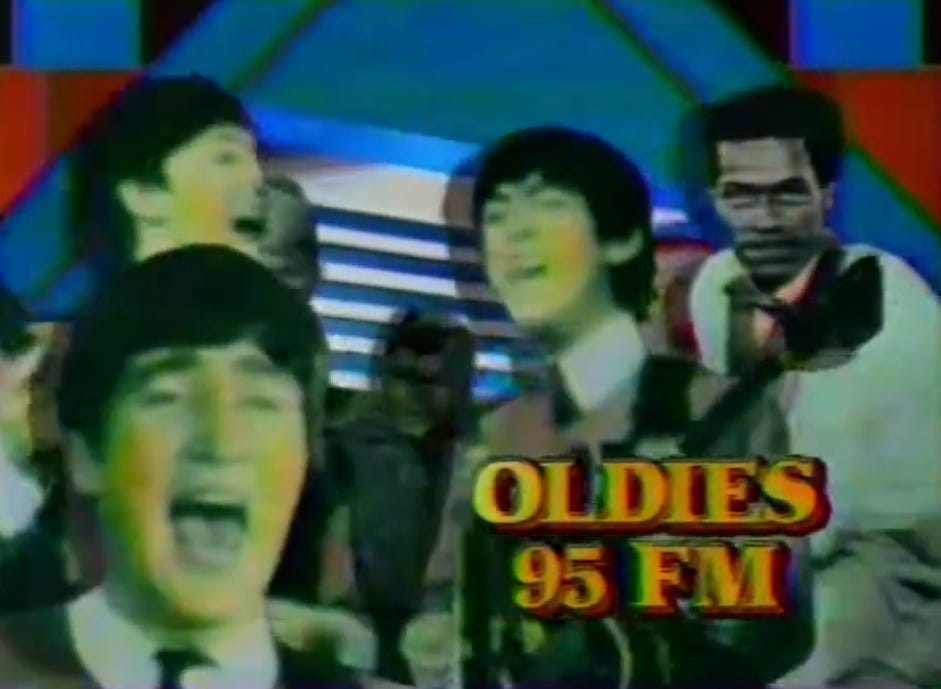
The fatal line that Oldies crossed was when it shifted to music from the ‘70s. “What if you could build a new kind of oldies radio station that was really different?” asked a 1993 commercial for LA station Arrow 93FM. “What if you could take out the ‘50s doo-wop and bubblegum oldies… and you could put in all the great rock ‘n’ roll oldies from the ‘60s and ‘70s?”
Out with the Fleetwoods and in with Fleetwood Mac, whose “Go Your Own Way” surges on the commercial’s soundtrack. Their 1977 mega-smash Rumours is shown among the CDs replacing old bubblegum-encrusted vinyl 45s, as is Bruce Springsteen’s Born in the USA (released in 1984). OK, that move was probably more in line with where the audience’s ears were. Or, more accurately, where the coveted 25-54 demographic and their money were.
But the distinction between Oldies and Classic Rock started to collapse. Classic Rock stations already owned the listeners who wanted to hear “the same 2,000 songs” from the ‘70s and ‘80s plus the very occasional new release. The more Oldies stations encroached on that turf, the more redundant they made themselves, and the more of them changed music formats, turned into talk radio, or went out of business. Today, if you want to tune in to ‘50s and ‘60s pop, you probably have to go to either satellite radio or the Internet, or shuffle a Spotify playlist.
The fracturing of retro-flavored radio since then, into Classic Hits and Adult Hits and Variety Hits and “We Play Anything”, is more turf than we can cover here. But essentially they all play lots of ‘80s and ‘90s, some ‘70s, a little ‘00s. Oh, and they have one other thing in common: they never, ever use any variation of the dreaded o-word. Even if their favorite nostalgic songs came out 40 or 50 years ago, the last thing today’s oldies listener wants is to be reminded they’re old.
Something's definitely wrong with time - 2010 has got to be just a few years ago, not 16. And there's no way Nirvana's Nevermind is closer to Ella Fitzgerald’s songbook era than today. What shocks you when you think back to things that sure seem recent, but are apparently just a billboard telling us how very old we're getting? Let's talk in this week's Shoddy Goods chat.
—Dave (and the rest of Meh)
Remember all the fun we had when we were young, grooving to these good-time Shoddy Goods oldies?
And if you like Shoddy Goods, don’t miss Jason’s new other newsletter, Gnomenclature. Every week he digs into the 178-year-history of Hammacher Schlemmer, America’s oddest retailer. It’s gonna get weird!
I listen to Sirius XM. The station numbers used to be aligned with the decade of music they played, at the lower number level: 50s on 5, 60s on 6, etc. Sometime in the last few years, they removed the 50s and 60s, kept 70s on 7, 80s on 8, and on up. Sirius has so many channels, especially online, that I'll bet they live on with a randomly assigned number. Presumably. 50s and 60s were rarely listed to, I only listened to 70s on up.
But in general, Sirius replays the same songs on different channels, you'll hear the same songs on 70s and on Yacht Rock, for example. so that 2000 songs number still hold true.
yeah, this has been driving me nuts for a long time.
I was born mid-60's and "grew up" in the 70s.
Oldies stations were "niche" and played songs from 50s & 60s (usually pre-Beatles 60s, so like "American Grafitti" 60s).
now it's 2026 and "classic rock" stations can go a stretch and never get out of the 1970s.
I heard a stretch the other day that had a cut from Pink Floyd's "The Wall" (1979), AC/DC's "Dirty Deeds" (1976), the Cars "Best Friend's Girl" (1978) and then Kansas' "Wayward Son" (1976).
it is very strange.
yes, this is the music that I grew up with.
but it's older than dirt and the most popular/common format.
I think to myself "when I was a kid "oldies" were 15-25 years old".
I try to envision a past where, in 1975, the most common form of music on the radio was Big Band music from the 1920s and they just played hits by Duke Ellington and Al Jolson.
as a Gen X member (and fan!), I blame the Boomers for this.
lol
it's . . . surreal.
and don't anyone say that "well, it's the best music, everything now is crap"
everyone from every generation has said that.
but, until now, they had to deal with living in the present.