

Rejoice! It’s time again for Shoddy Goods, the newsletter from Meh about consumer culture. I’m your host, Jason Toon, and while I like to complain about commercials as much as the next old man, I also try to understand how they got that way. This issue has a fair bit of both.
It is a truth universally acknowledged that an insurance company in want of customers must be represented by some kind of allegedly funny character. Since GEICO debuted their gecko in 1999, a quarter-century of mascot devolution has bottomed out in Liberty Biberty, the latest annoying spokesthing for Liberty Mutual.
The phrase “Liberty Biberty” is a reference to a 2019 commercial where an actor struggles to pronounce the company’s name. Describing this entirely scripted “flub” as “hugely culturally relevant“, Liberty Mutual and its creative agency, Bandits & Friends, created Liberty Biberty as “the embodiment of the warm, fuzzy feeling you get when you have great coverage at a great price.” That’s not a human emotion I recognize, but hey, I know how it is to fudge the justification for a creative idea you like anyway.
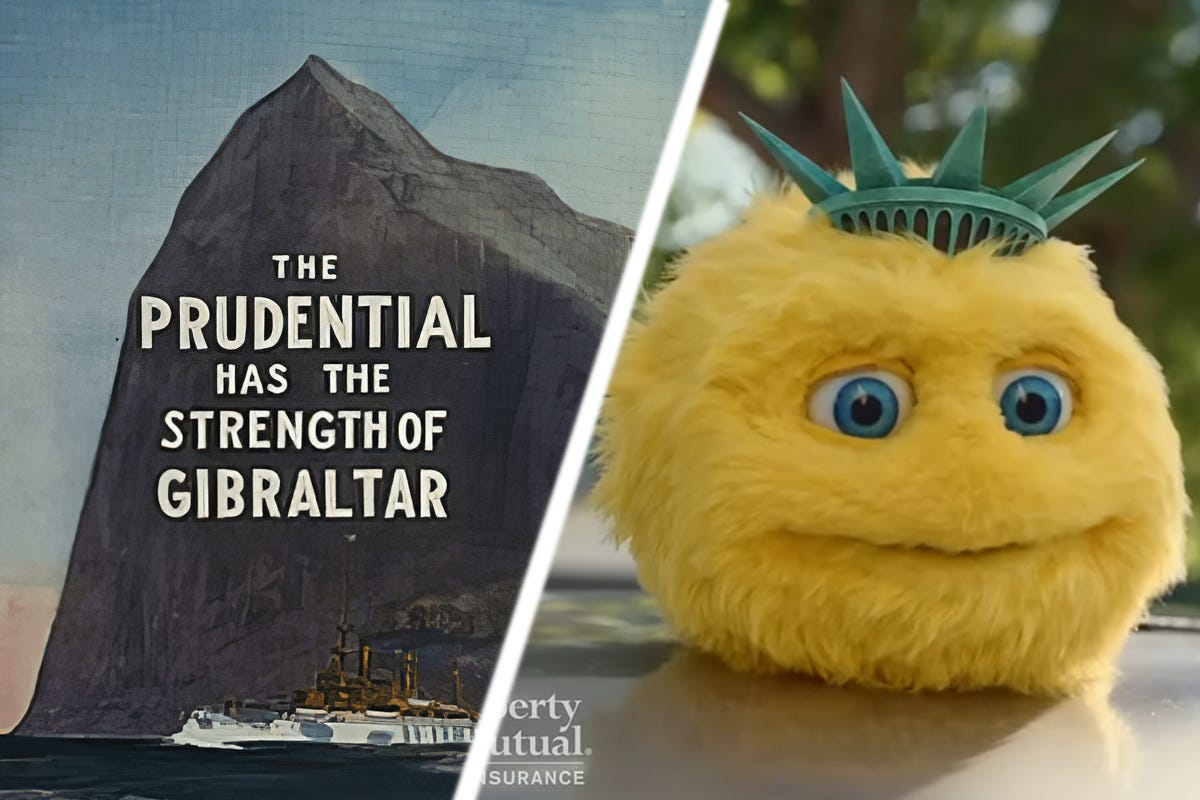
Unfortunately, the puffball’s first outing doesn’t bode well. It starts to deliver a promotional spiel from the roof of a car. Then it gets swooped up by a hawk, in the kind of cheap jump-laugh moment so typical of mediocre commercials. Just when you’re about to thank that anonymous raptor for sparing us, it drops Liberty Biberty onto a different car, where the spiel resumes. Tagline: “Great coverage. Great savings.” That’s it. That’s the ad. No warm and fuzzy feelings, nothing about what makes the coverage or savings great, not even an actual joke.
No one is surprised, of course, that the sixth-largest property insurer in the world chooses to embody itself in a clump of fluff with a name that sounds like baby babble. Never mind the old image of insurance companies as exemplars of steady reliability: “Get a piece of the rock”, “Like a good neighbor”, “You’re in good hands”. Now we expect insurance to be sold by TV commercial mascots who vaguely suggest the name of the company, from the GEICO gecko to AFLAC’s quacking ducks to Liberty Mutual’s other longstanding familiar, LiMu Emu.
How did we get here? How did one of the industries where trust and competence are most crucial wind up being the one advertised with the goofiest, most irrelevant mascots?
Buy my product or face legal consequences
As with most technologies, the law took a while to catch up to the automobile. The growing frequency of car accidents led Massachusetts and Connecticut to adopt “financial responsibility” requirements in the 1920s. This meant drivers had to prove their ability to pay for the damages in any potential accident, most commonly by showing they had insurance to cover it.
But these laws remained local curiosities until New York passed their own law in 1956 and North Carolina followed suit in 1957. That set off a steady spread of compulsory insurance laws over the following decades. A majority of states had some kind of car insurance mandate on the books by 1980. Virginia’s belated entry in 2024 brought the total to 49 states and DC, with New Hampshire the sole holdout.
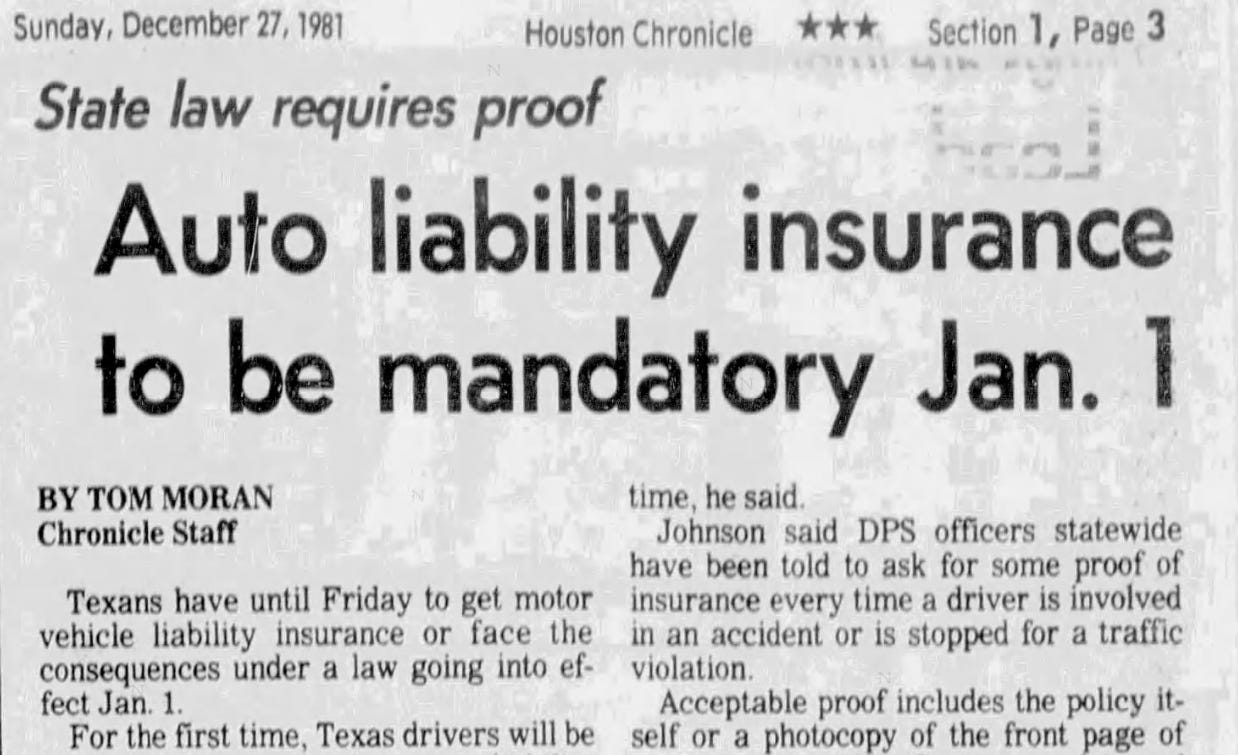
These laws dragged a huge new pool of customers - willing or not - into the insurance market. “It’s like a supermarket here,” State Farm agent Don Drott told the Houston Chronicle in 1981, as Texas’s mandatory insurance law was about to come into effect. “We don’t even have time to take lunch.”
Younger and lower-income, these clients weren’t perusing wordy ads in U.S. News and World Report and didn’t play golf with any insurance salesmen. They were much less likely to have other kinds of insurance: today, while 71% of Americans have car insurance, only 39% have life insurance. This cohort just needed proof of coverage fast to meet the legal requirements to drive.
The most effective “advertising” to reach these customers was to open a storefront near the state licensing office. That’s how I insured the first few cars I ever owned, back in the ‘90s. I couldn’t have told you the name of the insurance company, or how their policy offerings differed from any other company’s. All that mattered was that they were next door to the DMV, and offered cheap, minimal plans so I could get the registration chore done with as little hassle and upfront expense as possible.
When they did advertise, these mostly small-time local outfits hammered on the cheap-and-fast message in the time-honored tradition of local TV hucksters. This 1990s classic from Chicago’s Eagle Insurance not only has a scrappy charm and an authentically bizarre “story”, it’s also informative (arguably too informative) about the company’s pricing.
Thus car insurance customers were essentially split into two tiers. One was traditional clients, who often bundled their auto coverage with other forms of insurance, usually through an agent affiliated with a major national company. The other was working-class drivers who’d deal with anyone who’d give them the piece of paper that would keep their cars legal. And so it would have remained, had the Internet never been invented.
“Kick Flo’s ass”
As more and more commerce shifted online through the 2000s, the storefront near the DMV mattered less. The big insurers could now sign up all those little customers without needing to pay agents to do it. Policies began to look more and more alike in a comparison-shopping race to the bottom.
Car insurance mandates plus the Internet turned insurance into a mass consumer commodity. The result is clear any time you watch commercial TV, or scroll through social media, or attend a sporting event: an unprecedented glut of insurance advertising. The total insurance advertising market has tripled just since 2010, from $5.1 billion then to $15.6 billion this year. It’s hard to remember now that it wasn’t always like this. I watch a lot of blocks of old TV commercials, recorded as they aired, and it’s striking now how rare insurance commercials were in the ‘80s and ‘90s compared to today.
But the law and technology didn’t just spur the volume of ads, it also shaped their tone. As differences between companies and their policies shrank, insurance companies stopped trying to tell any kind of coherent story about the advantages of their offerings aside from the everpresent references to non-specific “savings”. The vibe of insurance marketing, once calm, sober, and reassuring, turned increasingly loud and silly in the quest for cut-through.
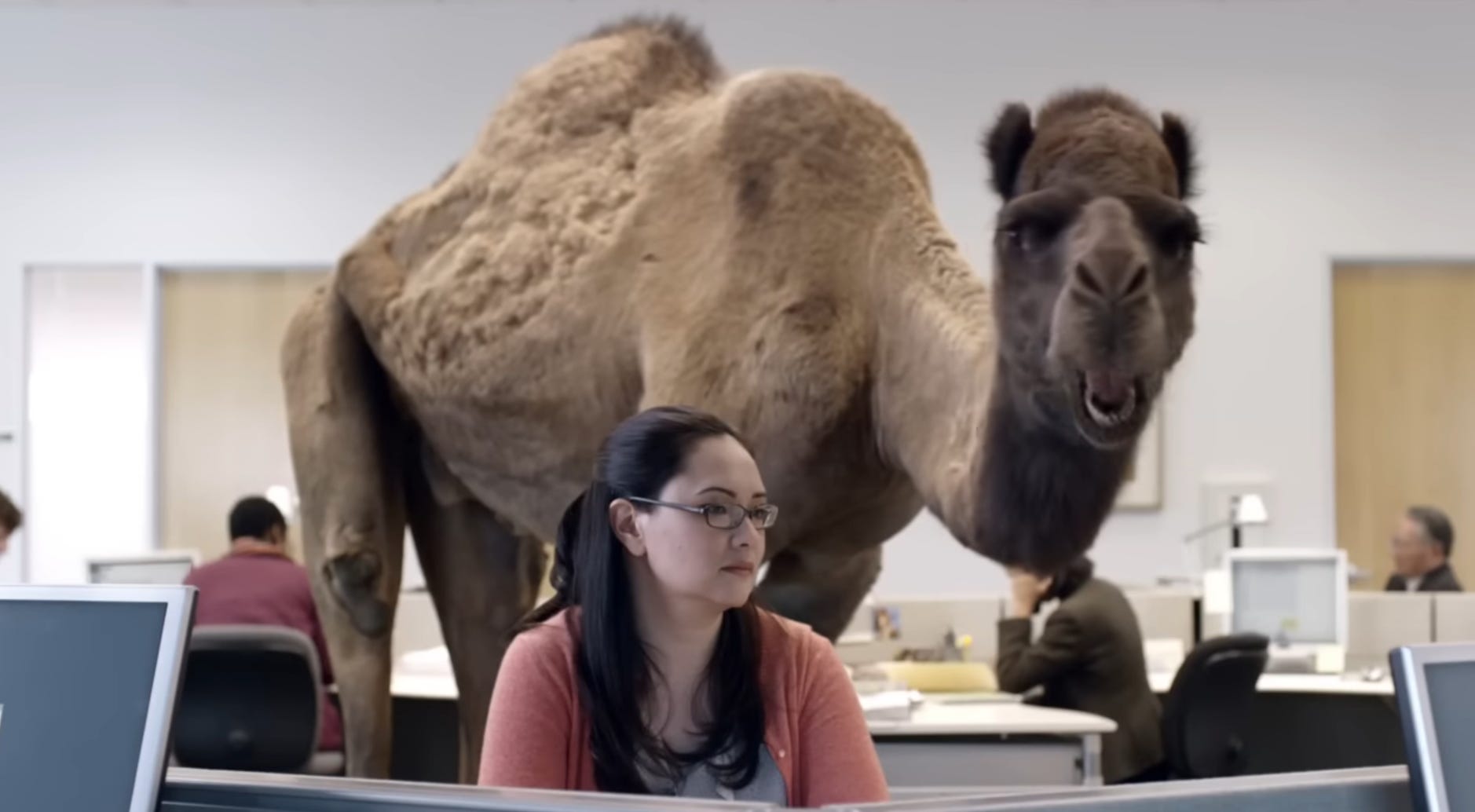
Ads became mnemonic devices to simply drill the company’s name into people’s heads through brute force repetition. “I need insurance. Where do I get it? I guess the one with the gecko/quacks/emu.” The relentless GEICO is the worst offender, also running what feels like a hundred other campaigns featuring such first-thought college-improv concepts as “happier than a camel on Wednesday” (because it’s hump day, get it? Me neither) to “cavemen in the modern world” (because switching to GEICO is so easy a caveman could do it, get it?), a campaign which has now run longer than actual cavemen roamed the Earth.
Other mascots, like Flo (Progressive) or Mayhem (Allstate), at least have something to do with insurance. But the ads seem aimed more at each other than customers. Leo Burnett creative exec Nina Abnee said the ad agency created Mayhem to “kick Flo’s ass”. Yet while the Mayhem campaign was winning a shelfload of awards, Allstate was losing ground to Progressive, which passed them in market share in 2018 and has stayed there ever since.
Whether you find these ads funny is a matter of taste. I think most consumers, though, would struggle to articulate a single difference between any of the major insurance companies, even after saturation exposure to their branding. Which just makes the insurers double down on hitting the jackpot with the next viral wannabe. It seems impossible to come up with a mascot more lazy and infantile than Liberty Biberty. But with the insurance advertising market still growing by at least 10% a year, you better believe they’re trying.
Funny thing that Jason didn’t know — I’ve actually met the guy who does Liberty Biberty. I took a tour of the Henson studios and he was our guide, showing us around where the Muppets were filmed and doing a how-to demo where I was the volunteer. Spoiler: I was terrible at it. But he was great, and funny, and regardless of what you think of insurance ads, it’s awesome that there’s still new physical puppet opportunities out there. So who’s your favorite puppet — Muppet or otherwise? Let’s talk about it in this week’s Shoddy Goods chat.
—Dave (and the rest of Meh)
These previous Shoddy Goods stories promise neither great coverage nor great savings:
And if you like Shoddy Goods, don’t miss Jason’s new other newsletter, Gnomenclature. Every week he digs into the 178-year-history of Hammacher Schlemmer, America’s oddest retailer. It gets weird!
As a longtime Virginia resident, I can assure you that's we've been required to carry liability insurance for far longer than two years. I think that in certain circumstances you could pay a fee to have the requirement waived, so maybe that changed in 2024?
I’m still bewildered by the short life cycle of Erin Esurance, who was retired in large part because internet artists were drawing her in NSFW situations.