

I’m Jason Toon and I’m a big baseball fan. So for this Shoddy Goods, the newsletter from Meh about consumer culture, I thought I’d tell a story about the, er, soft underbelly of the game I love…
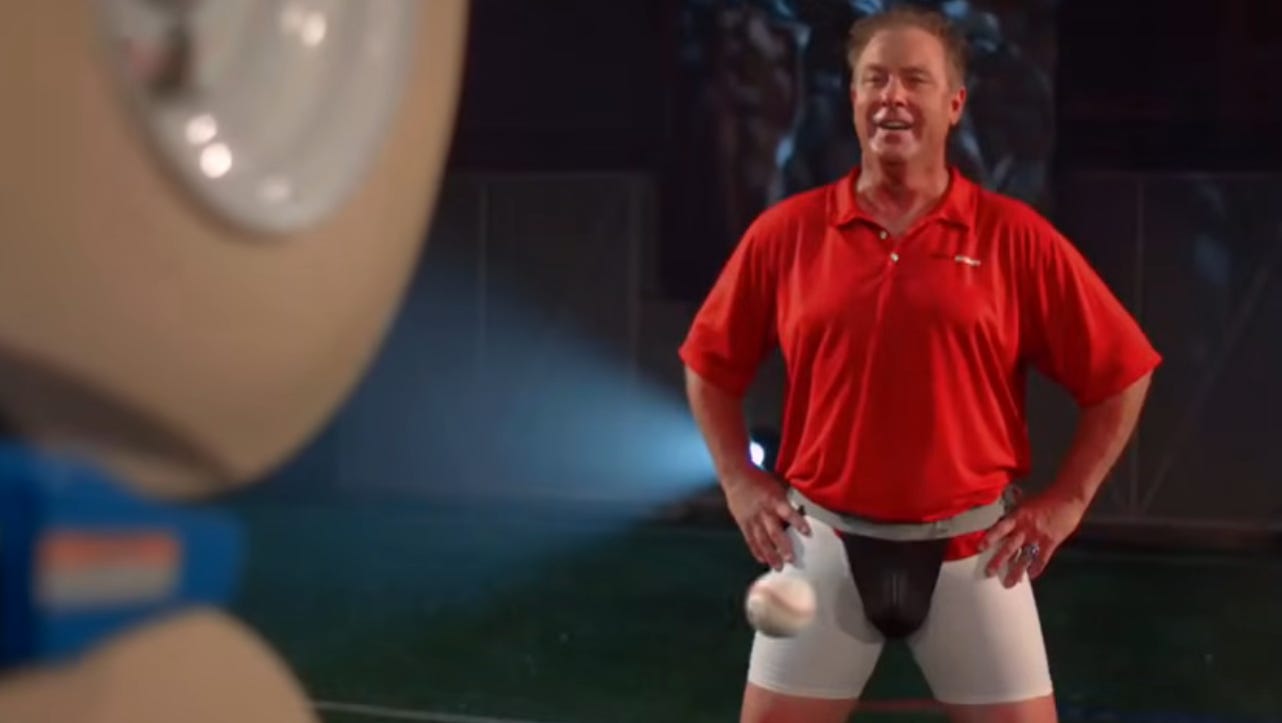
A ruddy man in his 50s squats with each foot on a different Gatorade jug. He’s wearing a t-shirt, a helmet, goggles, and white compression shorts - at least, that’s what we can see he’s wearing. From a few feet away, a pitching machine fires a baseball right at his crotch.
“Yeah!” the man shouts, pumping his fists, as off-camera bystanders roar with laughter. “All the way!”
So went one of the hit viral videos of 2008. This wasn’t a clip from Jackass or something posted to a dark-web masochism forum. The man was Mark Littell, former Major League Baseball pitcher, proving the effectiveness of the protective groin cup that he invented. Littell would repeat the trick over and over for any audience that would help him promote the Nutty Buddy. And he’d set a new standard for anyone on the diamond who wanted to protect the family jewels.
Every 10,000 balls
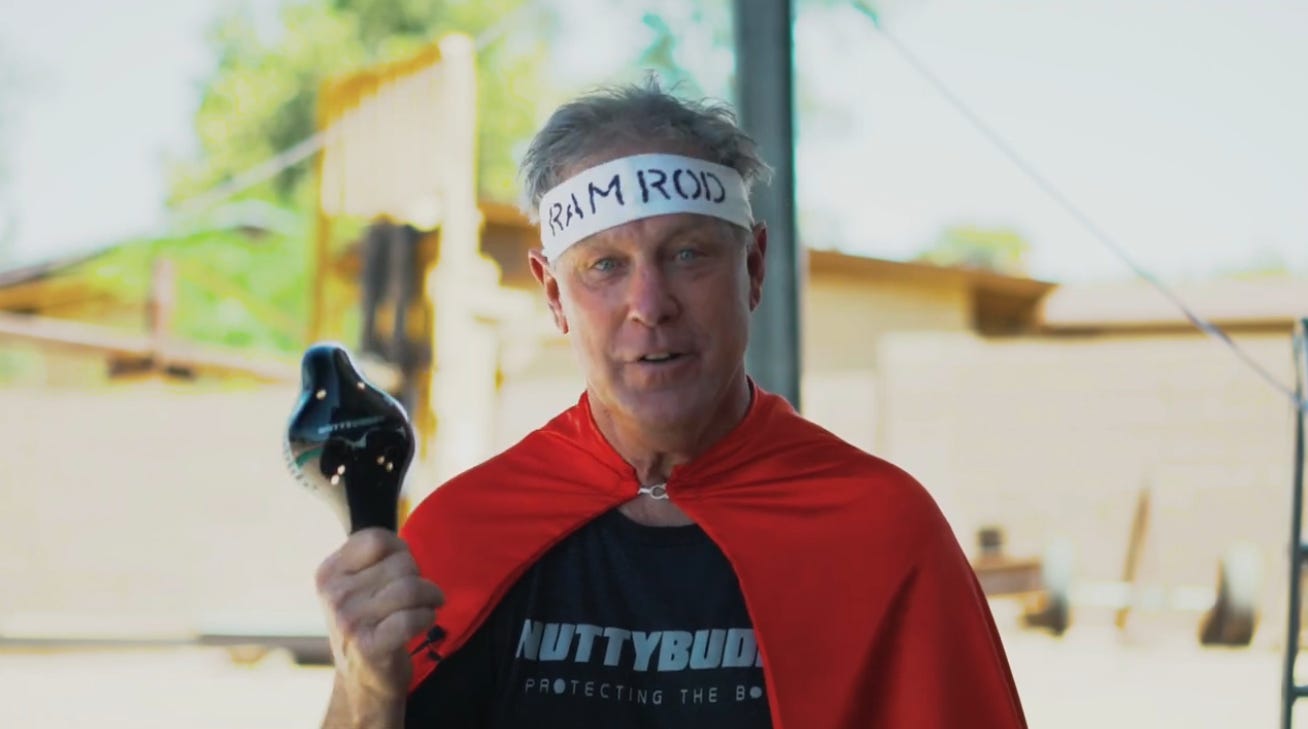
If big league ballclubs voted for “Most Likely to Get Hit in the Crotch By a Baseball on Purpose”, Littell’s teammates probably would have given him the award. Since he emerged from his native southeastern Missouri (also where my mom’s family is from) with the Kansas City Royals in 1973, Littell had been known as a character, talking up a storm in his cotton-fields twang, earning the nicknames “Country” and “Ramrod”. He’d later put all those words into three books of memoirs about his playing days.
Littell was also a lights-out relief pitcher in his prime, a key part of the Royals’ 1976 and 1977 playoff teams. (Well, almost always lights-out; he gave up a home run at the unluckiest possible time to lose the pennant to the Yankees, only the second homer he allowed that season.) After being traded across his home state to my beloved St. Louis Cardinals for equally colorful reliever Al Hrabosky, his 1978 and 1979 seasons were just as good. But persistent bone spurs in his elbow plagued him for the next few years. Littell’s playing career was over when he was only 29.
Years later, while coaching in the minor leagues, Littell started to wonder about one of the occupational hazards of his profession. “I asked my pitchers: How many of you guys don’t wear cups? And half of them raised their hand,” he told the Associated Press in 2007. “So I went off on a little mild tirade at the time… Every 10,000 balls you throw, there will be one that comes right back at you that you can’t avoid.”
The main reasons players didn’t wear cups were that they were uncomfortable, and they didn’t fully protect the equipment anyway. The standard cup, seemingly forever, had been a sort of rounded triangle that didn’t conform to the male human anatomy. It moved around, it pinched, and it just didn’t protect that well: a direct hit could still send you to the injured list.
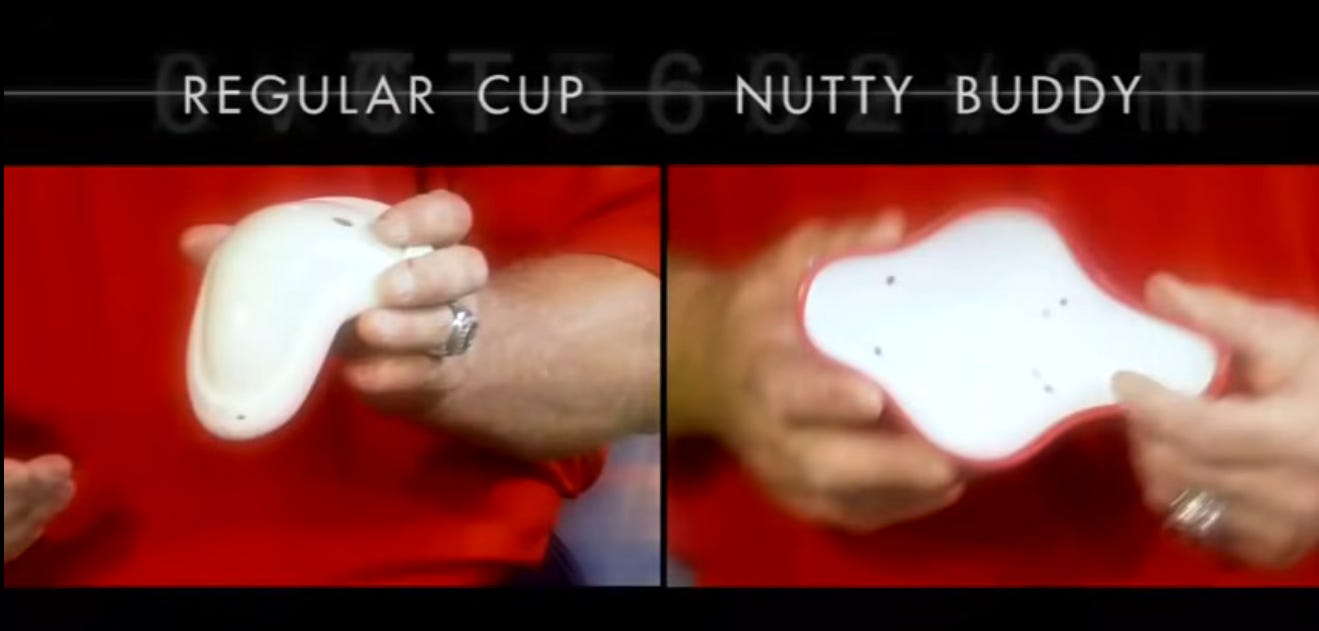
With some moldable plastic, two golf balls, and $40,000 of his own money, Littell started to design and patent the cup of his dreams, one that would fully protect the area while being as inconspicuous as possible. It featured a little tail that tucked under the area, and was curved in all the right places. “Testicle A, testicle B, they have a place to go,” he explained to ESPN’s Sports Science. “The energy [of being hit], when it disperses, it goes toward the pubic bone.”
Splatter my what now?
Of course, that explanation was followed by Littell taking a fastball to his junk on camera. He didn’t flinch. Littell’s willingness to, as he put it, “literally stand behind my product” was an irresistible attention-getter from the get-go. The crass anything-for-a-laugh vibe of the ‘00s was perfect for his high-speed patter and willingness to be silly, even when that meant risking severe gonad trauma. Astutely gauging the male psyche, he gave the different sizes of the Nutty Buddy flattering names like Hammer, Boss, and Mongo.
“Mark Littell, The Nutty Buddy, Is Completely Nuts“ was how Deadspin put it in the headline for a 2008 story. “For 20 minutes, Mark Littell proceeded to talk and talk and talk, using every testicular euphemism available about his product and its design and how this will save testicles all over the world. He said he personally has taken a few shots to the groin while wearing it this year (two with baseballs, three with paintballs).”
After hinting that he was considering getting shot - yes, shot, with a bullet from a gun - for a future video, Littell expanded on his insight that traditional cups only protected “one and a half testicles” in the most colorful terms: “Sometimes if you get hit on the cup, it still can completely splatter your nut just from the force alone.”
Competitors who doubted his design were challenged to prove their superiority. “Let’s get the CEO of every cup company,” Littell told the AP. “You put your cup on, and I’ll put my cup on, and we’ll see who’s left standing.”
The thing is, for all the laughs, the Nutty Buddy was no joke. The Sports Science staff’s tests showed that a typical ground ball could hit with 2400 pounds of force. A regular cup still delivered 450 pounds of that to the testicles, while the Nutty Buddy reduced that to just 110 pounds. Slow-motion cameras showed the force dispersing in outward ripples from the Nutty Buddy, just as Littell said.
That effectiveness, plus its reputation for comfort, has put the Nutty Buddy at the forefront of a protective renaissance. Cups were all but mandatory when I played high-school baseball in the late ‘80s, but usage had dropped quite a bit since then. The Nutty Buddy has started to turn the tide back. “If you are still playing, the Nutty Buddy cup has completely changed the game,” said one commenter on the r/collegebaseball subreddit. “I hated cups and wouldn’t wear one but I tried this one out and I won’t play infield without one now.”
Mark Littell died in 2022 at the age of 69 due to complications from heart surgery. It was too early, but all those shots to the crotch were not in vain. He’d lived to see his invention widely adopted from the Little Leagues to the Major Leagues. And to the considerable store of goodwill from his playing and coaching days, he added a dose of viral fame from the peak Internet era - and the gratitude of countless ballplayers who’d taken a bad hop to the groin and stayed in the game.
I’ll admit I probably never wore any protective gear, helmet, knee pads, uh…cup, until my twenties. I wasn’t particularly athletic and in those days it would’ve seemed bizarre for any but BMX bikers to put on gear for a ride down the street. I’m not one of those “and we were fine!” types though, I know about survivor bias and I’m all for avoiding scrapes, breaks, and worse. When do you don the protective gear, and when are you skipping it, for yourself or your family? Let’s talk in this week’s Shoddy Goods chat.
—Dave (and the rest of Meh)
These previous Shoddy Goods stories are mostly anatomically correct: