

The training wheels are off: Shoddy Goods 083
A metaphor that will outlive the thing itself
OK, my kids aren’t that grown-up yet, so it’s always unsettling to realize the ways parenting has changed since I was in the thick of it. I’m Jason Toon, and this Shoddy Goods (the newsletter from Meh about consumer culture) is about the decline and imminent demise of something it seems like we were doing, like, five minutes ago.
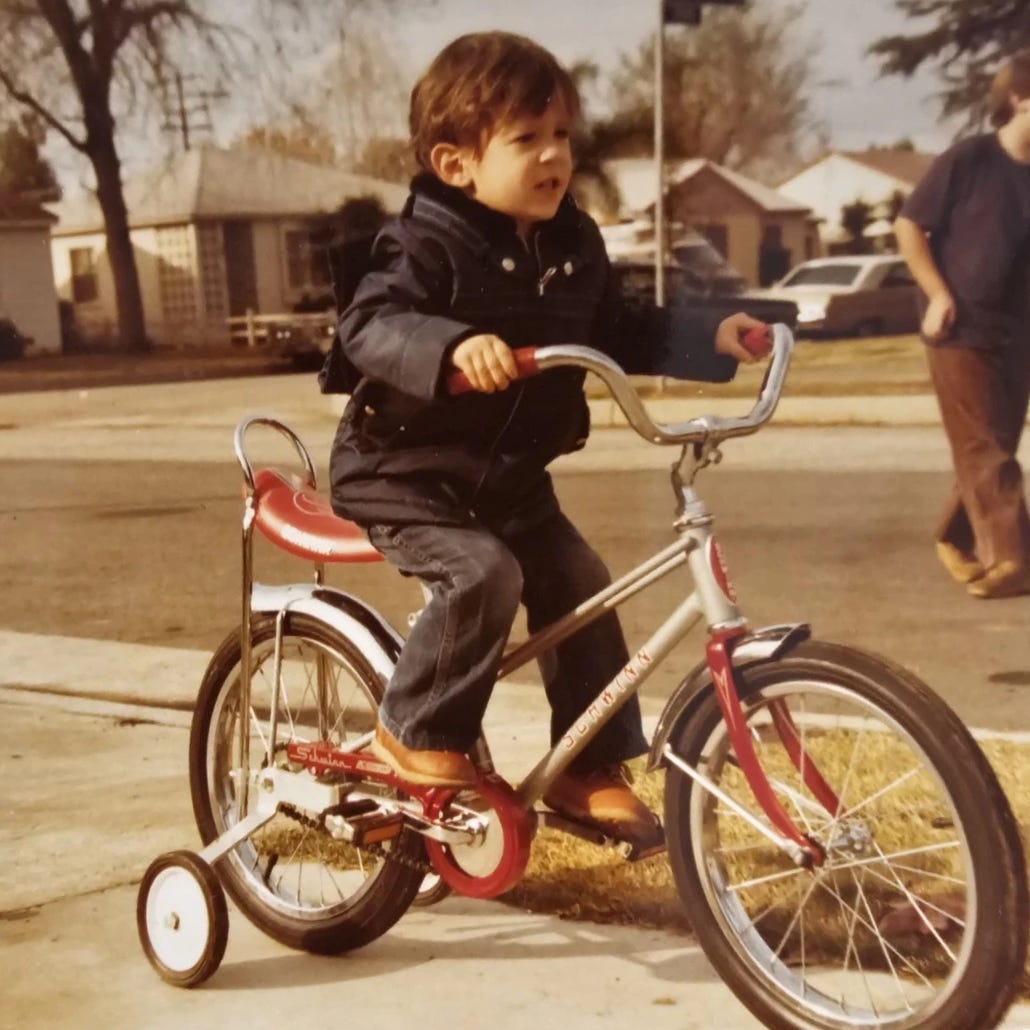
What does it take for a consumer product to enter language as a universally understood idiom? It’s gotta be ubiquitous: people have to know what the literal thing is before they can understand the metaphorical reference to it. It’s gotta be distinctive: it has to serve a function so unique and specific that no other doo-dad will do. And it’s gotta last at least a little while, because crossing over from the marketplace to the dictionary takes some time.
It’s a rare product that can manage it. But the bicycle giant Huffy introduced one in 1949: training wheels. And even as usage of training wheels themselves is vanishing, the idiomatic usage of “training wheels” just keeps on rolling.
“Non-spill easy riding”
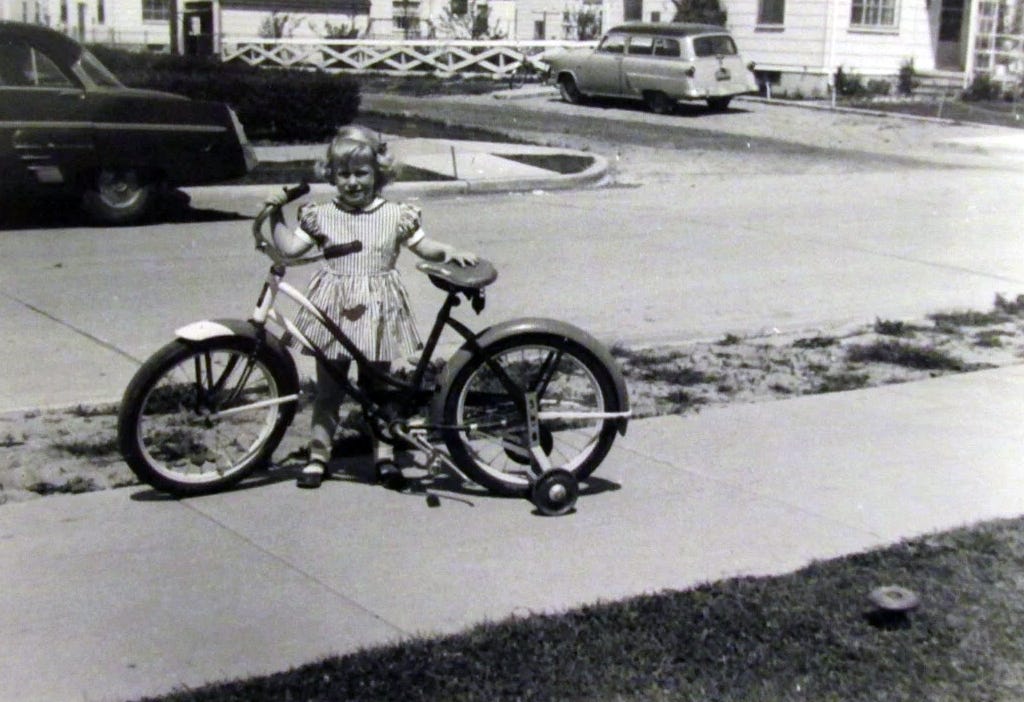
“Convertible side wheels form sturdy 4-wheeler for beginners… Safe non-spill easy riding.” That’s from a catalog listing for the Huffy Convertible, the first bike with training wheels. For those of us who grew up with them as an established fact, the idea of needing to explain training wheels is surprising. Surely they’re so obvious everyone gets it, right?
But the Huffy Convertible was something new. Aiming to attract more kids under the age of 6 to cycling, the Convertible was designed to smooth the way from tricycles to legit bikes, with a chain drive, adjustable-height seat and handlebars, and… balancer wheels? Convertible wheels? Stabilizers? Safety training wheels? The name took a few years to standardize into the familiar form.
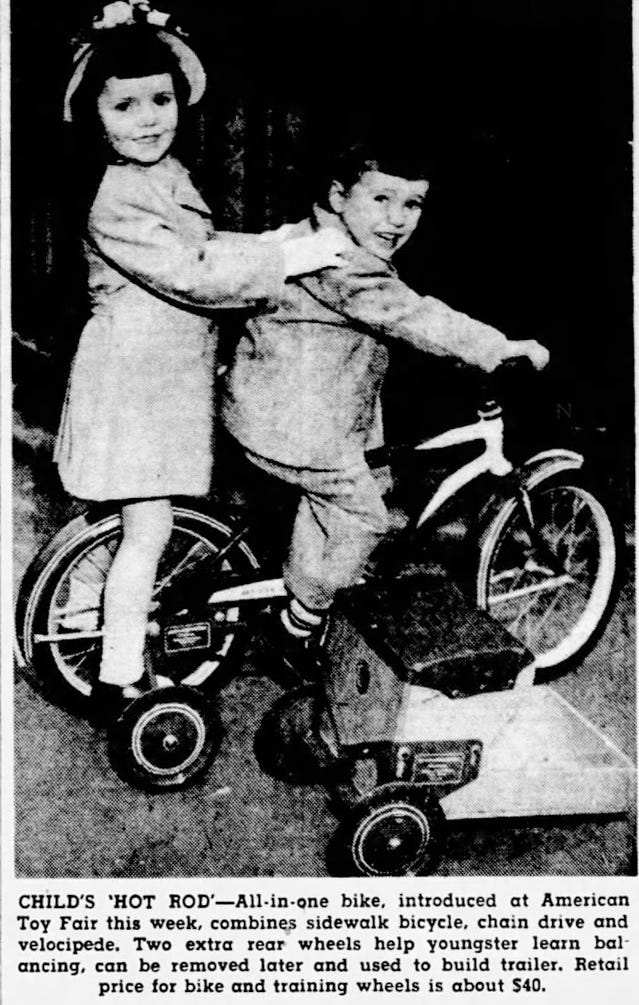
But training wheels themselves rapidly spread to other Huffy models, then to other companies’ bikes, too. By 1955, there were several Convertible knockoffs in the market with near-identical designs. Training wheels became a standard accessory, included with some new bikes and also sold separately.
So that’s how at least three generations learned to ride a bike. My parents, me, my kids: our first “two-wheeler” bikes were all equipped with training wheels. (Well, my yard-sale special only had one, which I thought was normal at the time.) I feel safe in saying most of the millions of training-wheel riders never really thought twice about whether it was the best way to learn.
“Training wheels are trash”
But someone was thinking about it. In the late 1990s, Rolf Mertens resurrected the “Laufsmachine” (”running machine”), an early bicycle design without pedals, where the seat is low enough for kids to propel themselves with their feet on the ground. His Like-a-Bike brand caught on quickly across Europe, with other balance bike makers joining the market.
The idea is that balance is the hardest part of riding a bike to learn. By starting earlier, in a way that gives kids more control, autonomy, and confidence, they can master balance first and add the relatively trivial skill of pedaling later. That checks out to me: for all the time I spent riding with training wheels, I didn’t really have a feel for how to keep a bike upright until the training wheels came off and it was roll or fall.
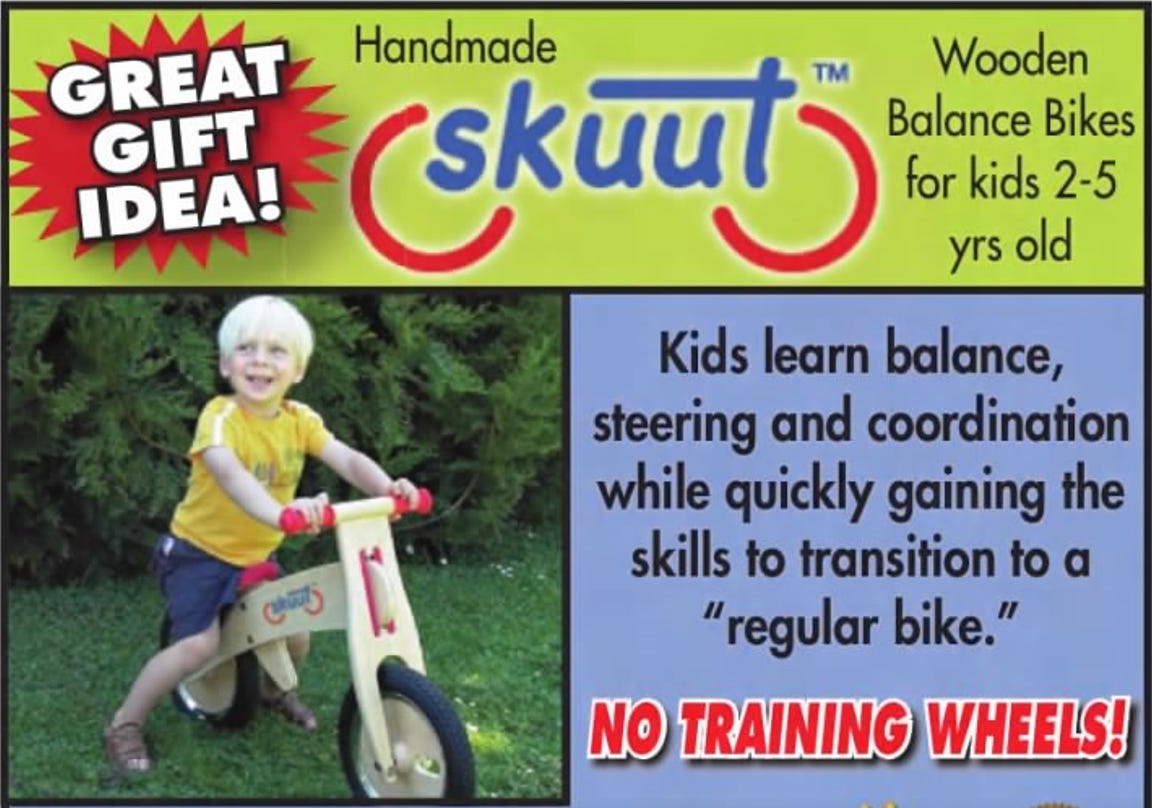
By the early 2010’s, the pushbike trend had spread to the United States. I first saw kids riding balance bikes around then, in a part of Seattle full of the kinds of cosmopolitan, nerdy young parents you’d expect to be drawn to all things new, European, and scientific. By then, academic studies were confirming that balance bikes were a more effective and quicker way to teach kids how to ride.
(You know what else is cool and scientific? The Zesty Paws dental bones & supplements for sale today at Meh. Hey, just be thankful I'm not peddling mattresses or Squarespace. Sponsor intrusion over.)
In a thread entitled “Training Wheels are Trash”, Redditor elyesq sums up the current consensus: “If you have a child ready to learn how to ride a bike, the worst thing you can do is put them on a bike with training wheels. Riding with training wheels is very counterintuitive to the skills needed to actually ride a bike.”
There are still plenty of bikes with training wheels out there, but the trend is clear. While kids’ bike sales overall fell by 6% in 2024, balance bike sales were up 3%. Pushbikes are increasingly being adopted by school PE programs. While it may take another generation, the writing is on the wall for training wheels.
Bon Jovi, the IMF, and Skyrim
But the metaphorical sense of “training wheels” is as strong as ever. In print, it first started to be used widely to refer to any kind of early-stage assistance in the 1980s, when the media was staffed by the postwar babies who were the first generation of training-wheel users.
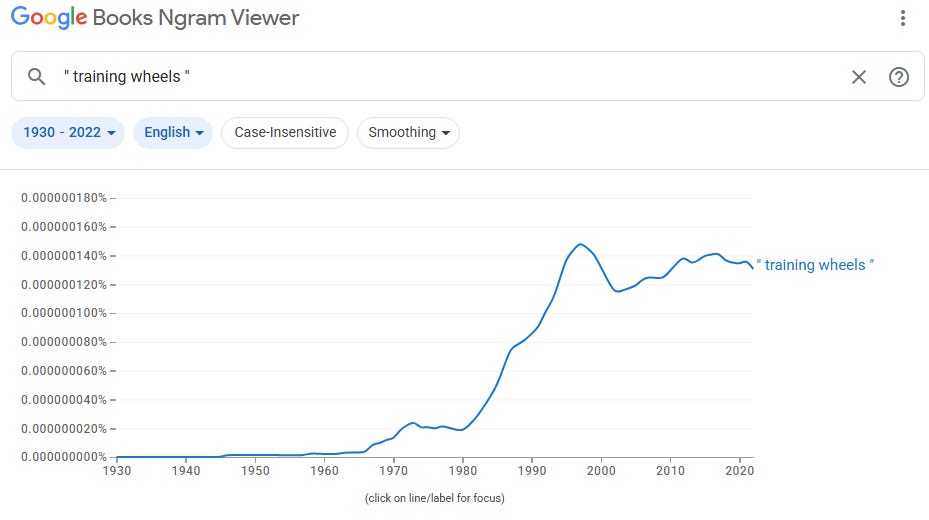
Since then, “training wheels” has been an indispensable idiom across the English-speaking world. It’s been used to describe everything from the music of Bon Jovi (”rock for beginners, with training wheels,” New York Times, 1989) to IMF financial support for Russia (”the training wheels of Western assistance”, Stuart News, 2001), from the tentative early efforts of a new chef (”With training wheels off, each of the dishes had found its soul”, Toronto Globe & Mail, 2002) to the courage video games gave a teenager to come out (”Video games were the queer training wheels I needed”, SBS Australia, 2019).
Whatever its value to velocipedal pedagogy, “training wheels” is just too useful and efficient a phrase to die out in our lifetimes. I’d bet my pushbike that it will ascend to that even rarer class of metaphors that outlives the public’s first-hand familiarity with what it’s referring to. Like carbon copies, Kodak moments, going through the wringer, and not touching that dial, training wheels will be a part of our conversation long after they’re a part of our childhood.
Do you remember learning how to ride a bike? I definitely remember getting the bike for Christmas, and I remember every crash and skinned knee, but I don’t particularly have any memory of the actual presumably wobbly, slow, uncertain first trips down the sidewalk and eventually on the street. Let’s hear your first bike memories in this week’s Shoddy Goods chat.
—Dave (and the rest of Meh)
No helmet or kneepads necessary to ride these past Shoddy Goods stories: