

Hey, Jason Toon here with another Shoddy Goods, the newsletter from Meh about consumer culture. Like many a current and former boy, I still have a soft spot for pretending to shoot things. I am less interested in getting shot for real. This week’s story is about a moment when our culture had to decide how to set the balance between the two.
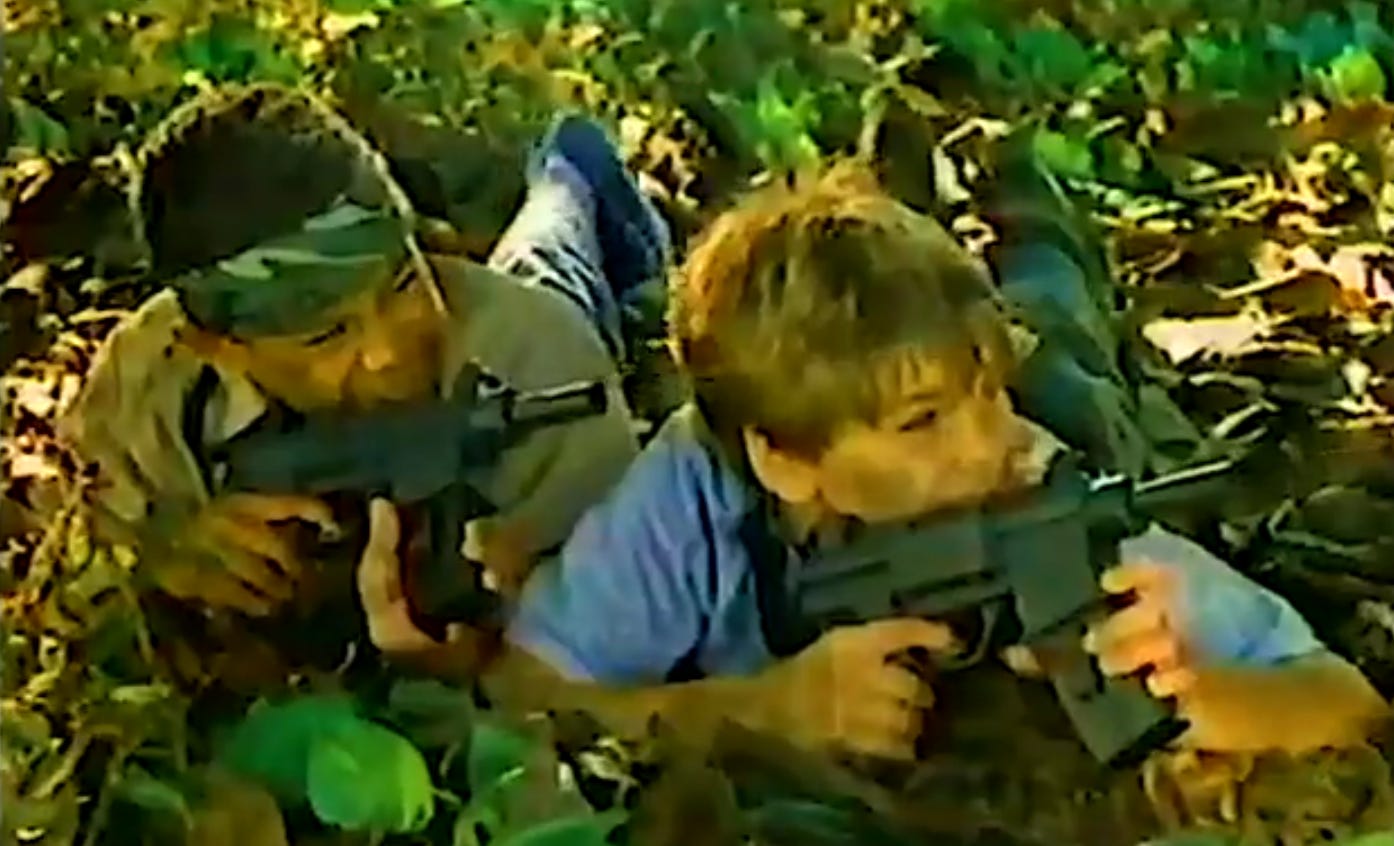
“The look! The feel! The sound! So real!” Forty years later, the 1986 commercial for Entertech water guns is a little unnerving: all-American suburban kids toting authentic-looking automatic weapons. Maybe we’ve seen too many real-life child soldiers since then. Or maybe we’ve just gotten used to toy guns having gaudy, obviously unrealistic colors - a shift Entertech played a major role in instigating.
Entertech wasn’t the only realistic toy-gun line at the time. But the manufacturer, LJN Toys, staked the entire brand on the resemblance to real deadly weapons. When the mood abruptly shifted after some high-profile tragic incidents, the Entertech name lost its value, its reason for being, and its existence.
“The play value is tremendous”
I was the target market for these water guns. Twelve years old at the time, I was still young enough to run around playing make-believe but old enough to crave some edge, some realism. I wasn’t even that into the Stallone/Schwarzenegger brand of action - my tastes ran more to superheroes and Indiana Jones - but come on: those Entertech guns looked awesome.
US sales of toy guns - “war toys”, in pacifist parlance - had dropped steeply through the first half of the decade, from 33 million units in 1980 to 19 million in 1985. The generation that marched against Vietnam were hesitant to put toy guns in the hands of their kids. Consumer advocates had opened up discussions in the 1970s about the connections between pretend violence and the real thing. But as the post-hippie generation grew up and had kids of their own, there was less of a stigma against toy guns.
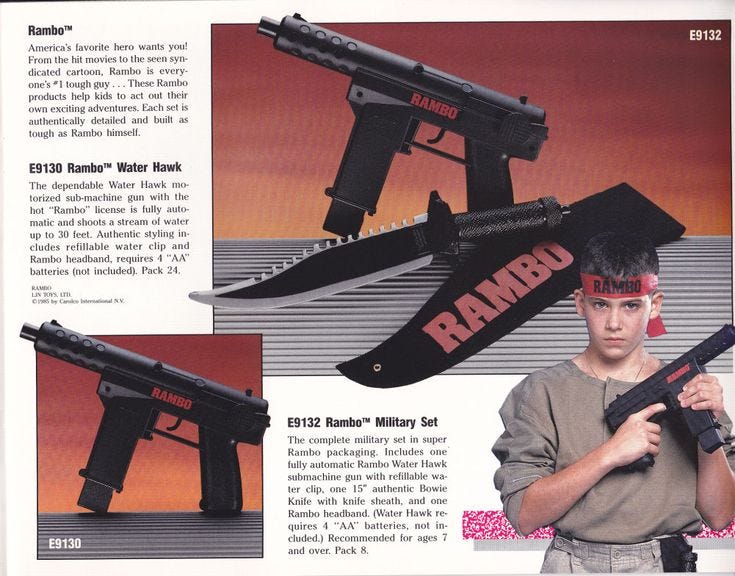
“I think today’s parents may be less averse to guns than many suspect,” said industry analyst Paul Valentine in 1986, “because they generally missed the height of the anti-war movement of the late ‘60s and they generally were not affected by the draft.” The same trends that made Rambo box-office gold showed up in the toy aisle, too, including licensed Rambo toys by at least three different companies, including LJN.
New technology also made toy guns a hot commodity. Worlds of Wonder’s Lazer Tag made it possible to play “for real”, with points and confirmed kills, and rapid-fire water guns like Entertech brought the chugga-chugga of action-movie battlefields to the backyard.
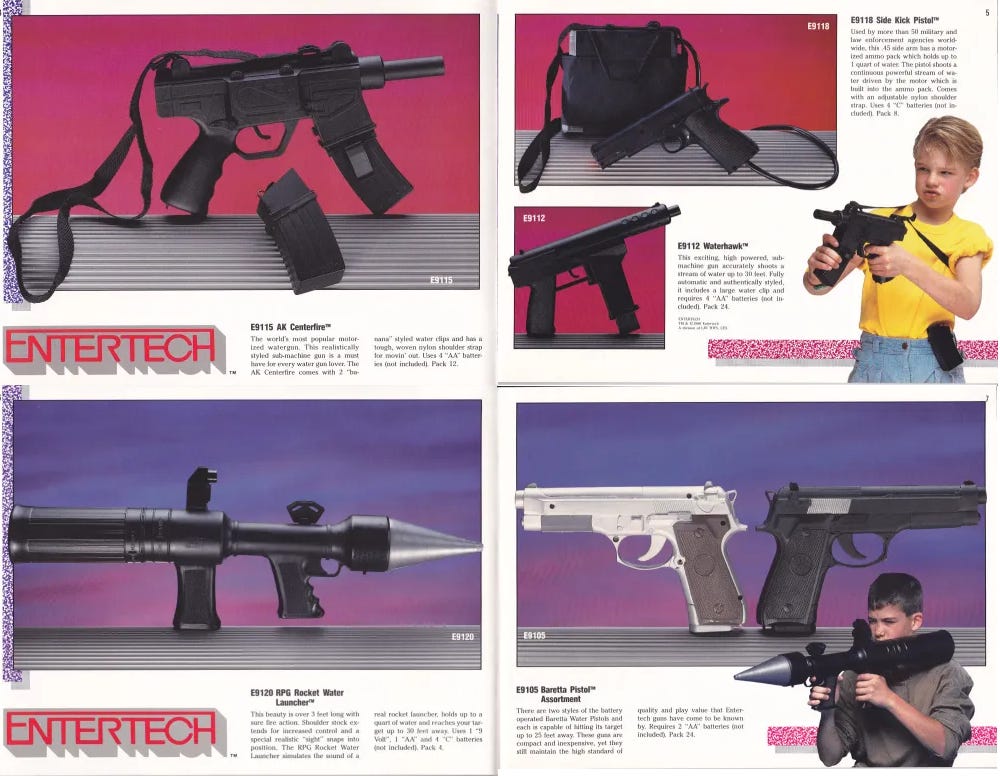
“The motorized water machine gun category is one that we think is going to grow,” said Leo Hoffman, LJN’s director of marketing, in the same news story. “The product has really universal appeal. The play value is tremendous, really.”
My friends and I would have agreed, if any of us had been lucky enough to have an Entertech. Authentic-looking M-16s and Uzis with automatic bursts of “fire”, 30-foot range, changeable water-filled “clips”... what’s not to love?
“Children have a built-in gun”
Of course, just because kids want something doesn’t mean it’s the best idea to give it to them. The toy industry at the time did what industries do: shrug off any responsibility for the even the possibility of harm from their products.
“We don’t create the trend in the market,” said Steven Kort, VP of marketing for a toy company that marketed a replica Baretta dart gun called “The Real Stuff”. “We just react. And we know that right now, the more realistic, the better.”
Penny Richmond, publicist for the Toy Manufacturers of America, said “”We don’t consider any of the guns or action toys ‘war toys’. Look, children have a built-in gun - they cock two fingers of one hand and bang-bang, they shoot their little brother or whatever. Kids have been doing that since ancient time.”
Richmond’s questionable grasp of firearm history aside, there was an issue that had nothing to do with flower-power notions of teaching the children peace: sometimes people mistake toy guns for the real thing.
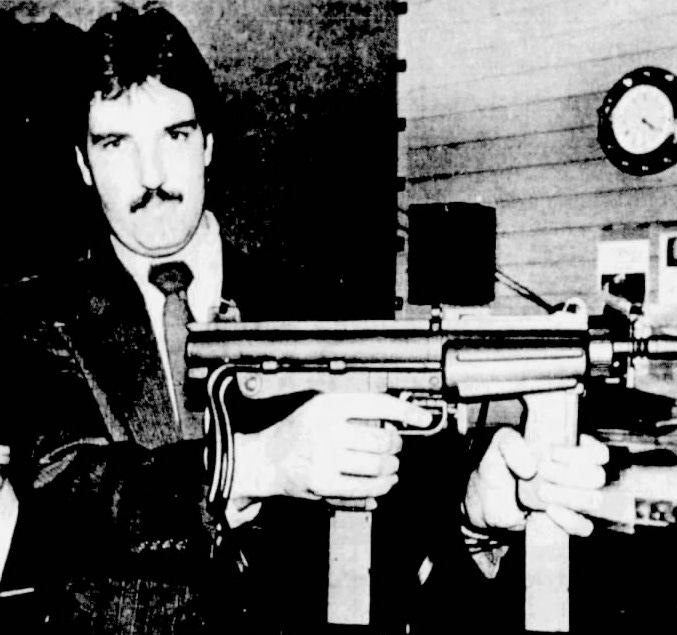
In a society with high levels of gun ownership, at a time when violent crime levels had been climbing for 25 years, that mistake could have disastrous consequences. And so it did. In truth, people toting play firearms had been getting shot well before Entertech came along. The victims were largely witless adults brandishing toy guns in robberies or disputes, only to find the other party was armed with the real thing: this actually happened to a teenage friend of my dad who pulled a squirt gun on a nightclub bouncer as a “joke”. But the casualties had also always included a few children. The main difference was that now more kids were running around with realistic toy guns because kids’ TV shows were inundated with commercials hawking them.
Living colors
So when a 13-year-old developmentally disabled boy in San Francisco was shot by police while playing with a toy gun, or a 19-year-old was killed by police during a game of Lazer Tag - not to mention countless near misses when police were called on kids with toy guns, from LA to Boston to West Virginia - the very conspicuous likes of Entertech found themselves in the figurative crosshairs.
Los Angeles became the first city government to ban realistic toy guns in 1987, with San Francisco following in 1988. Various cities and states joined in, with lawmakers considering federal-level bans. So the industry acted itself before it could be forced to. Led by retailers like Toys R Us, which banned realistic toy guns in 1988, toymakers shifted away from black and gray replicas of real firearms to big bulbous sci-fi contraptions in hi-vis shades of orange, green, and yellow.
Entertech tried to go along with the change, but now they were just one more motorized water gun in an ocean full of them. Their sales collapsed to essentially zero. After LJN was acquired by Acclaim Entertainment and converted into a video-game company, the Entertech trademark was allowed to lapse.
As you may have noticed, depending on where you live, realistic toy guns never went completely away in the US. Authorities from Mississippi to Massachusetts have recently warned of the dangers of toy guns being mistaken for the real thing. Last year, New York sued Walmart for shipping some realistic toy guns into the state, violating the state’s ban. But no doubt lives have been saved by the dayglo designs of toy guns over the last 40ish years.
Look, I get the appeal. 12-year-old Jason would have loved an Entertech Uzi. But he also would have loved an all-Big Mac diet, unlimited Little Debbies, and a 3 AM-noon sleep schedule. It’s a good sign that seeing little kids with toy Uzis seems just that unwholesome now.
I have a specific memory, growing up, of a law getting passed that dictated that as of January 1985 throwing stars were going to be 18+ only. Throwing star sales went through the roof that December, 1984. What else were we going to throw around in the construction sites we trespassed in? What toys or clothes were banned, legally, parentally, or in schools during your childhood? Let's hear about 'em in this week's Shoddy Goods chat.
—Dave (and the rest of Meh)
Nobody would ever mistake these previous Shoddy Goods stories for a lethal weapon:
And if you like Shoddy Goods, don’t miss Jason’s new other newsletter, Gnomenclature. Every week he digs into the 178-year-history of Hammacher Schlemmer, America’s oddest retailer. It’s gonna get weird!
I had one of these-the afore mentioned uzi, in fact. It was actually a piece of junk. Sure it looked cool, but the little water ‘clip’ ran out quickly and the batteries died more quickly than that.
Now-the 1980’s cap guns-those were where it was at. Talk about realistic. I would never been seen walking around with one of those these days. Instant Get Shot Kit 💯
In their heyday, Entertech had a GREAT lineup of full-scale realistic submachineguns:
- TEC-9
- MAC-10
- MP5 (sort of a sawed-off SD variant)
- UZI carbine
- UZI mini/pistol
- ?? sort of a VZ-61 Skorpion knockoff they called an "AK"
- ... I'm sure I'm forgetting some.
And some pistols:
- 1911 w/ backpack reservoir
- Beretta M92
Plus assault rifles:
- M16
And even a pump shotgun:
- Remington 870 w/ pistol grip (non-motorized)
The launchers were a bit silly because they operated the same as an SMG:
- RPG
The early models were crap, because they simply slapped a motorized gearbox with a steam-locomotive-style armature that pumped a traditional sprung trigger pump automatically. So on the firing part of the cycle it was pushing against water pressure PLUS the spring, and on the chamber-refill part of the cycle the spring was "helping" push the plunger back quite unnecessarily.
Later more-evolved models had a custom plunger head that ATTACHED to the armature, eliminating the need for any spring. Those shot a lot better... until they broke.
And it wasn't long after that they started painting or stickering them with bright orange, then transitioned to molding the muzzle pieces in orange, and then finally making the whole thing in day-glow kindergarten colors, which made them kind of pointless because Super Soakers massively outperformed them if you didn't care about realism.