

My name is Jason Toon and I’ve got a strong ‘60s mod streak. But to my shame, I’ve never owned a Vespa scooter. In this Shoddy Goods, the newsletter from Meh about consumer culture, I discover that a Vespa in disguise was once widely available across America - by mail-order, no less.
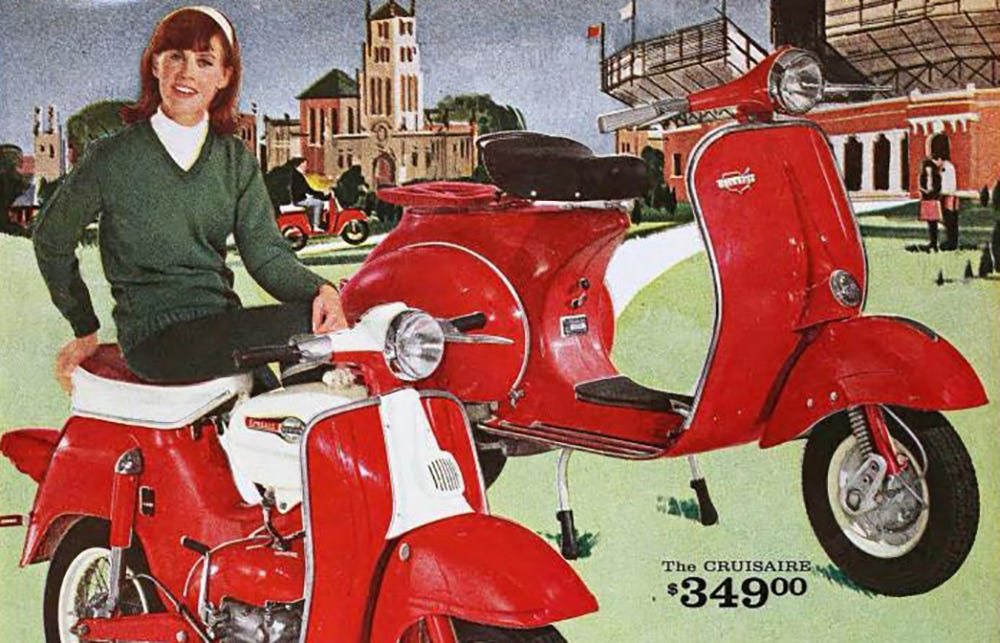
Does any motor vehicle embody European style and hipster urbanity like the Vespa? The buzzy little Italian scooter chugged into newfound popularity in this century by being, in many ways, the antithesis of quintessential American vehicles like swollen SUVs and steroidal pickup trucks. The fussy young continental wannabe, feeling stuck in the post-millennial suburbs of Houston or Indianapolis, could zip around on a Vespa and transform their humdrum surroundings into Rome at the height of la dolce vita.
So color me sorpreso to learn that this most Italian of conveyances was sold for 16 years by the pinnacle of mainstream American retail: Sears. Rebranded as the Allstate Cruisaire, it came off the same assembly lines with the same specs - a Vespa in all but name.
“European precision and streamlined styling”
“Want a new riding thrill… a ride packed with speed and power and finger-touch control, topped off with really eye-catching style?” asked the Fall 1952 Sears catalog. “Then ride the brand new All-State Cruisaire, the newest in motor scooters that brings European precision workmanship and streamlined automotive styling right to you!” While Sears had offered other motor scooter models for years, the Allstate Cruisaire was positioned as the top-of-the-line model. (Yes, that’s the same Allstate brand as the insurance company. Sears used it for tires and other auto parts first, before expanding from outfitting vehicles to insuring them.)
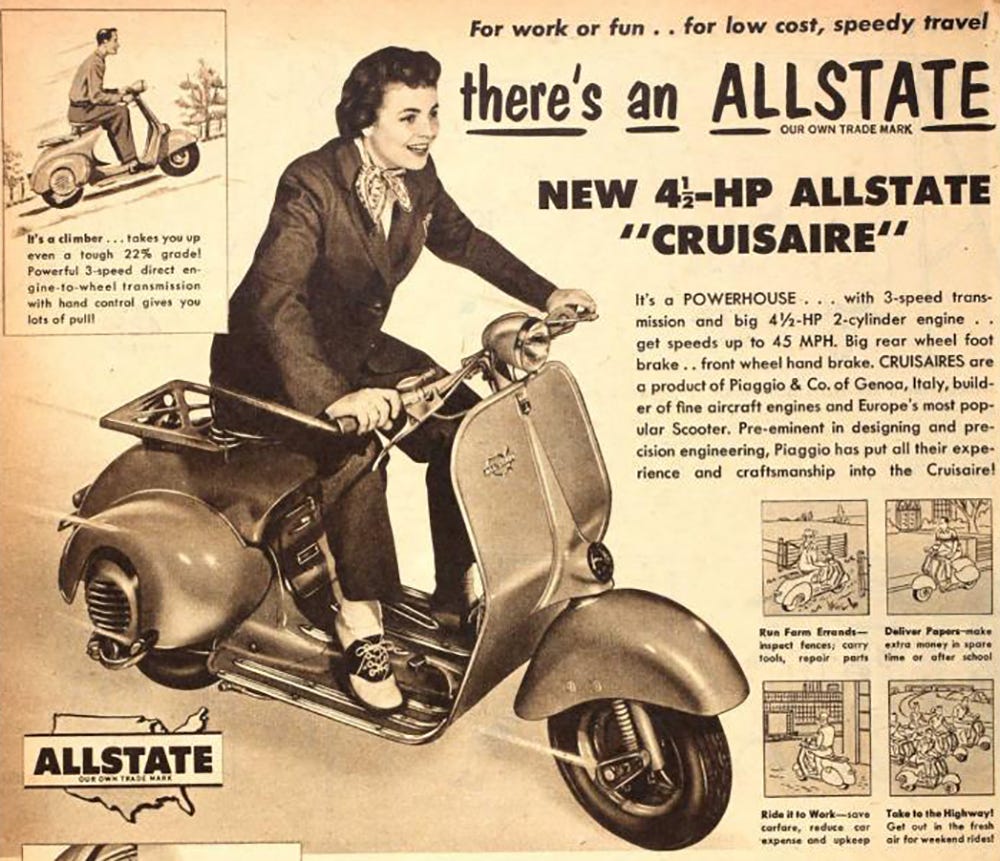
Priced at $279.50 (about $3600 today), the Cruisaire wasn’t merely “a product of PIaggio & Co. of Genoa, Italy, builders of fine aircraft engines and Europe’s most popular Scooter”, as the catalog put it. It was in fact that same scooter, the Vespa, with a different badge. Could Sears have known that the very next year, Gregory Peck and Audrey Hepburn would zoom around on a Vespa in the hit movie Roman Holiday? If not, whatever buyer decided to import these scooters deserves credit for their foresight.
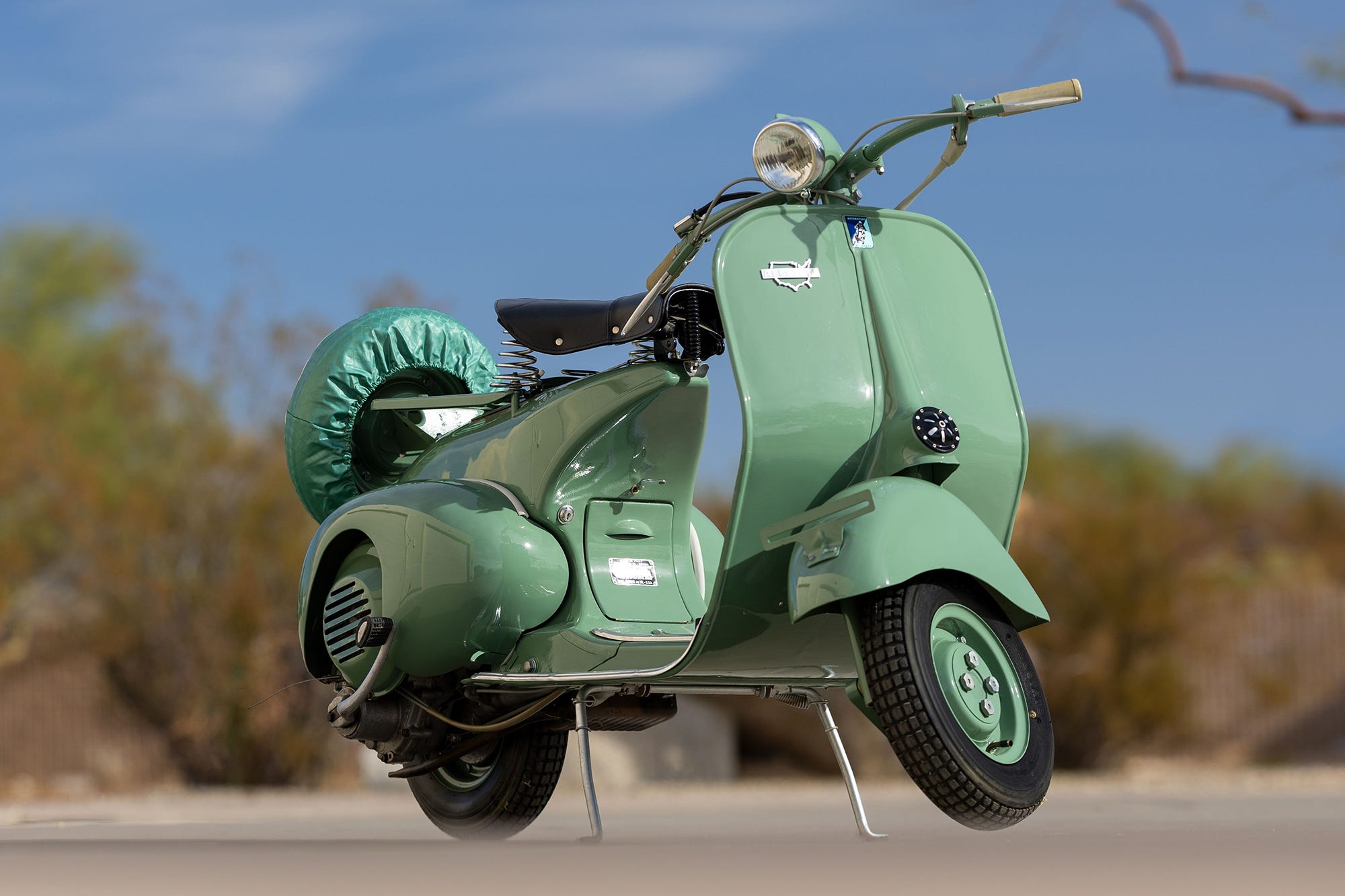
The first Crusaires were available only in a matte green color. Intentionally or not, it’s similar to the green of military hardware, at a time when millions of American men had recently had their first exposure to Europe during World War II, or while serving there after the war. Maybe that color association nudged some ex-GIs into recalling fond memories of r&r in some sun-splashed Mediterranean village.
While the Cruisaire’s motor was usually a year behind the concurrent Vespa model, it did beat its Italian twin to one innovation: a headlight mounted on the handlebars, so the beam turned with the scooter. This useful adaptation would be taken up by the Italian models in 1955.
“Power that pounds the pulses”
The suggested uses in the early catalog say a lot about who Sears saw as customers for the Cruisaire: run errands around the farm, get a paper route, ride it to your factory job. The thrust of the ad copy was about 10% style, 15% fun, 75% practicality. “Motor scooters are filling an ever-growing role in the nation’s transportation system,” ran a quote in the company’s 1952 press release, attributed in news stories to whoever managed the local Sears store. “Thousands of scooters are in daily use carrying people to school and work, running errands, making deliveries and providing healthy recreation.”
But another cultural earthquake was on the way, as newly assertive, affluent Baby Boomers reached their teens and young adult years. This was not a cohort that spent a lot of time mending fences on the back 40. Yet again, Sears seemed to sense the change in the air. “It’s Italian Racing Red,” the 1963 catalog proclaimed of that year’s Cruisaires. It would take another year for the scooters to show that color off in the catalog’s precious, expensive color pages. In that interval, the Beatles had kicked off the ‘60s as we know them.
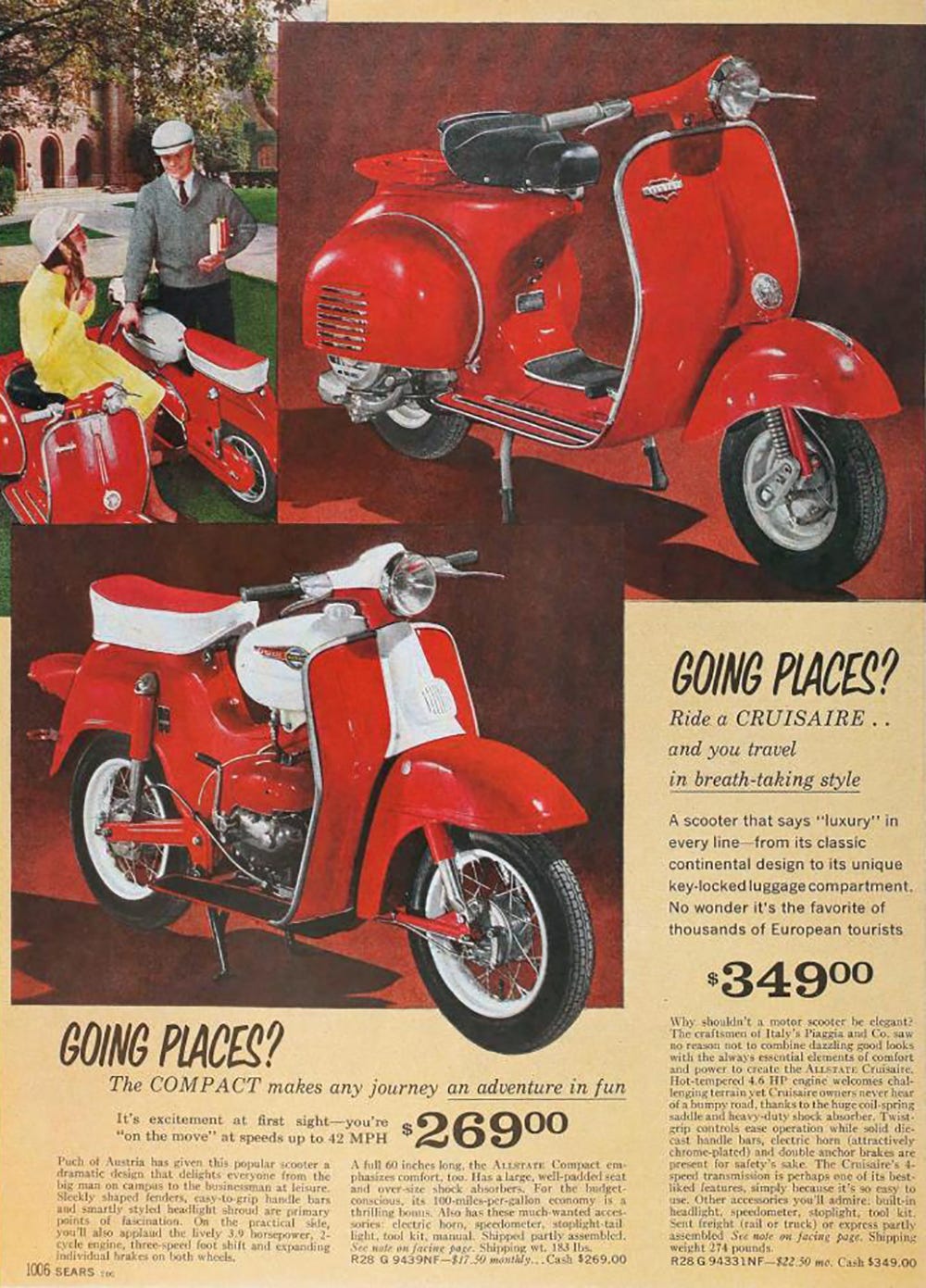
Youth, style, and adventure were the Cruisaire’s new watchwords. The scooter was right in tune with the colorful, streamlined Swinging London look newly beloved by millions of young Americans, even if almost all were totally unaware of the mods who swarmed British high streets and holiday resorts in their Vespas.
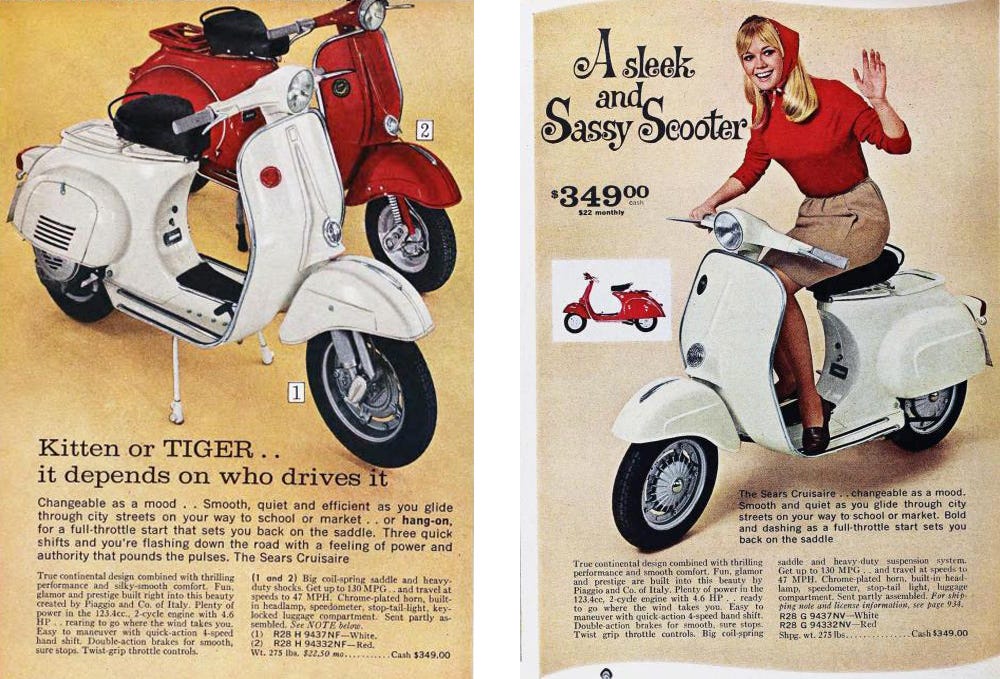
For the next several years, the Cruisaire and the rest of the scooter line was consistently featured on the catalog’s color pages - a sure marker of its priority to Sears. The models got a couple decades younger and much more fashionable. Photos were set against collegiate campus backdrops.. Adjectives like “sleek”, “sassy”, “bold”, and “dashing” were sprinkled around liberally.
“Kitten or TIGER… it depends on who drives it,” read the excitable copy in the Fall 1966 Sears catalog. “Changeable as a mood… Smooth, quiet, and efficient as you glide through city streets… or hang on for a full-throttle start… Three quick shifts and you’re flashing down the road with a feeling of power and authority that pounds the pulses.” Finally, the Vespa, dressed in American clothes, had met its moment.
“Turns up in even the most remote corners”
A moment is all it turned out to be. The changeable moods of young people were mutating with lightning speed during these years. What seemed thrillingly new in 1964 felt passé and uptight by 1968. That was the last year Sears offered the Cruisaire. Just as the Beatles themselves got hairier and their music heavier, rougher vehicles like motorcycles and dune buggies better fit the earthier, denim-clad tastes of the decade’s later years.
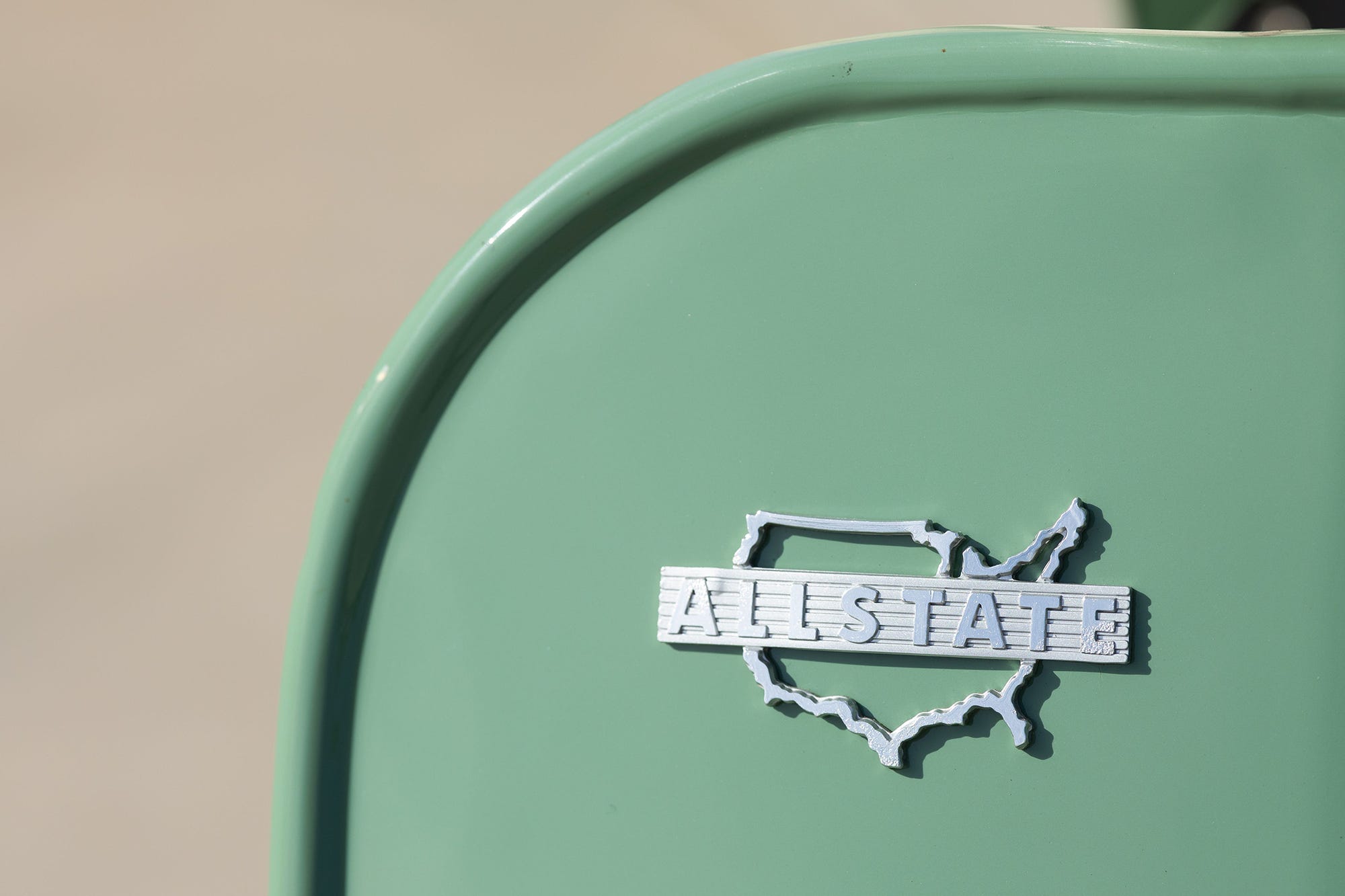
Those thousands of Cruisaires sold by Sears during those 15 years didn’t just disappear. “Because they were sold through mail order, the Allstates turn up in even the most remote corners of the country,” says one vintage scooter buyer’s guide. “In fact, outside of the larger cities, you are a lot more likely to find an old Allstate than a standard Vespa when looking for a scooter. Though they are fairly common, I would still expect to pay about the same as for the equivalent Vespa.” The immaculately restored green 1951 model pictured above sold at auction for $6,325 in January 2025 - not bad for a design classic you can also deliver newspapers with.
I love reading about and looking into alternatives to giant cars and trucks to get around, though I usually live in rainy and/or snowy enough places that a Vespa has never been a year-round option. I’m currently enamored with the new Fiat Topolino, even with its absurd 25mph top speed. Ever own or want to own any sort of abnormal vehicle? Let’s hear about it in this week’s Shoddy Goods chat.
—Dave (and the rest of Meh)
These previous Shoddy Goods stories feature precision continental styling (I didn’t say which continent):
Scopitones scandal: how the Mafia almost killed the music video
From the Dauphine to Le Car: the checkered history of French cars in America
And if you like Shoddy Goods, don’t miss Jason’s new other newsletter, Gnomenclature. Every week he digs into the 178-year-history of Hammacher Schlemmer, America’s oddest retailer. It gets weird!
In 1965 at age 16 I ran away from home in Steubenville, Ohio & hitchhiked to the Newport Folk Festival. There, I was able to rent a Vespa with $$ i made scalping tickets. What fun!!! Got to hear the crowd boo Dylan when he brought his electric band on stage for second set.