

Jason Toon here with a new Shoddy Goods, the newsletter from Meh about consumer culture, taking up the question a million schoolyard comedians have asked before me: “What’s the deal with those tags on mattresses?”
The proceedings of the US House Committee on Interstate and Foreign Commerce rarely produce comedy gold. But a bill they deliberated in 1957, which was passed into law in 1958, became the set-up for one of the most inescapable punchlines in American entertainment.
“You know those little ‘do not remove under the penalty of law’ labels they put on mattresses?” asks the escaped convict Mickey, who has just picked up the hitchhiking Pee-Wee in Pee-Wee’s Big Adventure (1987). “Well, I cut one of them off.”
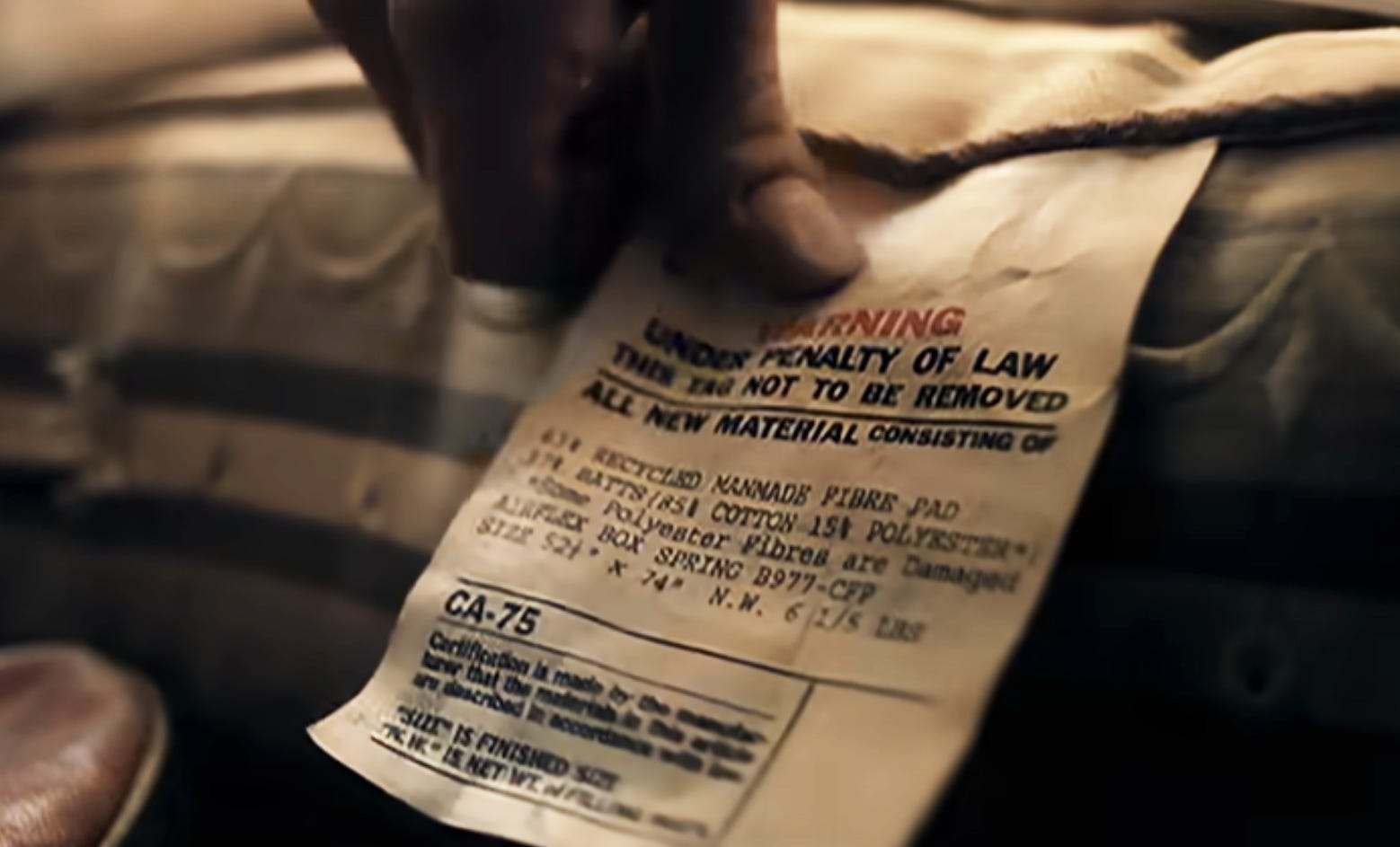
Mickey was far from alone. From Portnoy’s Complaint to SpongeBob SquarePants, the “crime” of removing a mattress tag has long been a reliable way to mock a vainglorious villain, send a milquetoast character spiralling into criminality, or lampoon an over-regulated society. The teenage rebel in Green Day’s “Warning” video (2000) starts a day of low-stakes mayhem by ripping the tag off his mattress, before moving on to swim right after eating and take candy from a stranger.
While I doubt the framers of the Textile Fiber Products Identification Act had comedy writers in mind among the law’s beneficiaries, jokes about the sternly worded tags on mattresses (and pillows, etc.) have been almost as ubiquitous as the tags themselves ever since.
“Such a label would not be read”
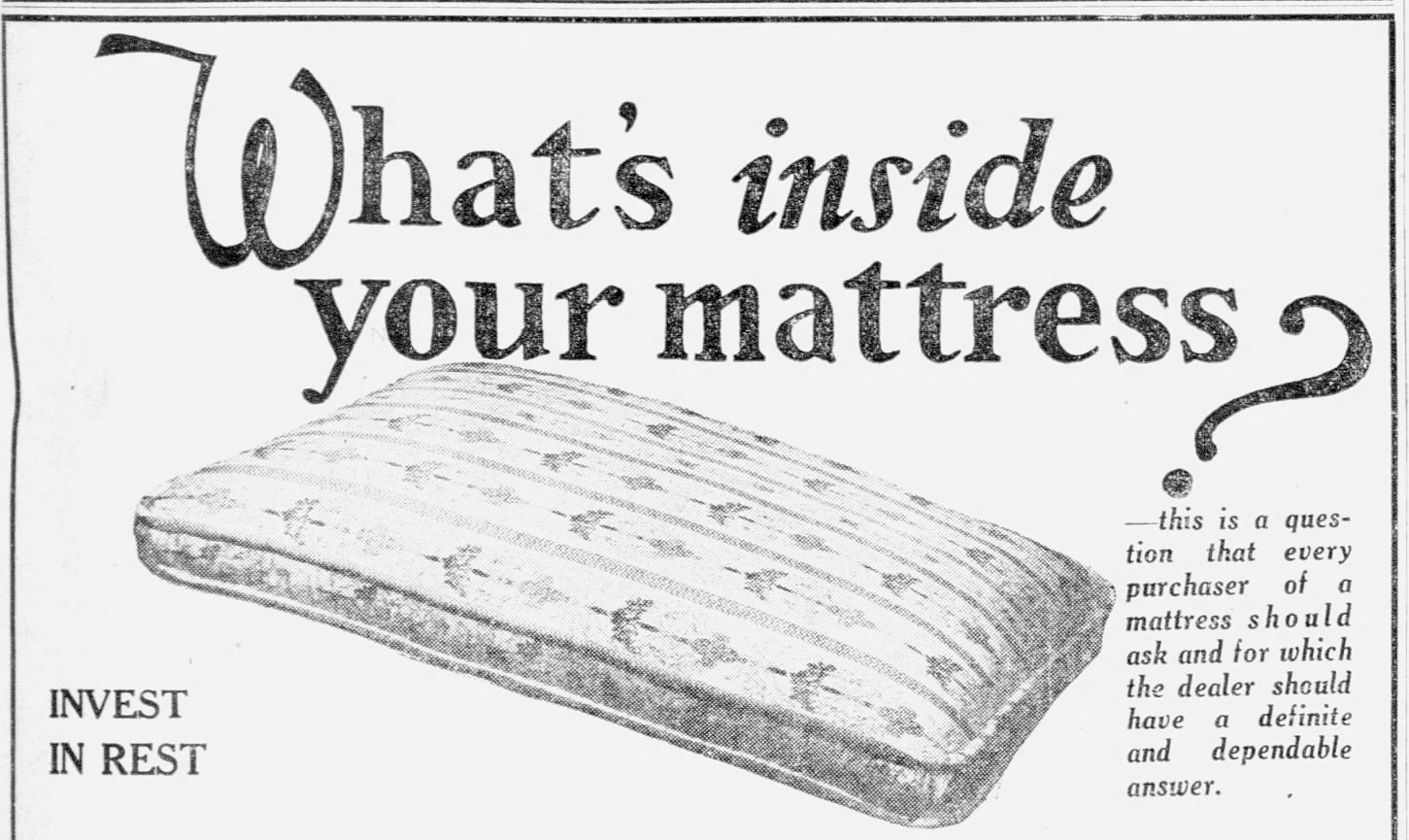
Think the mattress industry is shady now? A century ago, “new” mattresses were not uncommonly stuffed with used filling, shredded rags, or worse. A 1919 newspaper story tells of “a mother who let her 9-months-old baby sleep on a newly bought expensive cotton mattress. The baby was not thriving. The mother smelled something peculiar about the mattress. She ripped it open and found that it was stuffed with unwashed guano sacks.”
Mattress fraud could be even more dangerous than that. The Chicago Board of Health issued a 1924 bulletin titled “Menace of the Mattress” warning about reused mattress stuffing from “beds of sickness and death… used by persons ill from contagious and infectious diseases and oftimes infested with vermin… Dangerous infections, such as tuberculosis, typhus fever, leprosy, and other skin diseases, are possible perils from intimate association with these mattresses.”
Various remedies, from local “pure mattress” laws to an ultraviolet light that could distinguish between old and new cotton, left enough holes that by 1957, Congress was ready to take up the issue as part of a broader effort to require the composition of all textile products be accurately labeled.
Of course, politics is politics. Cotton growers and their representatives supported the law because it would protect their crop from the new synthetic-fiber interlopers. Industry lobbyists and congressmen from manufacturing-heavy states opposed it on the usual grounds.
“If this act is passed it would simply result in a lot of unnecessary red tape and would certainly increase production cost,” wrote J.H. DuBose of the Bridges Furniture Corporation in a letter to Congress. “Such a label would not be read by one customer out of a thousand, and if read, would have no meaning to the customer.”
“At least while I lived, I lived big!”
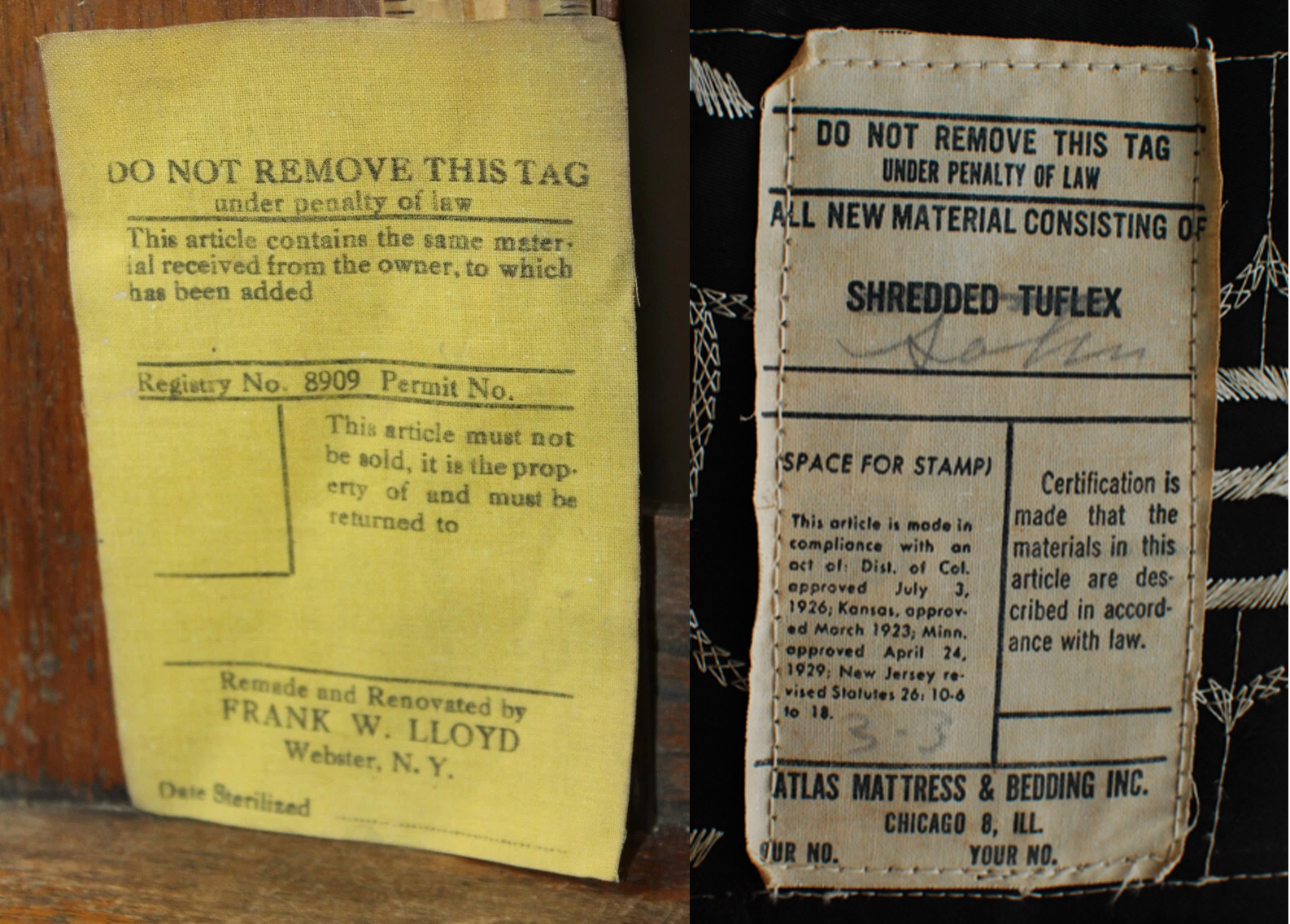
The act was passed, becoming law in 1960. DuBose couldn’t have been more wrong about the readership of at least one of these new labels: the one required on mattresses. Tens of millions of Americans, innocently changing their sheets, were startled to encounter the warning “DO NOT REMOVE THIS TAG UNDER PENALTY OF LAW”.
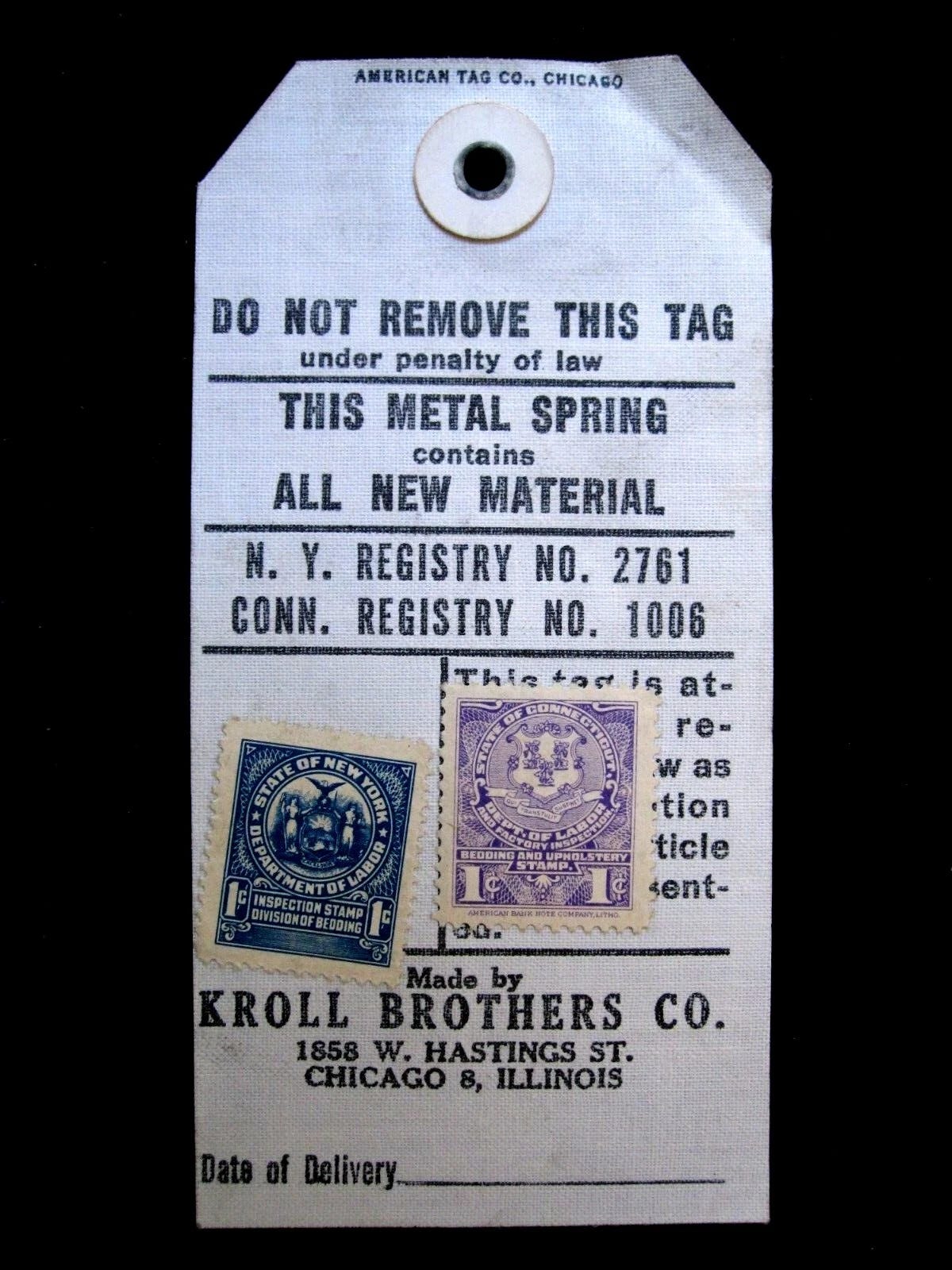
While some specifics varied from state to state, the tag designs were mostly strong stuff. Strident typefaces, more suitable for wanted posters and civil emergency alerts, spelled out intimidating blocks of legalese. The charge seemed absurd - certainly nobody would go to jail for tearing a tag off their own possessions? - but that tag looked like it meant business.
It wasn’t the kind of thing good citizens of midcentury America could just shrug off. Best not to tempt fate or the Federal Trade Commission. “You could walk into the most elegant homes in the world,” wrote the humorist laureate of the suburbs, Erma Bombeck, “but there was always that one common denominator: a limp tag flapping under the chair like a piece of dirty underwear.”
Alexander Portnoy, the dirty young man protagonist of Philip Roth’s landmark 1969 novel Portnoy’s Complaint, imagines getting gunned down by police because “I tore the tag off my mattress… But at least while I lived, I lived big!”
“I was pretty sure they applied to the seller of the furniture, not the buyer,” wrote newspaper columnist Sid McKeen. “My wife wasn’t so sure… [she would say] ‘Why take a chance? Obviously there must be some reason for a law like that.’”
McKeen continued: “The tags that I did take off made me very nervous. I never threw them away. I stored them in a dresser drawer just in case of a raid. I reasoned that while the detectives were pounding on the door, I’d have time to scurry around the house and reattach all the tags - somehow.”
“Power to the people!”
McKeen was right, of course: the prohibition against removal applied only to the seller of the mattress, not the buyer. American mattress owners had been free all along to rip the tags off to their hearts’ content. So in 1971 the FTC allowed new wording: “This tag not to be removed under penalty of law except by the consumer.”
Nevertheless, the jokes kept coming - or rather, the joke, since it was basically the same thing every time. In 1977, it might be Fred Sanford of Sanford & Son ripping a tag off and proclaiming “Power to the people!”. In 1987 it was a Soviet defector on Night Court hoping that removing a mattress tag would get him deported back to Russia. And so it goes. Sections on the TV Tropes page “Mattress-Tag Gag” for webcomics and web video attest to the one joke’s ongoing durability.
The mattress-tag gag wouldn’t work if “not one customer out of a thousand” had read those tags. But they do depend on misunderstanding their purpose - maybe willfully. Of course no SWAT team is going to descend on you if you take a tag off your own mattress. It’s just more fun to believe it will. So that joke probably isn’t going away anytime soon.
“Fun of ripping off tags is gone“ was the headline of a 1986 column by Eric White after he belatedly noticed the changed label on some new pillows. “I ripped those tags off,” he wrote. “It wasn’t much fun, though. I missed the outlaw’s thrill of defying the law.”
I happened to have dressed up as escaped convict Mickey for Halloween this year. Maybe I'll dig up a photo and share it in the chat this week. I'm not sure I ever worried about going to jail for this one but we definitely had playground rumors that if you got pulled over 3 times, for any reason, you were going to jail. I remember being terrified the second time my mom got pulled over for speeding. Do you remember any myths about getting arrested or going to jail as a kid? Any warnings you were terrified you'd accidentally not follow? Let's talk about 'em in this week's Shoddy Goods Chat.
—Dave (and the rest of Meh)
These previous Shoddy Goods stories may not be consumed except by the consumer:
And if you like Shoddy Goods, don’t miss Jason’s new other newsletter, Gnomenclature. Every week he digs into the 178-year-history of Hammacher Schlemmer, America’s oddest retailer. It gets weird!