

Whenever I explained my copywriting job at Woot to someone not hip-deep in ‘00s Internet culture, they usually landed on the same comparison: “Oh, like Elaine on Seinfeld!” That character’s job as head writer for a fictionalized version of the J. Peterman catalogue was indeed a pretty dead-on parallel. We both went way beyond what was necessary or even sensible to make our product copy entertaining and original. Our mockery of retail was right there on the surface while theirs was more implied, but I think I detected a kindred spirit, in both the show’s version of the catalogue and the genuine article.
We’ve talked about Woot here before. Now this week comes news that J. Peterman may finally have met an ending it can’t wriggle free from. After years of purported losses, the company appears to have not taken any orders since July, and their listed phone numbers have been disconnected.
The company has been on the ropes many times before, and always came back. This time, though, namesake founder and driving force John Peterman is 85 years old, and it’s a legitimate question whether he’s got any more flamboyant gambits left in him.
“Uncivilized decibel level”
If this is the end, it’s a sad one for a brand that stayed unusually true to its original weird instincts. At a stretch, Woot lasted about a decade in its peak incarnation; J. Peterman has been doing its thing for 39 years, although a couple of those were under different management.
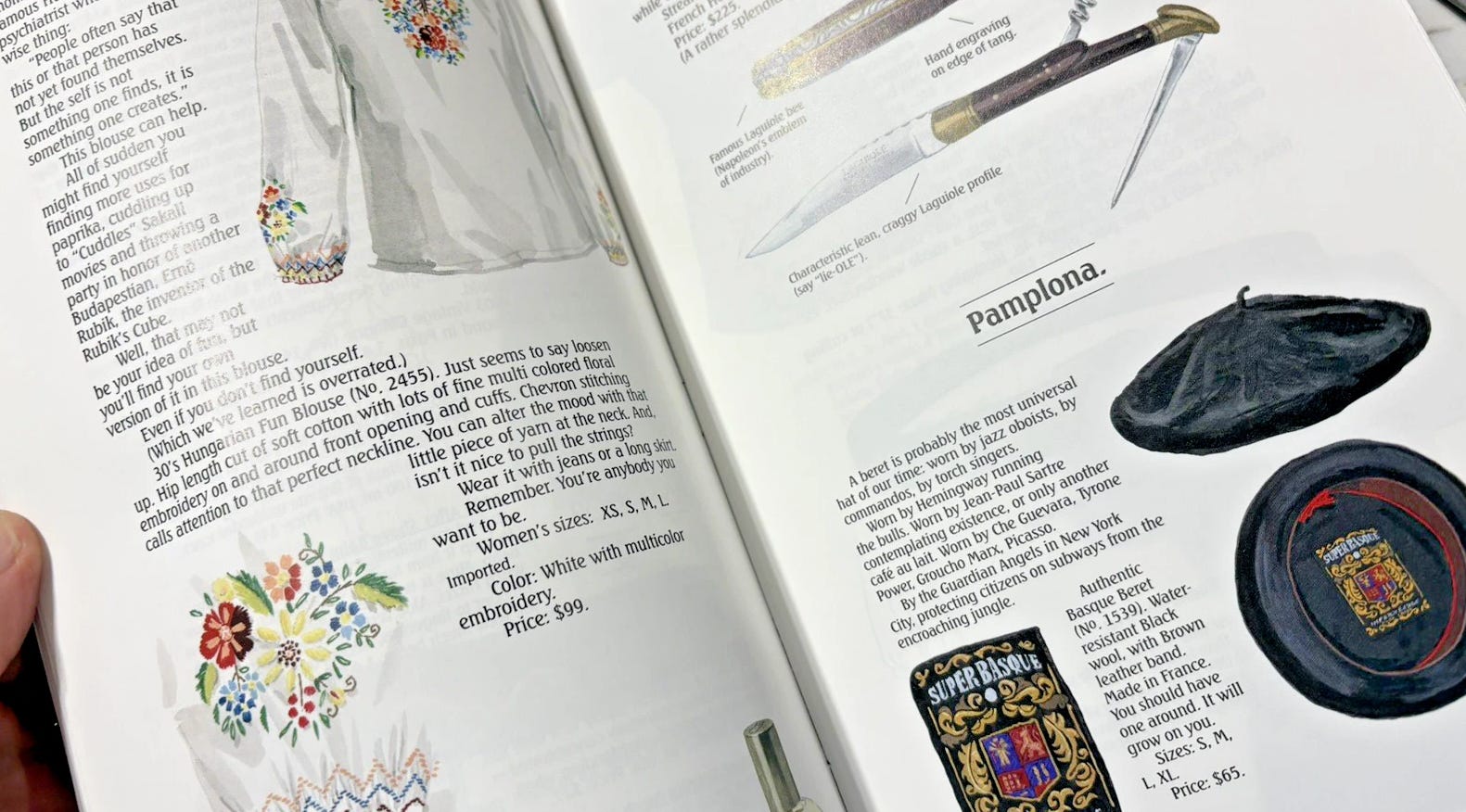
By “its thing”, I really mean “his thing”. The company’s eccentricities were Peterman’s own. The catalogue itself was like nothing else in that highly standardized field. It’s not just the famed copy, which might start off a blazer description with “Fiona has all-night spat with Beckwith. Uncivilized decibel level, tears, recrimination.” Or muse on how a beret was worn “by jazz oboists, by commandos… by Che Guevara, Tyrone Power, Groucho Marx, Picasso.”
It also called itself not a catalogue but an “Owner’s Manual”, with numbered issues, implying a certain collectibility. Instead of slick product photos, it used hand-drawn illustrations. Even the shape was weird, tall and narrow instead of the standard 8.5”x11” optimized for easy mailing. “I broke all the rules of a catalogue, but I didn’t know I was breaking them,” Peterman told his college alumni magazine in 2001.
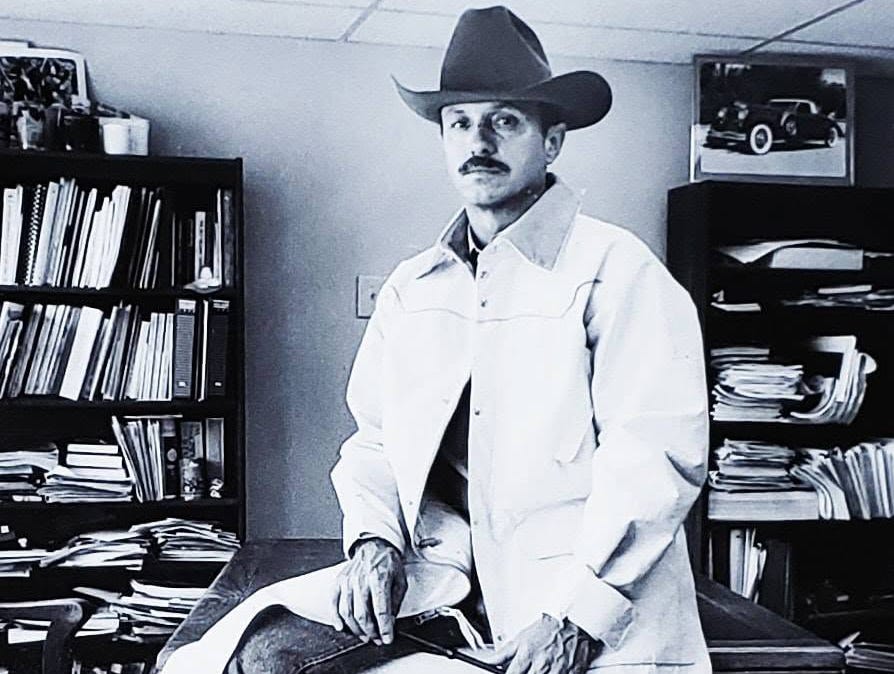
Born in New York in 1941, Peterman played minor-league baseball in the Pittsburgh Pirates’ farm system from 1963-1965. It appears his strength was his good eye: he drew a lot of walks. Years later, in 1986, that same eye was drawn to a floor-length cowboy coat in a Wyoming shop. After receiving compliments while wearing the coat, Peterman - by now a sales manager and serial entrepreneur - and a copywriter friend took out an ad in the New Yorker to sell “The Horseman’s Duster”. Thus J. Peterman the company was born.
“A risky modus operandi”
For such seat-of-the-pants origins, Peterman’s creative vision was sharply defined from the beginning. “Unique, hard-to-find items with a little romance attached to them” was how he described it to the Louisville Courier-Journal in 1988.
“Peterman says he sells what he likes, figuring that his eclectic tastes are shared by enough people to keep him in business,” the paper continues. “It’s a risky modus operandi, he admits, ‘but no one has job security except in yourself.’” He was right: the catalogue was profitable from the beginning, and its “factually romantic” copywriting approach got attention.
“As usual, I dropped what I was doing and sat down to read it,” wrote best-selling management guru Tom Peters in a 1990 syndicated column. “The J. Peterman catalog is fun. The products and presentation are ‘world-class quality’ writ large. A few thousand more J. Petermans and we could kiss our economic woes goodbye.”
Of course, J. Peterman’s Q rating really took off when it was noticed by the writing staff of TV’s top sitcom. What’s stunning to me about Peterman’s Seinfeld fame is how young the company still was when it happened. The first catalogue launched in 1988; the show’s “Peterman” debuted in 1995. Like many others, I assumed it was some long-standing blue-chip import-export concern. Maybe that’s down to its old-world, old-money aesthetic, or maybe we were all just mixing it up with Hammacher Schlemmer, an actual old company.
The Seinfeld spotlight, followed soon after by a big score on official Titanic movie replica collectibles, brought a lot of money into the company. But in a familiar story, the sudden weight of success knocked it off-balance. Private equity investment, ventures into brick-and-mortar retail, spending based on projections of $500 million in annual sales (the real figure topped out at $75 million)… “I was trying to go too fast and hit a brick wall,” Peterman said in that same alumni magazine interview. “Revenue was slipping, the banks began pulling credit lines, and there was a flurry of activity to save the ship.”
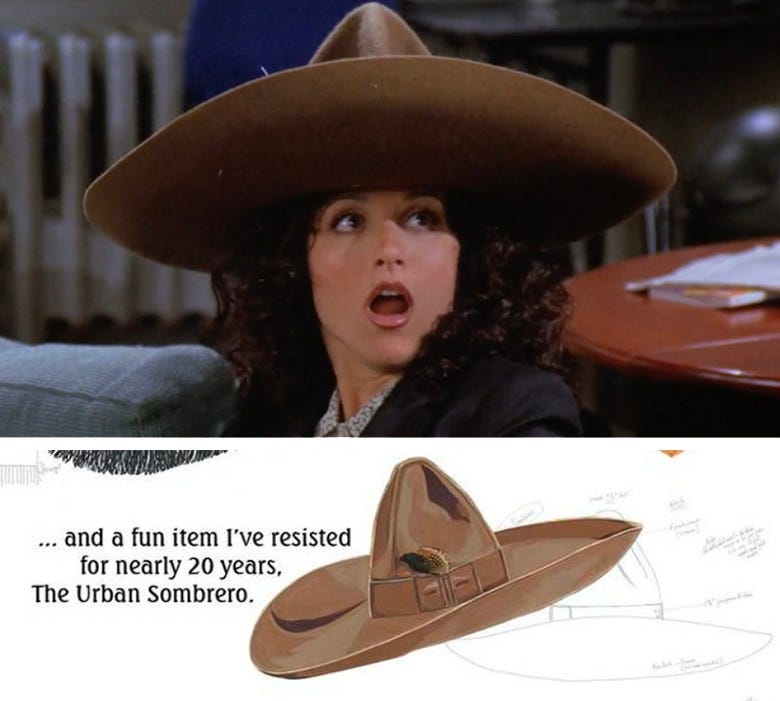
That time, it worked. After losing the company in bankruptcy, Peterman recruited new investors, including John O’Hurley, the actor who played his pompous Seinfeld doppelgänger, to buy it back in 2001. More recently, a 2016 Kickstarter finally attempted to bring the Urban Sombrero to life, but fell short of its funding goal. Whatever may be happening now, Peterman has managed to keep the company alive for the quarter-century since his reacquisition of it.
To me, Peterman’s career is better understood not as a businessman’s arc, but an artist’s. The initial shock of the new. Whirlwind fame. Competing pressures. Uncertainty about how to develop. Some flops. Then the settling of a certain equilibrium, and a long steady coda in relative obscurity, as the frontiers move on and some of his innovations are assimilated by the mainstream of his craft. The “rediscovery and reappraisal” phase is still pending at press time.
There hangs a (re)tale
Of course, all this is on my mind quite a bit lately, because part of my day job is restoring the glories of another idiosyncratic mail-order stalwart, the aforementioned Hammacher Schlemmer. At their respective peaks, both Hammacher and Peterman were among that rare class of catalogue that had fans, not just customers. Either one arriving in the mailbox was an event. Both took chances no other catalogues would; both were willing to risk baffling nonbelievers to please their devotees.
Nobody yet, that I know of, has figured out how to translate that peculiar appeal to the Internet age. Meh, to me, is as close as it gets - and I’m not just saying that because they sponsor this newsletter, I’m saying you can tell it’s true because they sponsor this newsletter. Who else would commission someone to write 113 issues (and counting) of these nerdy little stories? And then start up another one with Gnomenclature, the Hammacher Schlemmer newsletter?
Our job now is to prove that in the face of ultra-optimized agentic algorithmic data supremacy, “if we think it’s cool, other people probably will too” can still be a sustainable basis for a store. And to discover what forms can keep eccentric retail storytelling alive now that we know sending 20 million print catalogues isn’t the answer. Wherever you are, John Peterman, thanks for the courageous example.
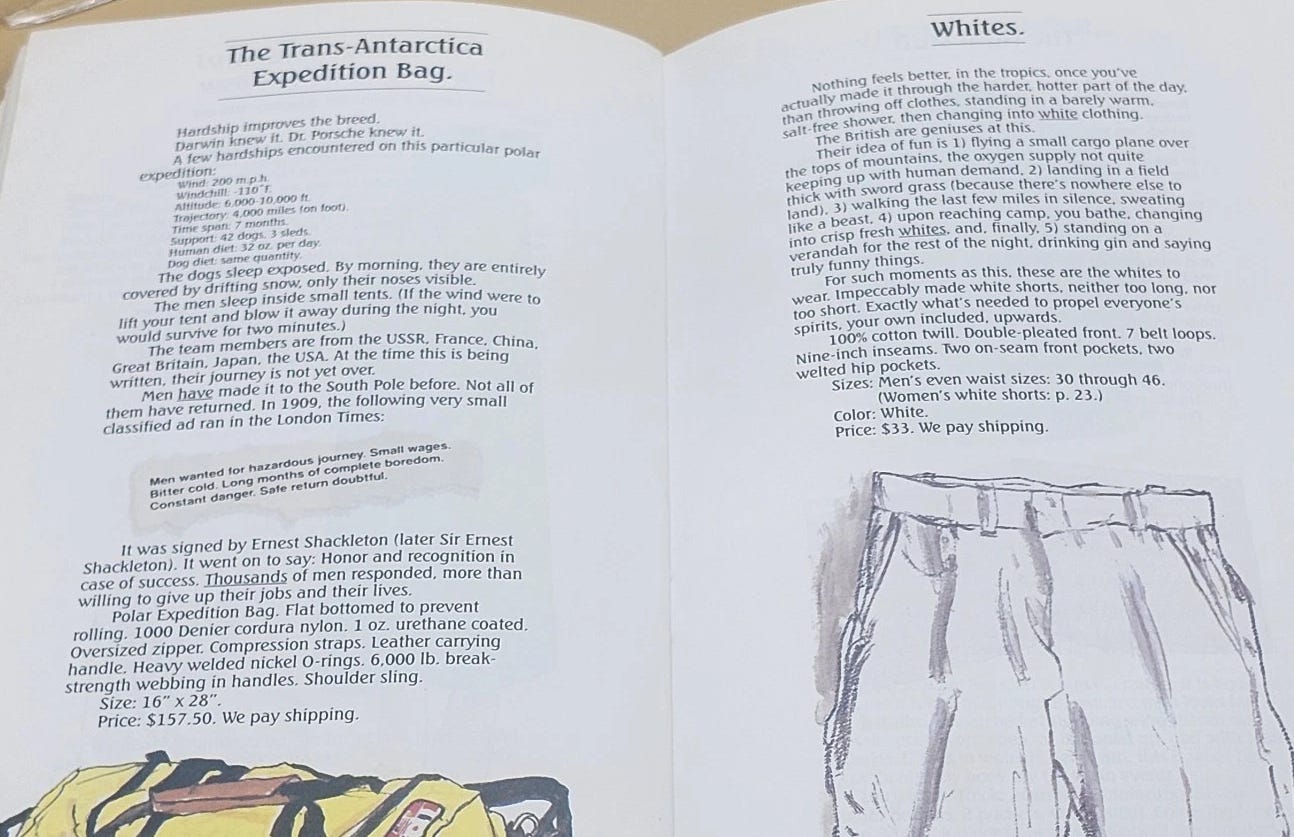
It's likely no surprise that I absolutely love brands that put stories and narrative around their pitches. Along with J Peterman, I used to love getting the old Banana Republic catalogs, back when they kept up their pastiche of faux-yellowed pages, sketches from their 'explorations' and visual sketches of their clothes in use in jungle adventures. Do you have any fond memories of catalogs or brands that you loved paging through because it didn't really feel like 'shopping'? Let’s talk about it in this week’s Shoddy Goods chat.
—Dave (and the rest of Meh)
previous Shoddy Goods stories:
And if you like Shoddy Goods, don’t miss Jason’s new other newsletter, Gnomenclature. Every week he digs into the 178-year-history of Hammacher Schlemmer, America’s oddest retailer. It gets weird!
For me it was Sharper Image. I am a gadget freak and for a time they dominated that space both through their catalog and brick and mortar. Alas, the Internet has changed a lot of things, including them.
I really liked this piece. I also have a writing job that I have to explain to people constantly - but unlike Seinfeld, our biggest media representation was fucking Dilbert (Tina the technical writer).
I don’t know what else I wanted to say. I fought with my phone and made a substack account though because it made me sentimental and curious about a man I didn’t know existed, a career I also didn’t know existed*, in an era I wasn’t alive for. It’s also the only time I’ve ever read a whole article that was sent to me on a mailing list.
I agree with him on the topic of images, too. It’s better for us to use diagrams than screenshots. Screenshots can come out looking awful or dated. Even if a sketch is also dated, it has a better chance of being a style choice than just “this is a picture taken on April 9, 2029”.
*But now that you’ve written it down, of course that career exists.