

Hey, Jason Toon here. Dinosaurs are all well and good, but I’m more of a prehistoric mammal fan. In this edition of Shoddy Goods, the newsletter from Meh about consumer culture, we meet an Arctic animal who’s been basically unchanged for tens of thousands of years - and the people using gentle husbandry to keep these animals thriving.
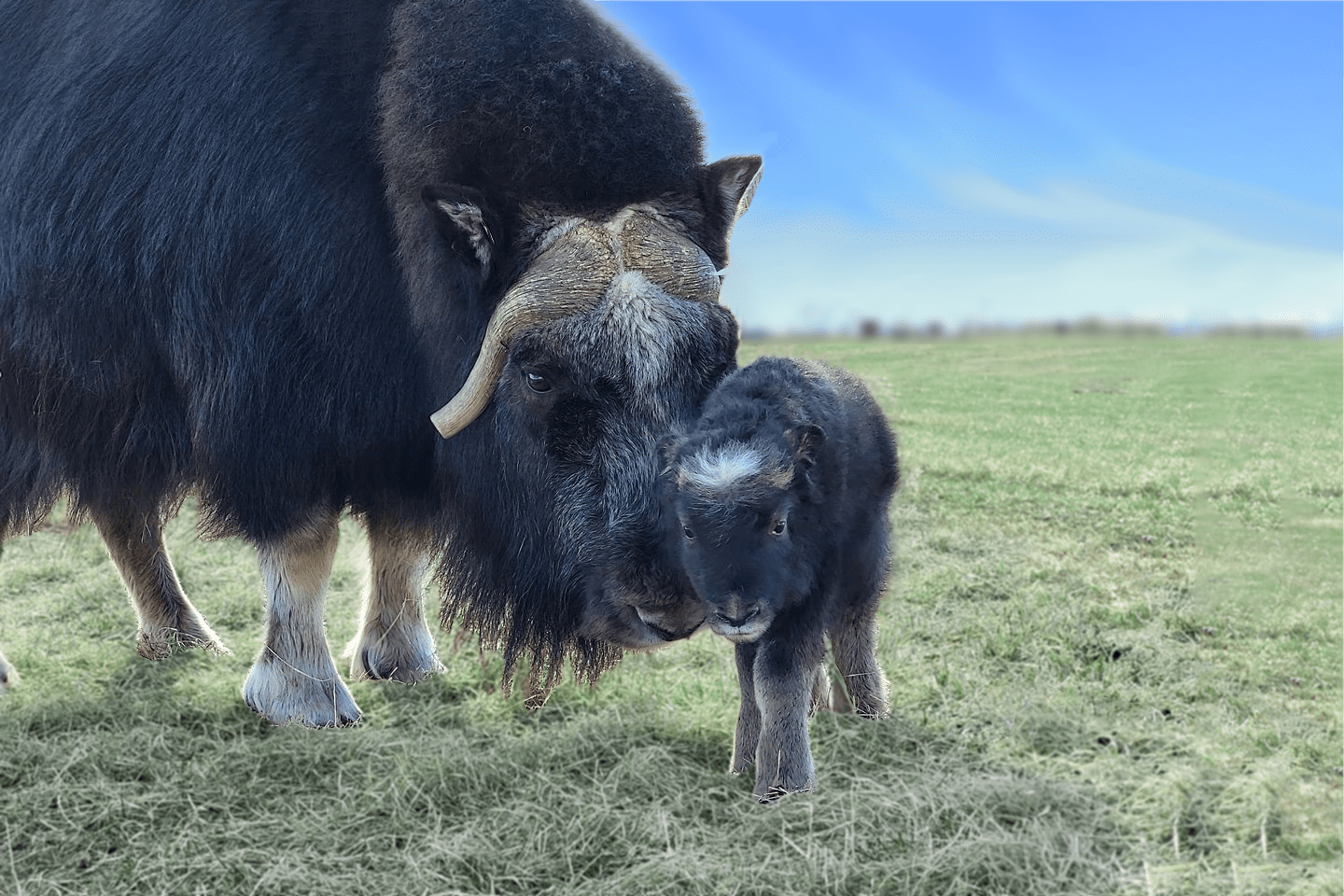
It’s one-eighth as fine as the finest human hair, finer than the richest cashmere. An ounce of its yarn is worth twice its weight in silver. The only animal who produces it lives exclusively in Arctic or near-Arctic latitudes, and it can only be collected from a living animal by combing a couple of months out of the year. “It’s just the softest thing you’ll ever touch,” says Mark Austin of Palmer, Alaska.
It’s qiviut, the fiber from the undercoat of the musk ox. Austin has been Executive Director of Musk Ox Farm since 2010, overseeing a herd of these woolly, willful Ice Age survivors and the annual combing that yields qiviut. (How do you pronounce qiviut? Austin suggests the rhyming mnemonic “give a hoot about qiviut.”)
Musk Ox Farm is the legacy of a 70-year experiment in domestication, launched by one guy with a vision, and the audacity and tenacity to carry out.
“A huge crazy concept”
Born in New York City in 1921, John J. Teal, Jr. earned a BA in anthropology from Harvard and a Master’s in international relations from Yale. After serving as a bomber pilot captain in World War II, he went to live with the Sámi people (formerly, and offensively, known to English speakers as “the Lapps”) of northern Norway, to study their systems of reindeer husbandry.
At some point during his three years with the Sámi, Teal started thinking about how domesticating another animal might be the key not only to economic survival for the indigenous people of Arctic North America, but to its own survival: the then-endangered musk ox.
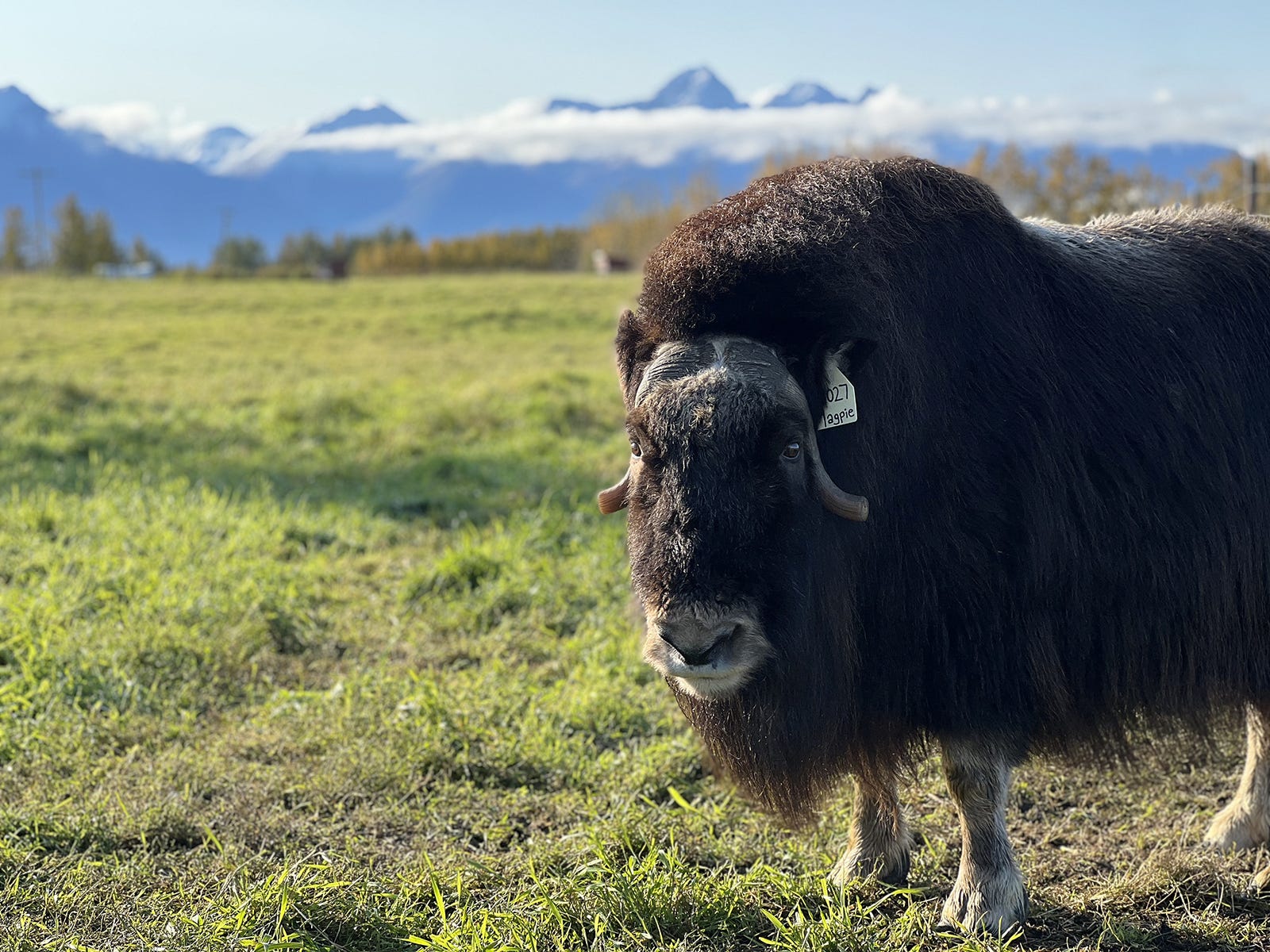
“What he was recognizing was that a lot of indigenous people who are living in these rural remote areas were coming into this relatively new world where they had incredible wealth and abundance of food and culture and tradition,” Austin says. “What they didn’t have, and to this day still can be a challenge, is it’s very hard to find cash dollars in these isolated communities.”
Musk oxen and their predecessors had once roamed as far south as Mexico and the Mediterranean. But by 1954, their range was reduced to the most remote parts of northern Canada and Greenland. Even in Alaska, the musk ox had only recently been introduced after being wiped out around 1900.
Teal saw musk ox as a potentially lucrative source of milk, meat, and wool. He was far from the first confident adventurer to look at a wild animal and think, hey, let’s build a farm around these guys. Ill-fated attempts to domesticate zebras, hippos, and moose, among many others, had come to nothing.
“For him to decide that you’re going to get this geographically appropriate animal into agriculture to benefit people was a huge crazy concept,” Austin says. “But he did it.”
“Bearded one”
Teal’s plan was covered by Time before he’d so much as fenced in a single musk ox. The magazine sounded skeptically amused by his idea of capturing some juvenile musk oxen from Canada and raising them on a farm in Vermont. “[Musk ox] will not be a common sight in Vermont for some time,” the piece ran. “This is probably just as well.”
Doubts aside, Teal did indeed start the Musk Ox Project in Vermont. His original handful of animals successfully bred in captivity and grew. Less successful were Teal’s exploration of dairy production: musk ox just aren’t amenable to being milked. “I’m one of the very few people on this planet that’s ever milked a musk ox,” Austin says, “and let me tell you, it’s no easy thing to do.”
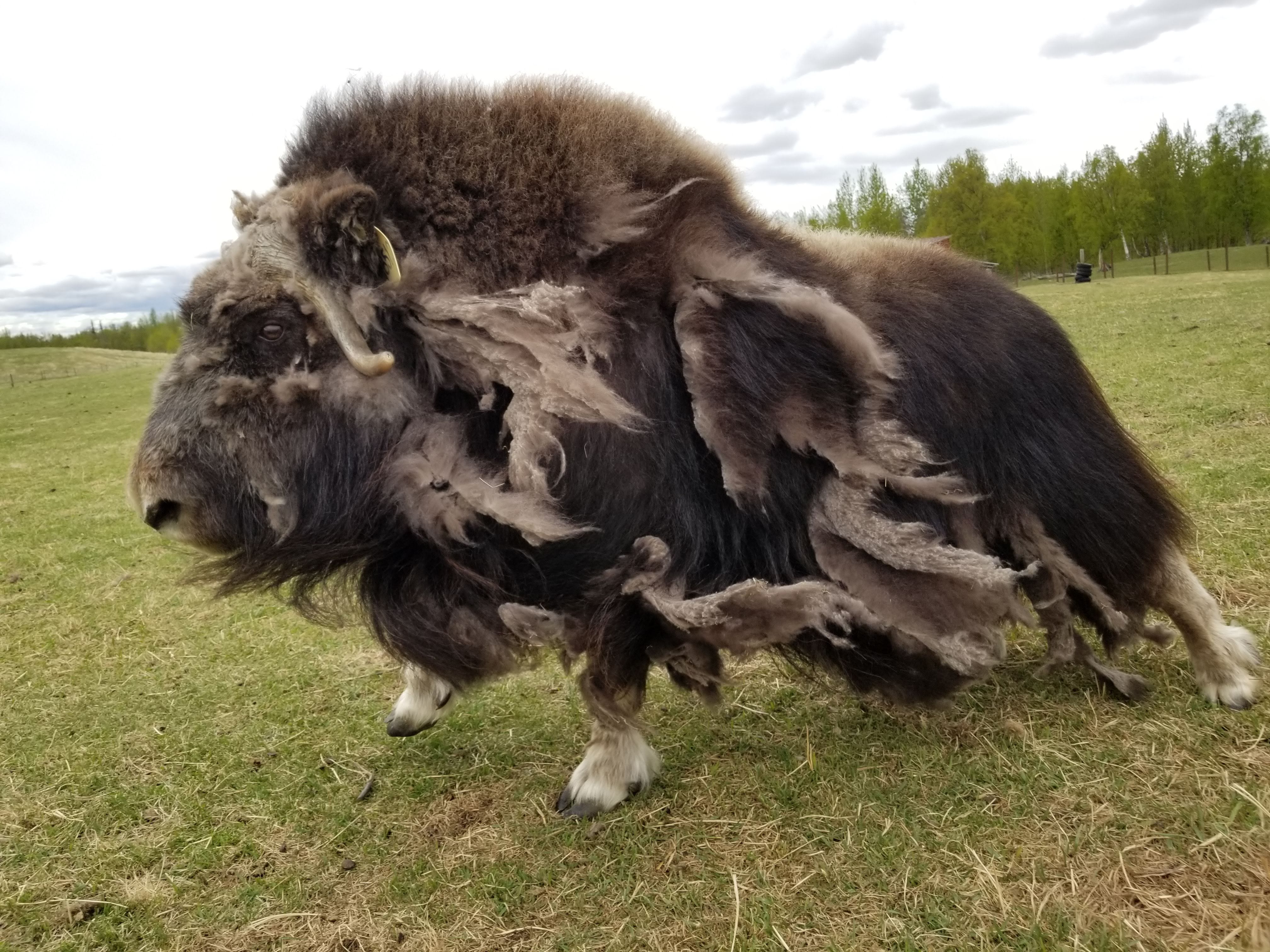
But their woolly undercoat turned out to be a remarkably high-quality fiber. Its zig-zag shape traps a lot of air when it’s woven together, making it one of nature’s most insulating fibers. Also unlike sheep wool, qiviut can be combed off during the April-May shedding season, and has a naturally smooth surface, so it doesn’t have the sharp edges or tiny snags that make sheep wool itchy. After a decade in Vermont, Teal knew he had something there.
It was time to head for the real frozen north and start working with the local communities, and the local musk oxen. In 1964, the Project started a new herd in Alaska, and by 1969 had helped found the Oomingmak Musk Ox Producers Coooperative as an umbrella organization to produce and market the qiviut knits crafted by Alaska Native women. “Oomingmak” is the Inupiaq word for musk ox, which translates to “bearded one”. (By the way, the once near-extinct musk oxen are now considered of “Least concern”, a conservation success story.)
“I’m sure that we can all look back and find fault in the big white guy walking in and telling people what they should do,” Austin says. “But honestly, in the era that he was doing it, he did it in a remarkably sensitive way and tried to get the populations that were living there to embrace, engage, and really take ownership of it from the beginning. I think he was ahead of his time.”
Teal died in 1982, a couple of years before Musk Ox Farm found its current home and incorporated as a nonprofit. Qiviut had proven to be his dream’s lush, crimpy lifeline.
“They’re not going to run away”
“Qiviut is obviously one of the rarest natural fibers,” Austin says. “It’s one of the warmest natural fibers. Also because it’s so fine, it’s one of the softest natural fibers. Between its softness and its fineness and its rarity, it’s very valuable. And so we are blessed as a nonprofit to largely be an earned income nonprofit. We don’t do a whole lot of begging for money.”
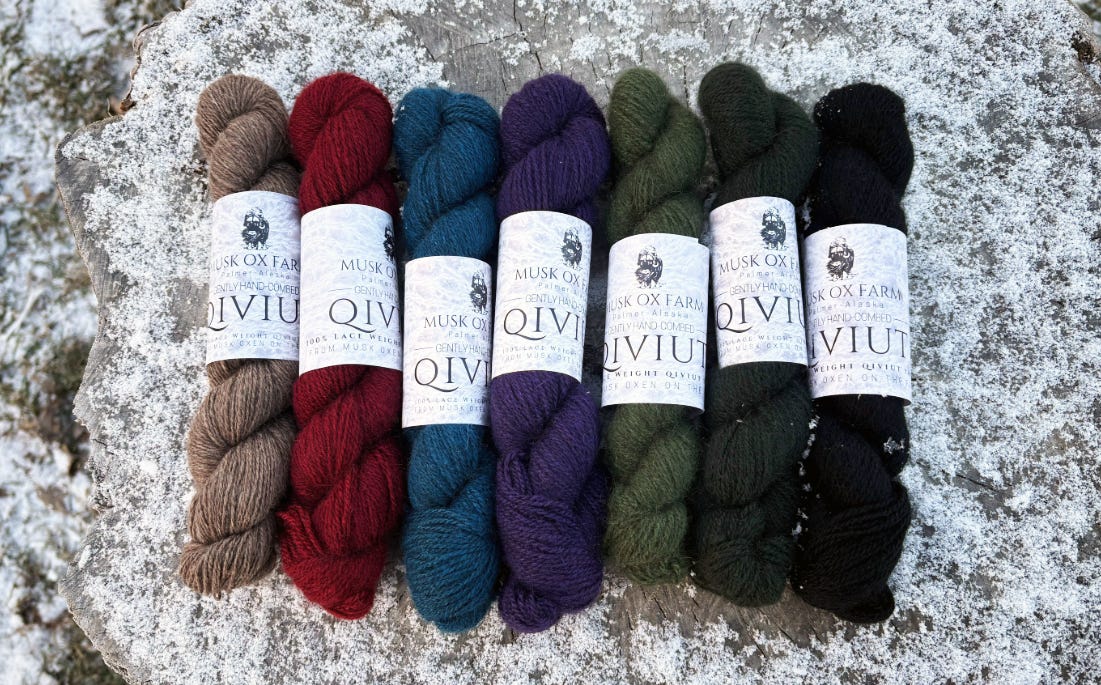
Not that it’s always been smooth sailing. “We’ve gone through good and bad years,” he says. “We were almost shut down in at the end of the ‘00’s, and had kind of a big reckoning to rebuild. And that’s been a very successful endeavor. The animals are living longer than we’ve ever had them live before, the healthiest, happiest animals, a great staff that’s taking care of these guys.”
As extraordinary as qiviut is, the animals themselves are what make Musk Ox Farm remarkable. Austin characterizes their demeanor as laid-back but no pushover. “These guys are a bunch of veg-heads,” he says. “They’re not out to get you. But they live in an environment in the wild where there’s no place to hide. They’re going to confront anything. They’re not going to run away from a wolf or a bear, ‘cause once they do, they expose all the soft spots. So they put the head and the shoulders and the horns up front and they’re like, all right, well, let’s do this if we’re going to do it.”
The staff of Musk Ox Farm know who the stars of the show are. An appreciative audience gets to know the 77 members of the herd through the Farm’s social media feeds and personality profiles on the website.
Every musk ox is up for virtual adoption, and the lucky few who can make the trek to Alaska can take daily tours. But Austin’s quick to emphasize that Musk Ox Farm is “not a petting zoo. We never will be. It’s not our goal. We work hard for them to become musk oxen.”
This brings up the question of whether the herd at Musk Ox Farm is really domesticated or not. “I think that the short answer one would have to say is no,” he says. “We’re a bunch of, you know, warm fuzzy bunny huggers here who put the animals first. It’s all about their comfort.”
Austin concedes that domestication is not a simple black or white question, but also a bit beside the point. “We stopped with that concept. It could be hundreds of years, it could be a thousand years before we see musk oxen with floppy ears and spots, you know, two hallmarks of domesticated animals.” The point at Musk Ox Farm, he says, is to give the animals space to be who they are.
“They spend the first several months [of their lives] learning to be a musk ox. We want them to behave like a musk ox. We want them to be a musk ox.”
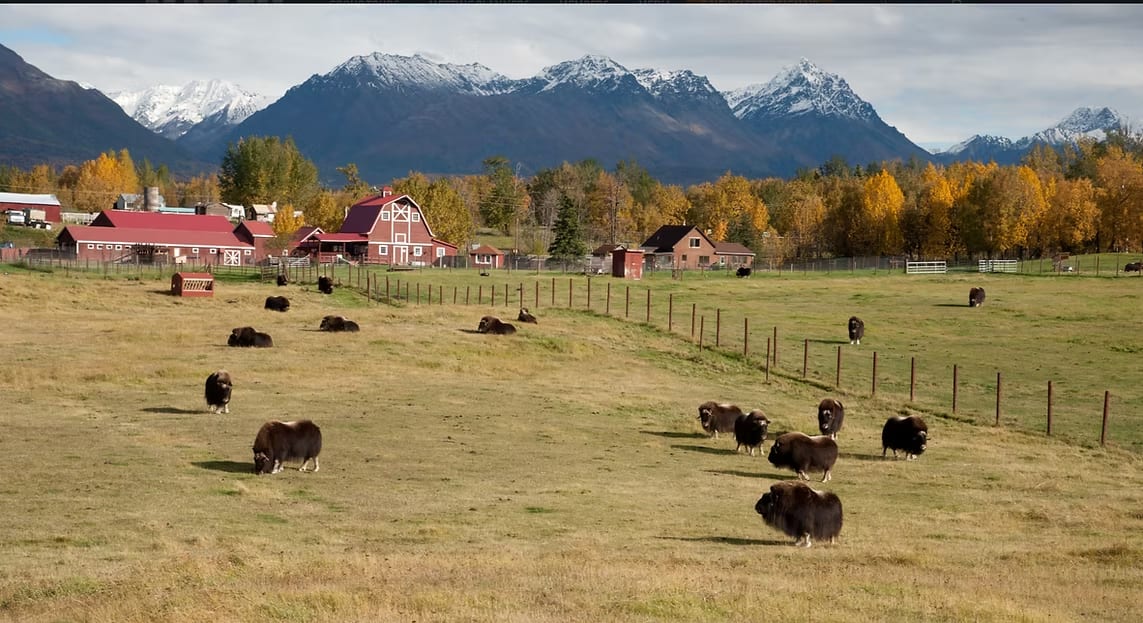
Thanks to Musk Ox Farm for the photos!
If you could magically domesticate one animal, what would it be? I suppose there's 'practical' answers that would get you the most material output, whether that's fur or milk or meat or whathaveyou, but I think I'd go for the fun or cute pet angle. Like, if it was 100% domesticated in some friendly, uncruel, totally good way, I'd like a pet fennec fox. (No one should have a pet fennec fox, to be clear.) How about you, what animal would you pick to magically domesticate? Let's hear about it in this week's Shoddy Goods chat.
—Dave (and the rest of Meh)
We’re committed to keeping these previous Shoddy Goods stories wild, too: