

Jason Toon here with another Shoddy Goods, the newsletter from Meh about consumer culture. This story brings together one of my favorite animals with one of my favorite foods.
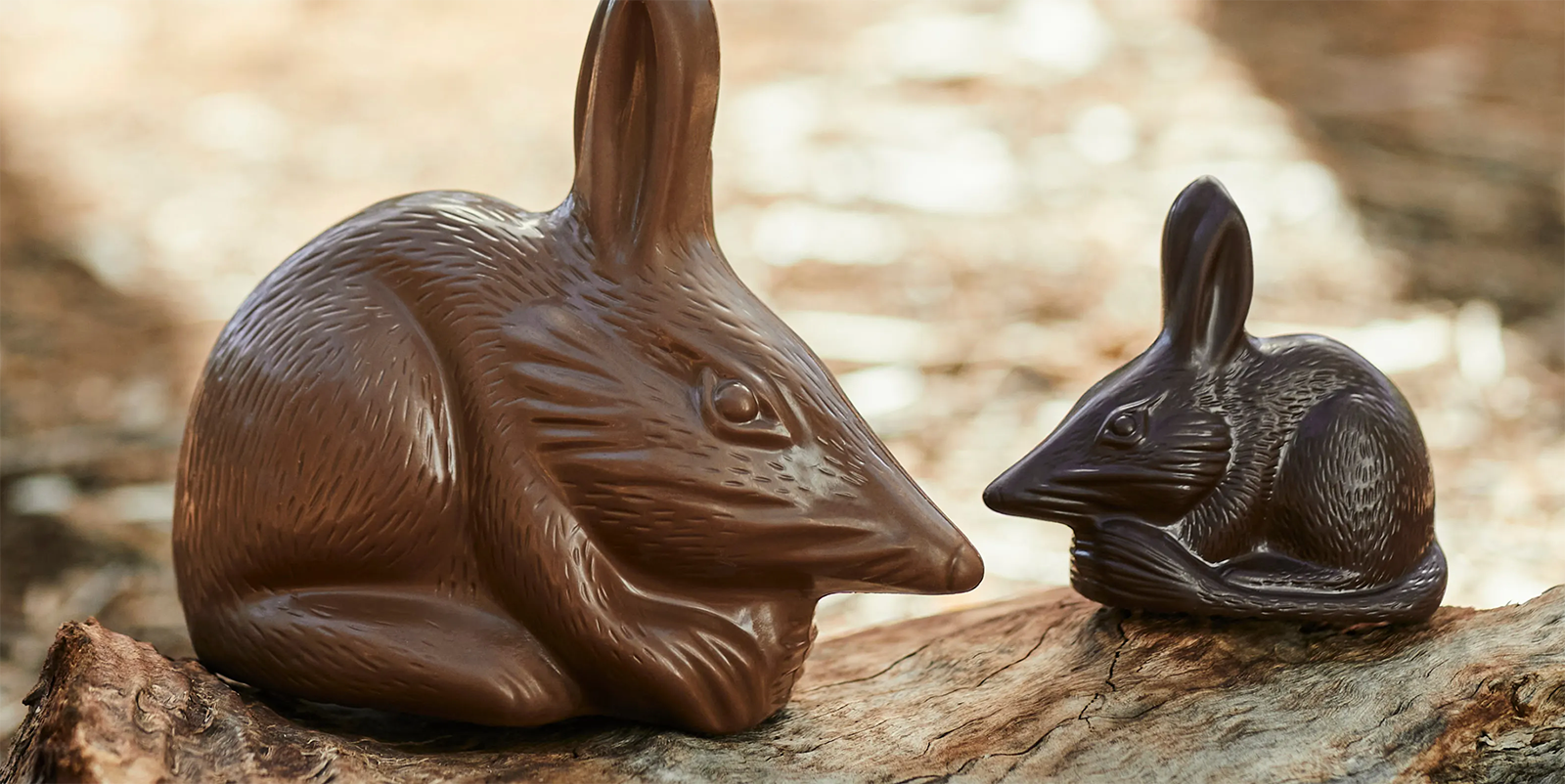
As an American living in Australia, holidays are when I’m reminded that I’m not in the Northern Hemisphere anymore. The transplanted holiday iconography drives the point home. Christmas decorations still sport fake snow even when it’s 90F outside. Halloween pumpkins in the springtime make about as much sense as Easter flowers during fall.
The most notorious transplant is the biggest Easter icon of all: the rabbit. One hemisphere’s symbol of fertility is another hemisphere’s environmental catastrophe, with feral rabbits remaining the most widespread and destructive introduced pest in Australia.
So for the last few decades, conservationists have backed a local contender for the Easter throne: the bilby, a long-eared desert-dweller with impeccable Aussie credentials. And they’ve managed to turn that cultural campaign into real-life protection for this charmingly weird and highly vulnerable marsupial.
Bunnies vs. bilbies
To the American eye, Australia’s full of animals that look like Star Wars creatures, but none more than the bilby. Its long ears are rabbit-ish, but pointy; so is its snout. Stout forelimbs help it burrow into the desert soils, and its tail is almost as long as its body, for swatting away the relentless Australian flies. They’re bigger than I expected, too: males are about the size of a house cat, but chunkier.
It looks a little bit rabbit, a little bit aardvark, a little bit kangaroo, and a little bit rat - but comparisons miss the point. It’s all bilby.
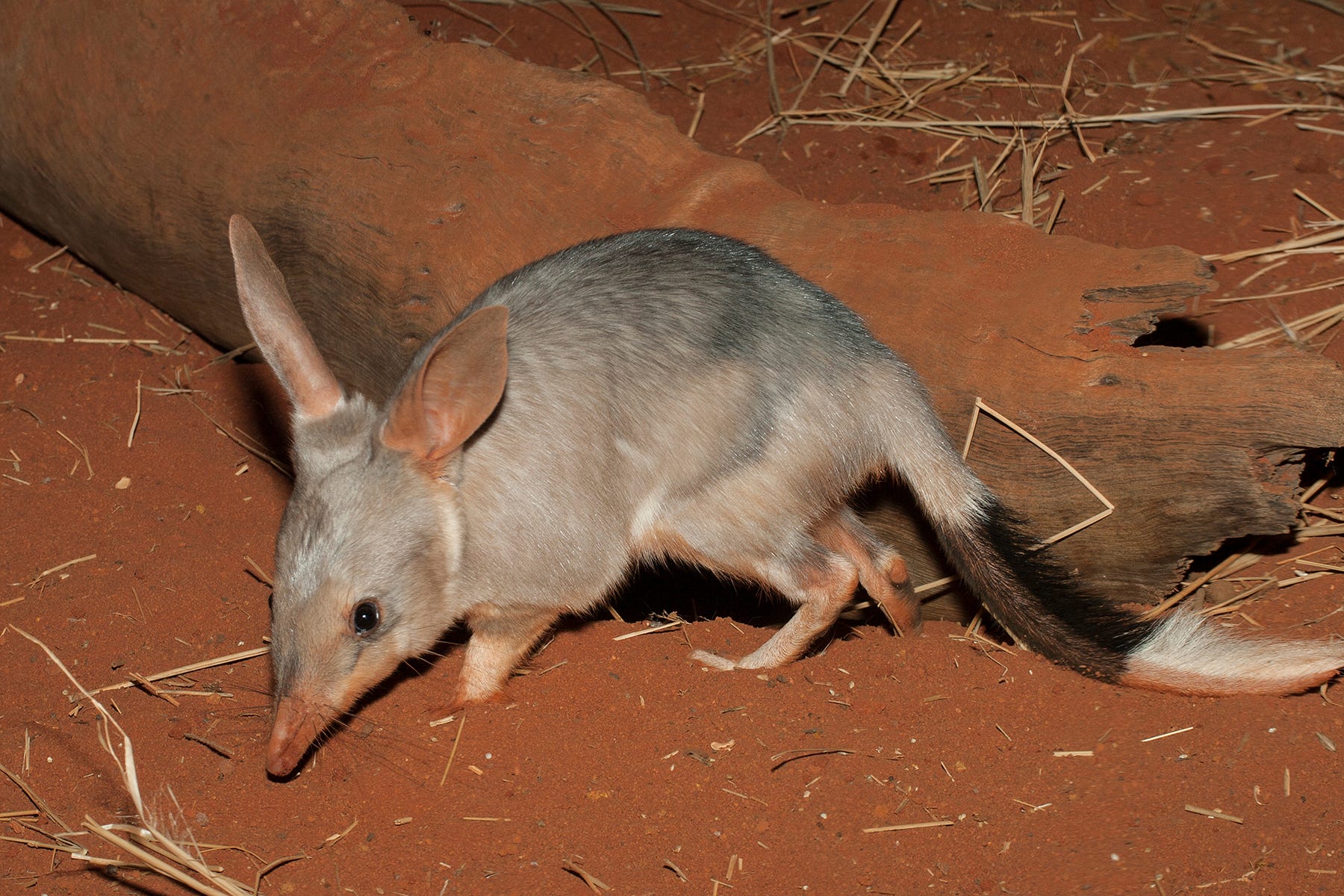
If you’ve fallen in love and want to jump on a plane for some bilby tourism, you’ll probably need tickets to a zoo. Bilbies not only live in the remote Outback, they’re extremely reclusive, staying in their underground burrows by day and only emerging at night. And, with no natural predators, that’s how it stayed for tens of thousands of years, with millions of bilbies spread across 70% of the continent.
Then came European settlement, bringing with it not just people but animals. Foxes, rats, and feral cats preyed on defenseless bilbies. Livestock took over vast tracts of their habitats. But rabbits were by far their worst enemy. A colonist named Thomas Austin had 24 rabbits shipped over from England in 1859 and set them free to roam on his estate, to remind him of home. Today Australian feral rabbits number some 200 million, almost all genetically descended from those original two dozen.
They haven’t been considerate guests. Rabbit overgrazing and crop damage costs the country’s economy $200 million a year, contributes to ecosystem collapse, and puts pressure on vulnerable native animals. Alas, rabbits are wonders of adaptability, evading every attempt to control the population. Their famous fecundity is hard to beat: where a fertile bilby might have eight offspring a year, rabbits can give birth to 40 or 50 bunnies.
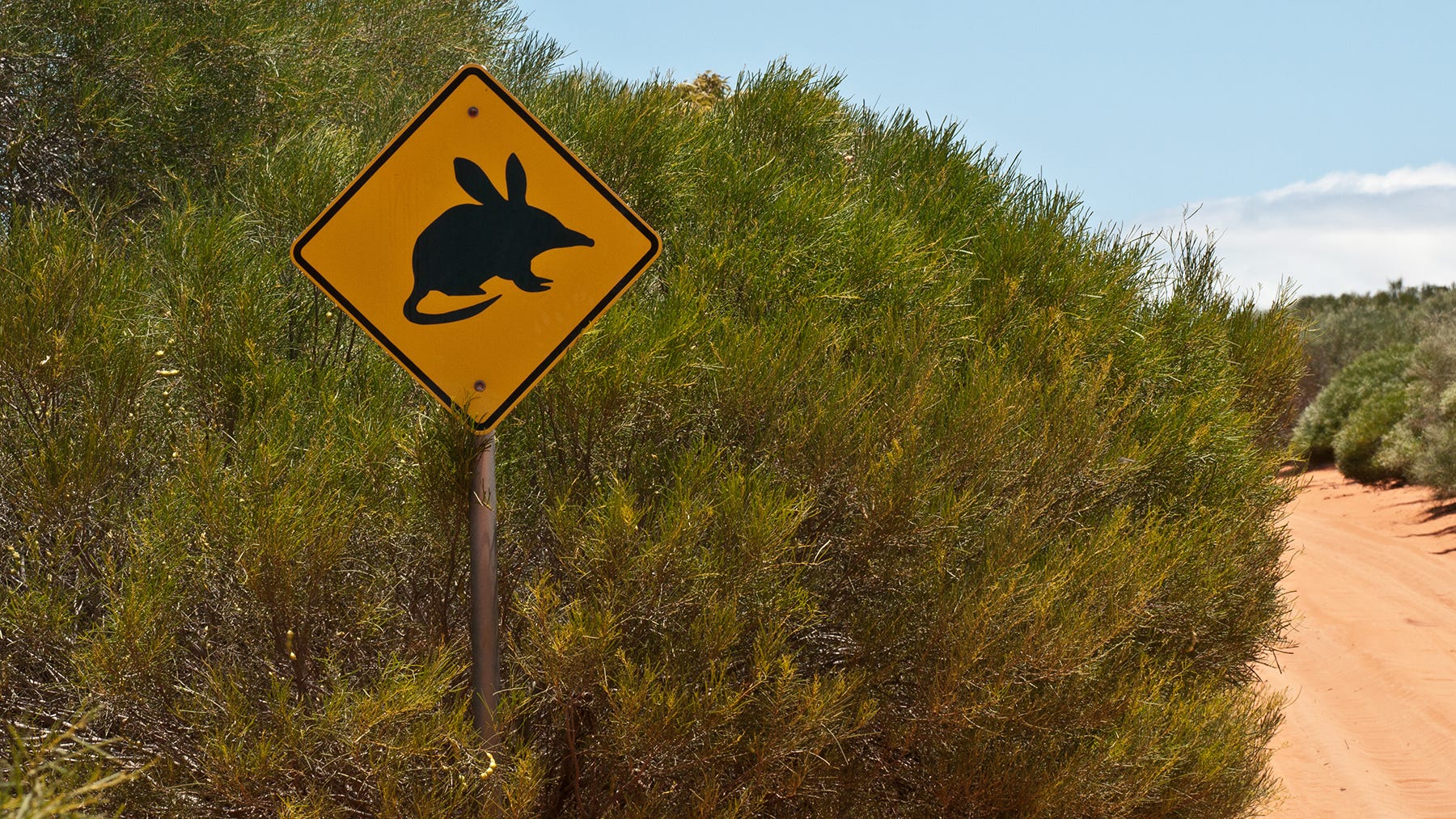
All of these pressures mean the bilby is now officially classified as vulnerable nationally and critically endangered in some states. Its range is down to just 15% of the country, and estimates of the wild population are under 10,000.
The Easter Bilby
Easter’s a big deal in Australia; it’s the most important holiday outside the Christmas/New Year season. Both Good Friday and Easter Monday are public holidays, and everybody looks forward to the four-day weekend. But for the Anti-Rabbit Research Foundation of Australia (ARRFA), Easter was a painful reminder of the damage these cottontailed vandals wreak on Australian ecosystems. So in 1991, they launched a campaign to make the bilby the symbol of Australian Easter, sort of the Easter Bunny’s regional manager.
One form this took was legislative. “An environmental menace… [is] revered by children as a cute and cuddly animal while Australia’s own cute and cuddy bilby [is] a threatened species,” said Australian Senator Dan Coulter in 1992, after introducing a bill that would make the Easter Bilby’s status official. It never passed, but even if it had, the ARRFA knew that laws were no match for chocolate. So they started talking to candy companies about making chocolate bilbies - and maybe putting a bit of the proceeds toward saving the bilbies.
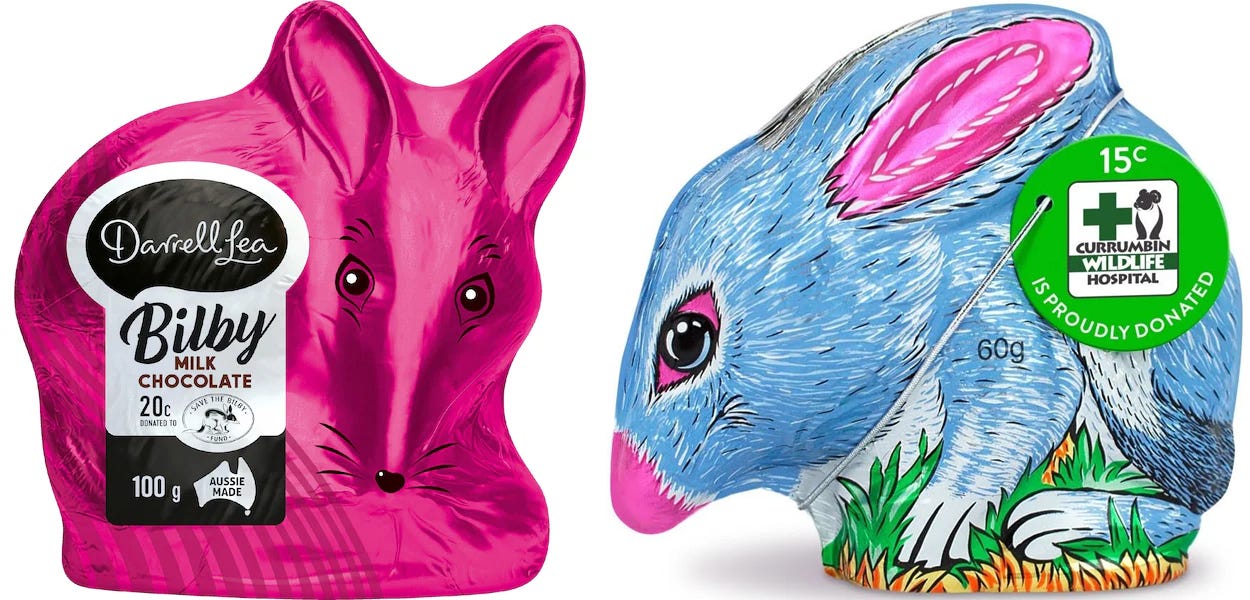
The first known chocolate bilbies were made by Melba’s Chocolates in South Australia in 1992. The idea was quickly taken up by local chocolatiers around the country, but the mass-market companies were skeptical, at first. “The Easter Bunny is at the heart of Easter and he’s there to stay,” said a spokesman for Cadbury, the biggest chocolate producer in Australia, in 1999. But even Cadbury eventually got with the program for a while.
Somewhere beyond 1 million chocolate bilbies have been sold since, directly raising substantial money for the likes of the Save the Bilby Fund and Rabbit-Free Australia (the former ARRFA, who own the “Easter Bilby” trademark). Maybe more importantly, this shy, utterly unique animal is now known and valued by millions of Australians who will never see one in the wild.
There’s some reason for optimism. Conservation efforts are reintroducing bilbies into areas where they haven’t been seen wild in decades, and annual censuses have shown bilby population increases for five straight years. Even as corporate backing wavers - Cadbury stopped making chocolate bilbies in 2019, and Darrell Lea only started again in 2022 after an eight-year hiatus - independent chocolatiers still treat the chocolate bilby as a prestige Easter item.
At this point, the very success of the Bilbies Not Bunnies ethos means the bilby doesn’t need chocolate anymore to maintain its place of honor among Australian wildlife. But of course, it doesn’t hurt.
I loved getting chocolate bunnies for Easter but pretty quickly realized even as a kid that the chocolate is usually the worst, waxiest kind, somehow not even worth finishing as a ravenous sugar-fueled kid. Still, I’ve got enough fondness for the memories that I get ‘em for my kid - though I at least try to find a step up from the checkout lane drek. Now I really want to get my kid a chocolate bilby, just to freak him out. What treats do you most fondly remember from the various holidays and occasions you celebrated as a kid? Let’s hear about ‘em in this week’s Shoddy Goods chat.
—Dave (and the rest of Meh)
These old Shoddy Goods stories are guaranteed not to run wild all over your country and eat up all your crops: