

Hey hey, Jason Toon here with a new Shoddy Goods, the newsletter from Meh about consumer culture. There sure are a lot of vegetarian meat substitutes out there these days - but remember, trends are cyclical…
The early 1990s was not an easy time to be a vegetarian in America. It wasn’t just that there weren’t as many choices - it’s that it was hard to even figure out what your choices were. Whole articles in vegan ‘zines would be dedicated to breaking down what to look out for in food ingredient lists, and many a personal favorite food had to be sacrificed because of what seemed like capricious inclusions of gelatin or anchovy paste.
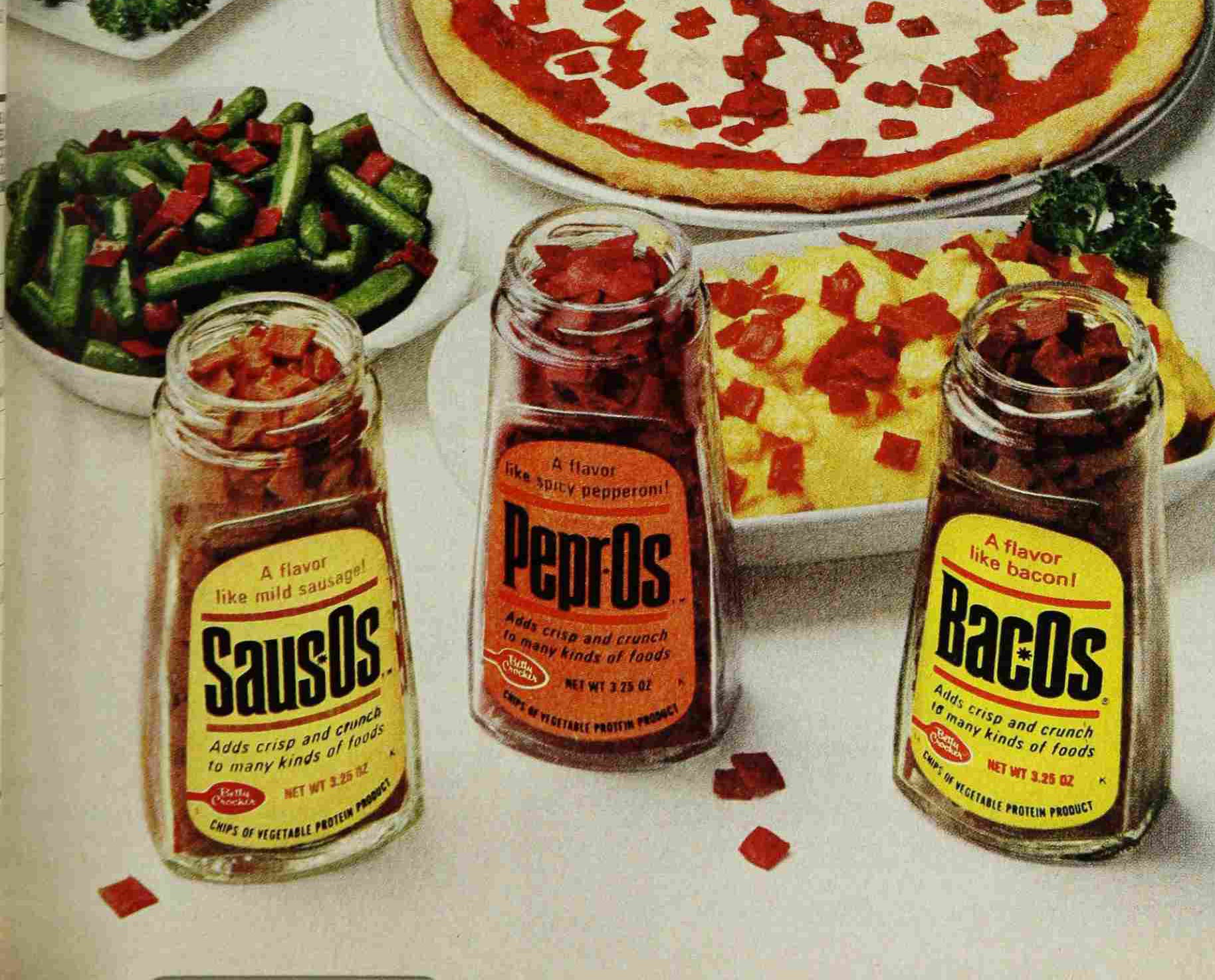
But when that same arbitrariness worked in your favor - when some random supermarket staple turned out to be accidentally vegetarian - the clouds parted. The most life-changing example of this, for me, was that Bac-Os, and other imitation bacon bits like Bac’n Pieces, were vegetarian. Oh, the veggie BLTs we had! Little did I know that they were the last survivor of what we can call the first wave of meat substitutes.
“Food of the future”
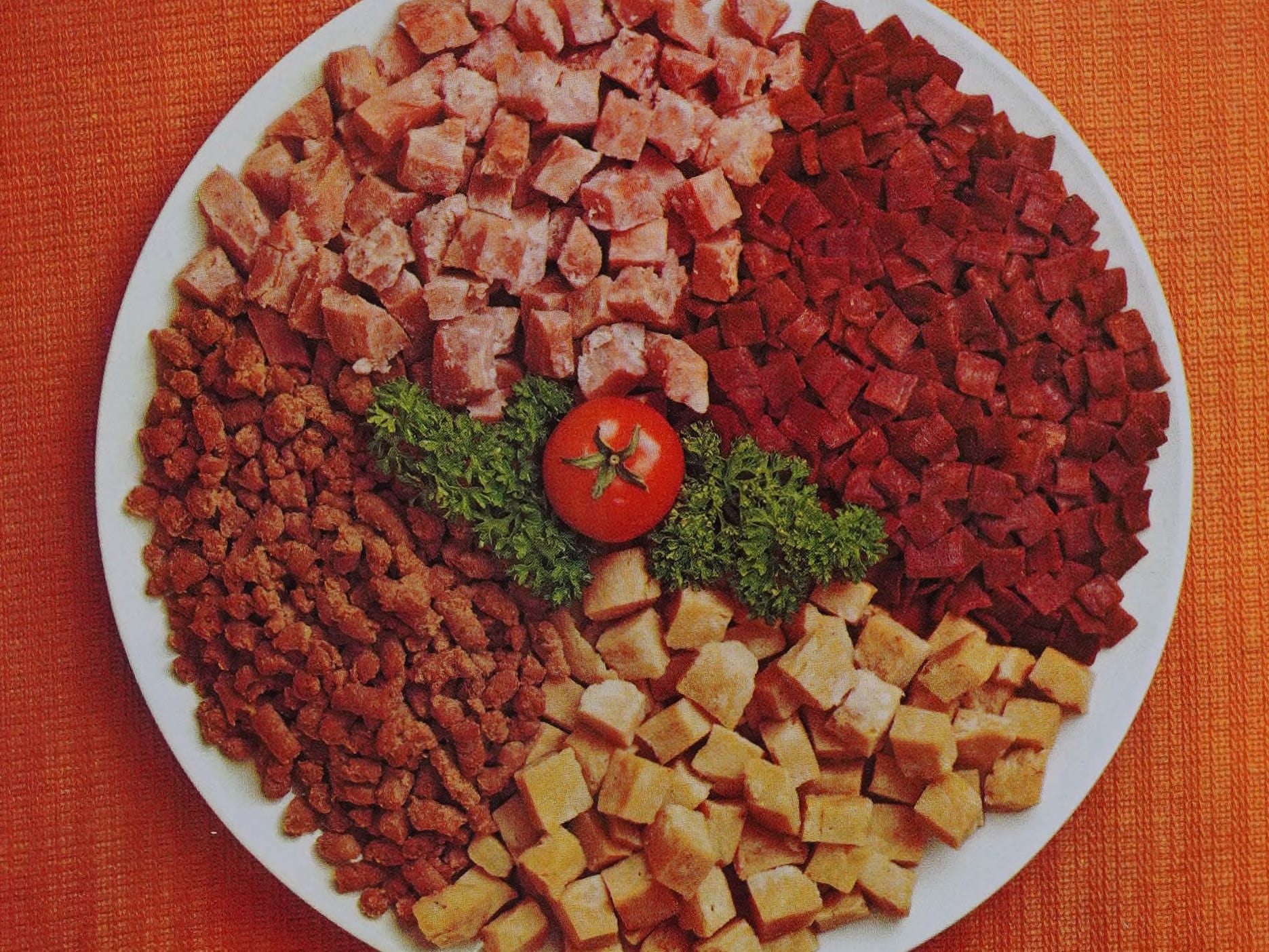
“From a new plant at Cedar Rapids, lowa, BONTRAE textured vegetable protein foods will flow to restaurants, schools, hospitals, food processors and consumers,” enthused the 1970 General Mills annual report. A Betty Crocker magazine ad spelled out exactly what Bontrae was to readers of Woman’s Day and Better Homes and Gardens: “It’s General Mills’ name for a food of the future made with vegetable protein… Today you can buy it in crisp little Bac-Os - a unique product with a flavor like bacon. But some day you may be able to buy Bontrae tasting like chicken or beef or ham (and very much like them nutritionally).”
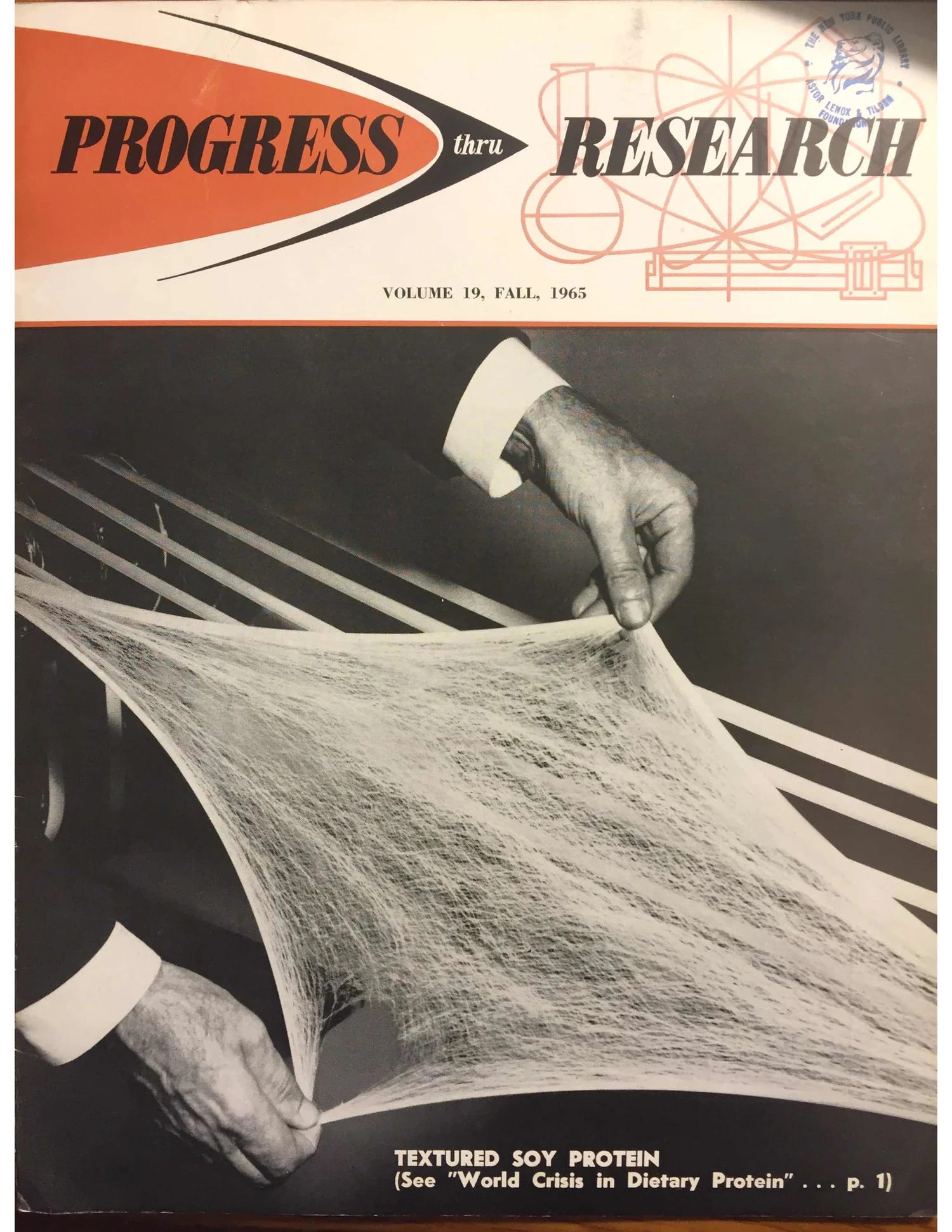
So far, so uninformative. What Bontrae really was was spun soy protein, a kind of textured vegetable protein (TVP) made from, you guessed it, soybeans. Scientists had been exploring how to make fibers out of the leftovers of the soybean oil processing since the 1920s, when Henry Ford thought it had promise as a source of fabric, or plastic, even debuting a soy-plastic car in 1941. But as food scientist Nadia Berenstein explains, it was the catering for that event that really pointed to the future, with the vegetarian Ford laying on a buffet of soy steaks, soy milk, and soybean coffee.
It would be decades before the most obvious drawbacks in soy “meat” were ironed out: the taste and its propensity for causing excessive farting. Then there was the related question of who would eat the stuff. The first commercial imitation meat made from spun soy protein, in the 1950s, was FriChik, a canned chicken substitute marketed to Seventh Day Adventists, whose religious faith required vegetarianism.
But in a booming postwar America with a dozen burgers on every grill, there was about as much demand for vegetarian meat as there was for Bolshevism. Besides, Americans still remembered when soy meal was used as a “meat extender” to bulk up such World War II delicacies as “victory sausages”, and those memories were not fond.
“Picked by a computer”
It would take a convergence of economic, ecological, and health anxieties to make companies like General Mills consider the potential of soy protein. Paul and Anne Ehrlich’s book The Population Bomb was published in 1968, declaring “In the 1970s hundreds of millions of people will starve to death.” Its nightmare scenarios of global famine quickly became conventional wisdom. A less alarmist school of thought, embodied in another bestseller, 1971’s Diet for a Small Planet by Frances Moore Lappé, argued that the planet produced more than enough food to feed everyone; the issue was that too much of it was used to feed animals to produce meat.
Either way, steadily rising meat prices seemed to confirm that the future of food would be increasingly meatless. By 1969, General Mills was ready to meet the trend.
They gave their non-meat the non-name “Bontrae”. General Mills president James MacFarland told the hometown Cedar Rapids Gazette that Bontrae didn’t mean anything in particular: “It was picked by a computer.” More likely, what it meant was that he hoped the meat industry (which General Mills was part of) wouldn’t see it as competition, and consumers wouldn’t associate it with bad memories of victory sausage.
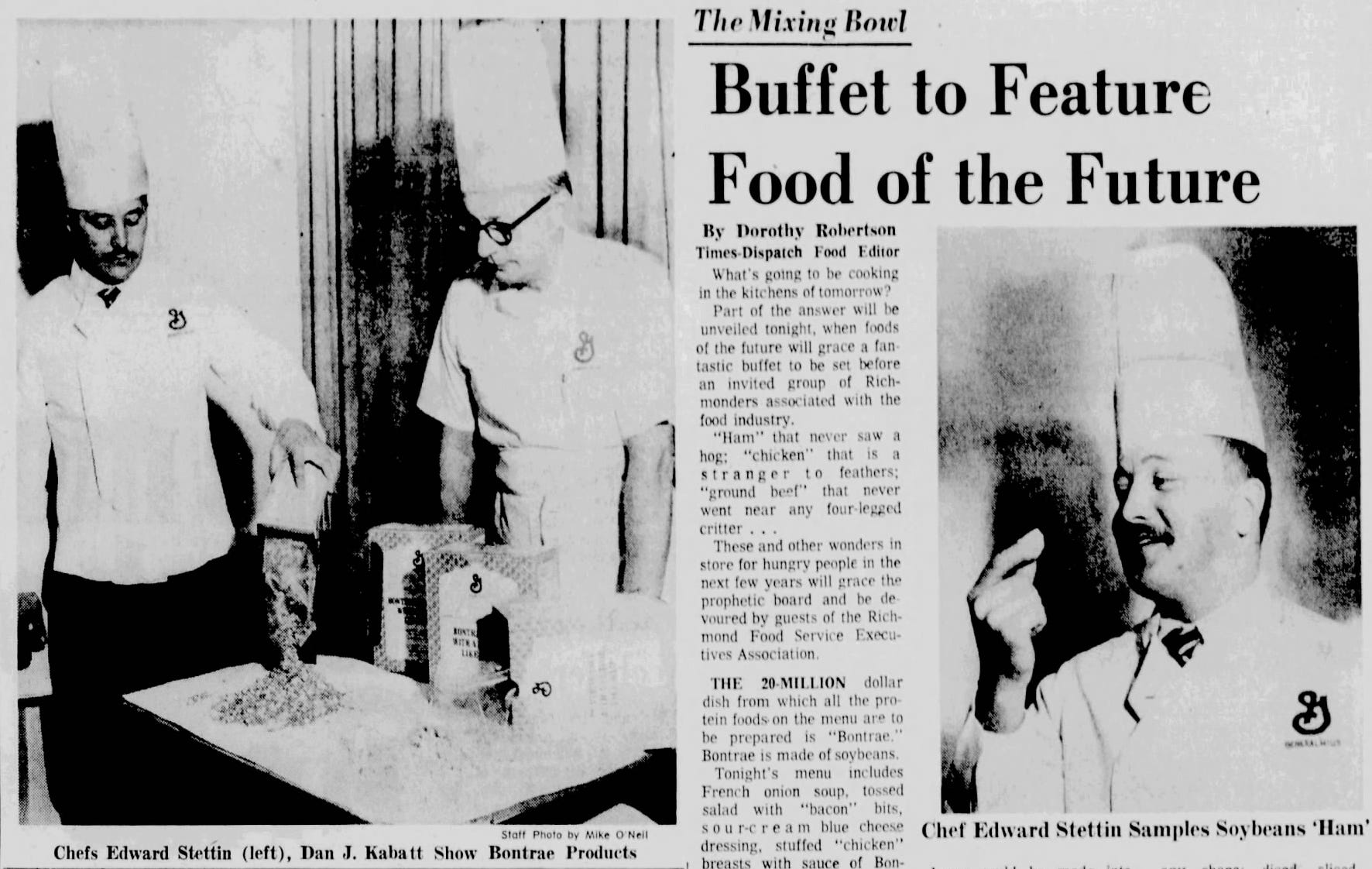
Then they took the “food of the future” on a national coming-out tour of publicity luncheons. The Cedar Rapids event featured such dishes as “a seafood dish called Coquilles Saint Jacques and Bontrea alla Barbara, containing chunks of ham made from soy.” In Richmond, Virginia, General Mills experimental chef Edward Stettin told the Times-Dispatch “General Mills has been experimenting with this for 20 years,” predicting that the “ham”, “chicken” and “meat loaf” served at the event would be in supermarkets within two years.
The bacon bits already were. At first, Bac-Os made no secret of its Bontrae connection. The aforementioned Betty Crocker ad devoted as much space to Bontrae as to Bac-Os themselves. The Bac-Os jar initially bore the description “Crispy Bontrae bits with a flavor like bacon”. The product was clearly meant to introduce the public to this “new kind of food”, as General Mills was hoping the US Department of Agriculture would classify Bontrae, neither flesh nor flora. (Its petition was denied.)
Bacon bits made a lot of sense as the first mass-market Bontrae product. So much of the appeal is in the texture, and neither that nor the smoky flavor was difficult to mimic. It was also an embellishment to another dish, not a main dish itself, so nobody would really be tasting it in isolation. A small jar of shelf-stable Bac-Os was a low-risk purchase for a curious homemaker. Initial sales of Bac-Os were so strong that General Mills introduced Pepr-Os and Saus-Os, spun soy protein takes on pepperoni and sausage chunks. If Bac-Os were any indication, America was hungry for the rest of the Bontrae line.
“Just like the Army”
As you may have noticed, it didn’t work out that way. In 1972, just a little behind Chef Stettin’s prediction, the first Bontrae diced chicken and ham started to appear at butcher counters, after first being rolled out to institutional kitchens at facilities like schools. In many of those cases, Bontrae was used as an additive in meat products, helping bring the phrase “mystery meat” into the vocabulary.
Hopes were high - “you can cut your protein cost by 25 percent and have a food that is lower in bacteria count,” chirped a newspaper advertorial - but sales and reviews were mixed. A Boston Globe reporter was initially fooled into thinking the fake chicken was real turkey before noticing “a potato-like taste.” Some of the University of Massachusetts students he spoke to thought it was OK, but others thought it was “a little powdery” or, in the words of a school administrator, “just like the Army”. Turned out replicating the complex experience of eating fresh meat - the overall flavor, the texture and bite, the way it cooked, everything - was more complicated than mimicking the smoky crunch of bacon bits.
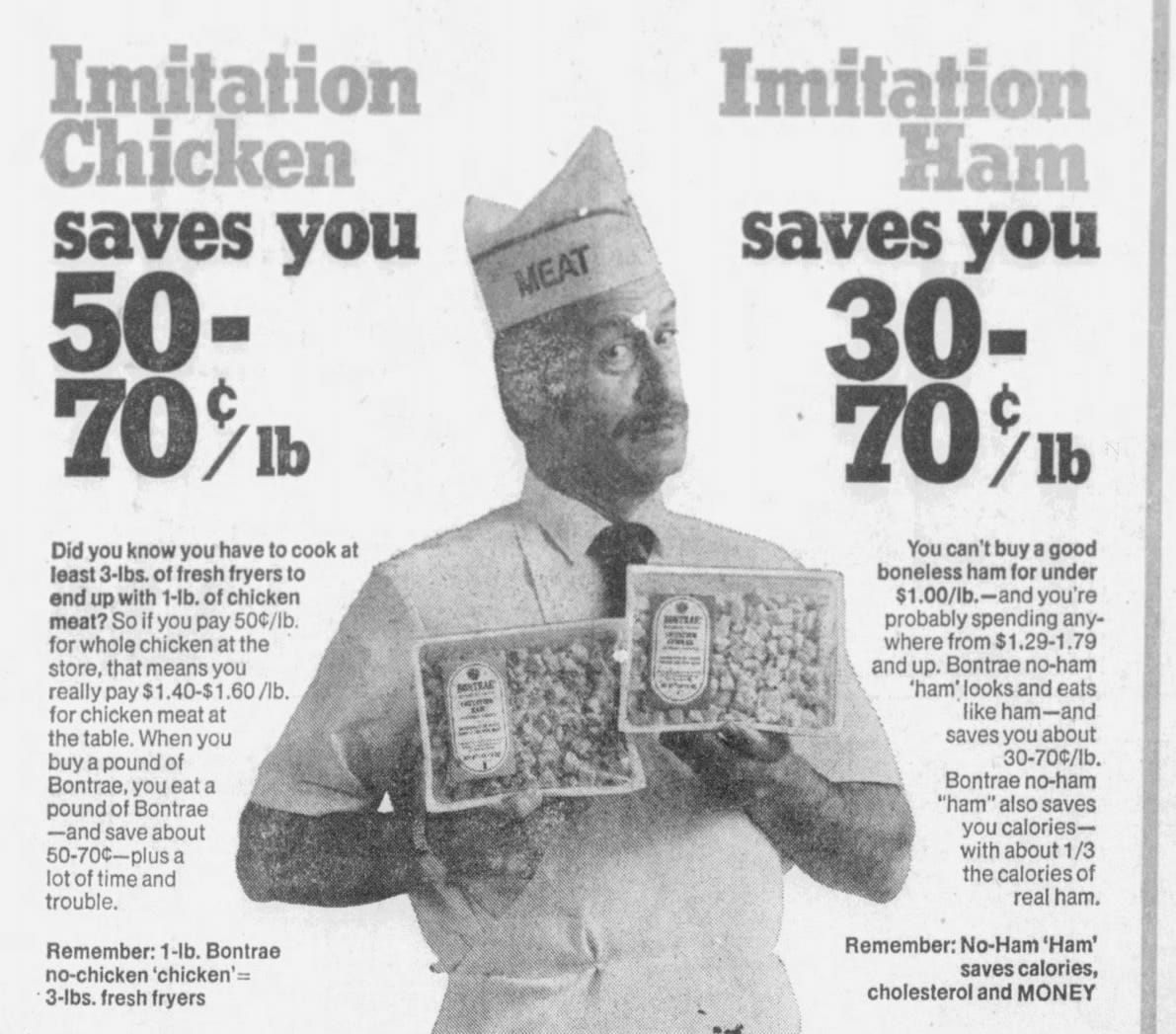
As Bontrae stubbornly refused to fly off the shelves, any mention of the “new food” was quietly removed from Bac-Os packaging and advertising. By 1975 General Mills was running a campaign called “the Bontrae Bribe”, offering customers a $1 rebate on any fresh Bontrae purchase even if the customer hadn’t spent that much to begin with. “Why would we pay you a $1.00 to try our under-a-$1.00 product? Because we think once you sink your teeth into no-chicken ‘chicken’ and no-ham ‘ham’ you’ll be hooked - on saving money, saving time, saving cholesterol - and besides, we’ll bet you can’t taste the difference.”
Like their big investment in Bontrae, that was a bet General Mills would lose. It would take more than a dollar to get 1970s America to swap its meat for sculpted strands of soy protein. As the very title of the industrial-cannibalism dystopia Soylent Green (1973) shows, there was a deep vein of public mistrust toward the idea of futuristic engineered foods. General Mills didn’t do itself any favors by using terms like “textured vegetable protein” and “meat analogs” in the media.
That was Bontrae’s last stand. In 1976 General Mills surrendered and sold the trademark, converting the Cedar Rapids plant to make Wheaties instead. But Bac-Os would remain a staple of home salad bars and vegetarian BLTs until 2016, and imitators continue to this day: the last remnants of an idea that was several decades ahead of its time. My teenage vegetarian self appreciated it.
My habit of scanning the ingredient lists started when my mom said I pick any cereal I wanted, as long as sugar wasn’t in the first two ingredients. It’s absurd how hard that is. But it’s continued on through my vegetarian years and into hunting for food allergy issues. Have you lived blissfully unaware of the ingredients lists on everything in your pantry? Or do you have your own reasons you’re checking those side panels? Let’s hear about ’em in this week’s Shoddy Goods chat.
—Dave (and the rest of Meh)
These previous Shoddy Goods stories contain no more than 30% spun soy protein:
And if you like Shoddy Goods, don’t miss Jason’s new other newsletter, Gnomenclature. Every week he digs into the 178-year-history of Hammacher Schlemmer, America’s oddest retailer. It gets weird!
My mom got into these for a while. (She was a longtime subscriber to "Prevention Magazine" undoubtedly she'd discovered this product there) The 'ham' wasn't half bad, made into ham salad, but as we know from Baco's and the like, some sort of smoked pork flavored product is easier to concoct.
I wouldn't call it "fake meat" these days. A lot of it is imitation meat, some real good and some... not so much. I do remember Bac-Os as a kid. I just ate them right out of the jar. These days my local Mega Mart only carries "Real Bacon" and you can't find Bac-Os anywhere.
I do remember in the 80's trying some "vegetable protein" in the form of a veggie dog and veggie burger... And they were terrible. The flavor was off, the texture was bad, and they didn't smell like something you'd want to eat.
Of course these were marketed as "Healthy"... something I've come to regard as a big red flag. "Healthy" to the food corps means: Minimum amount of sodium, texture like spackling paste, flavor like well chewed wet cardboard. I had a "healthy" breakfast burrito that after taking one bite, threw it away.
Thank god there are people out there making vegetarian and vegan (Two different things mind you.) foods by people who like food and like to eat what they make.