

As someone who (a) likes to eat and (b) is lazy, I’m always up for a salad bar. Jason Toon here with a new Shoddy Goods, the newsletter from Meh about consumer culture, where I discover that the salad bar hasn’t always come with a sneeze guard.
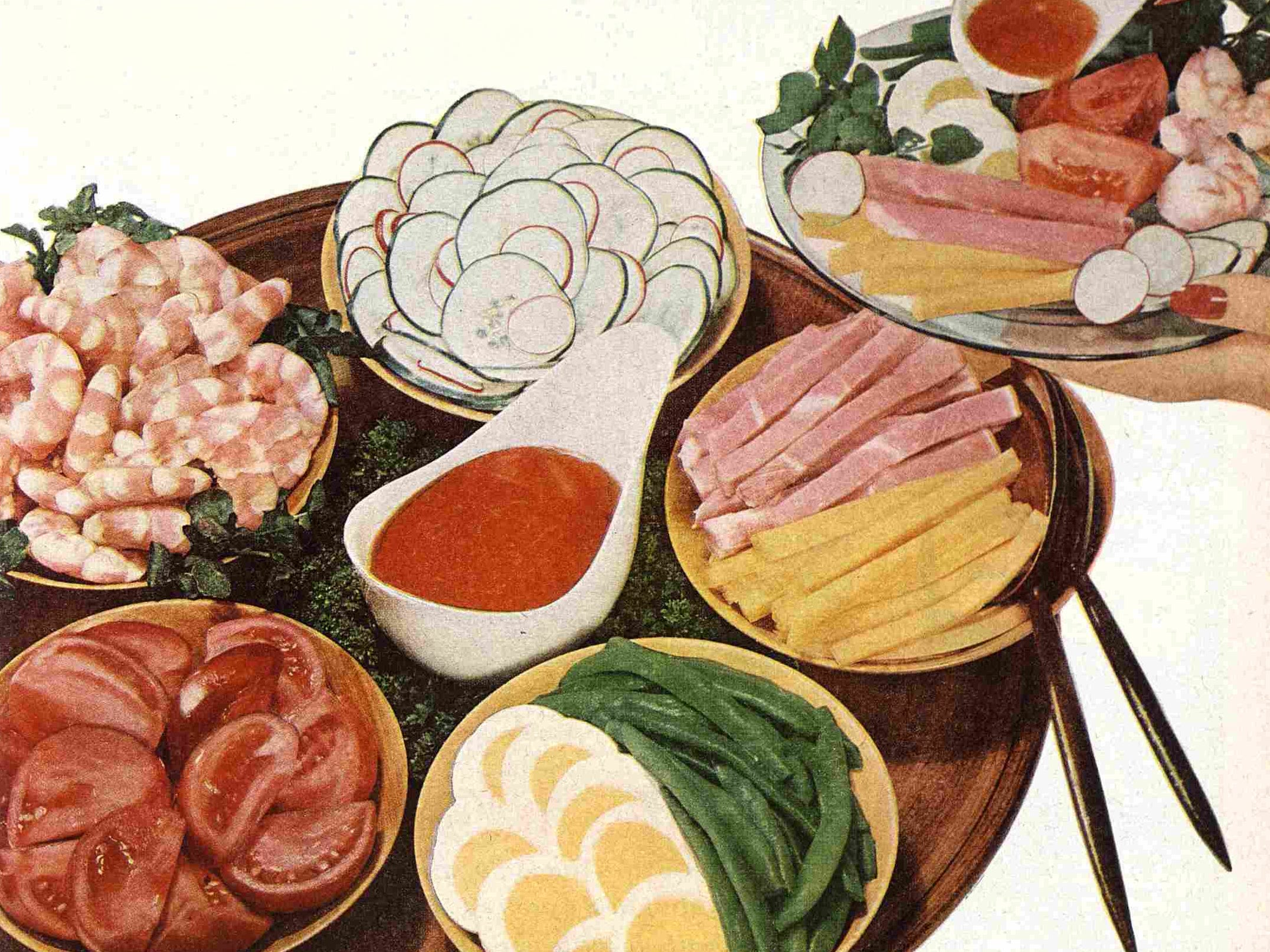
“The women have been at it again!” announced the July 19, 1940 edition of the Daily Press of Newport News, Virginia. “And they’ve solved the problem that’s given many of us desperate qualms and hostess-jitters for a long time. The problem of entertaining a dozen or more people in a modest-sized dining room - without a servant! The women - bless ‘em - have seen fit to invent - and now present - the salad bar!
“Simple? Practical? Of course it is! We said the women invented it, didn’t we?”
Just who invented the salad bar is a point of contention that will never be settled (we’ll come back to that later). But long before it was a fixture from steakhouses to cafeterias to fast-food chains, the salad bar was deployed by home hostesses as an easy, fresh (in more ways than one) way to satisfy guests with diverse tastes - and by ladies’ organizations to socialize and raise funds.
“A one-woman job”
Of course, like many a grassroots phenomenon, this one was helped along by advertising. When smorgasbord eating made something of a splash during the New York World’s Fair of 1939, Wesson Oil saw a way to sell more oil for salad dressing.
Wesson launched a full-court press in 1940 for “the Wesson Salad Bar”. Ads in magazines like Life, American Home, and Woman’s Home Companion touted it as “a quick one-woman-job - for six guests or twenty!” and explained how it worked. “You serve a Salad Bowl of mixed greens as a starter, then they add the chicken, anchovies, cheese, or whatever they like best from the side dishes.”
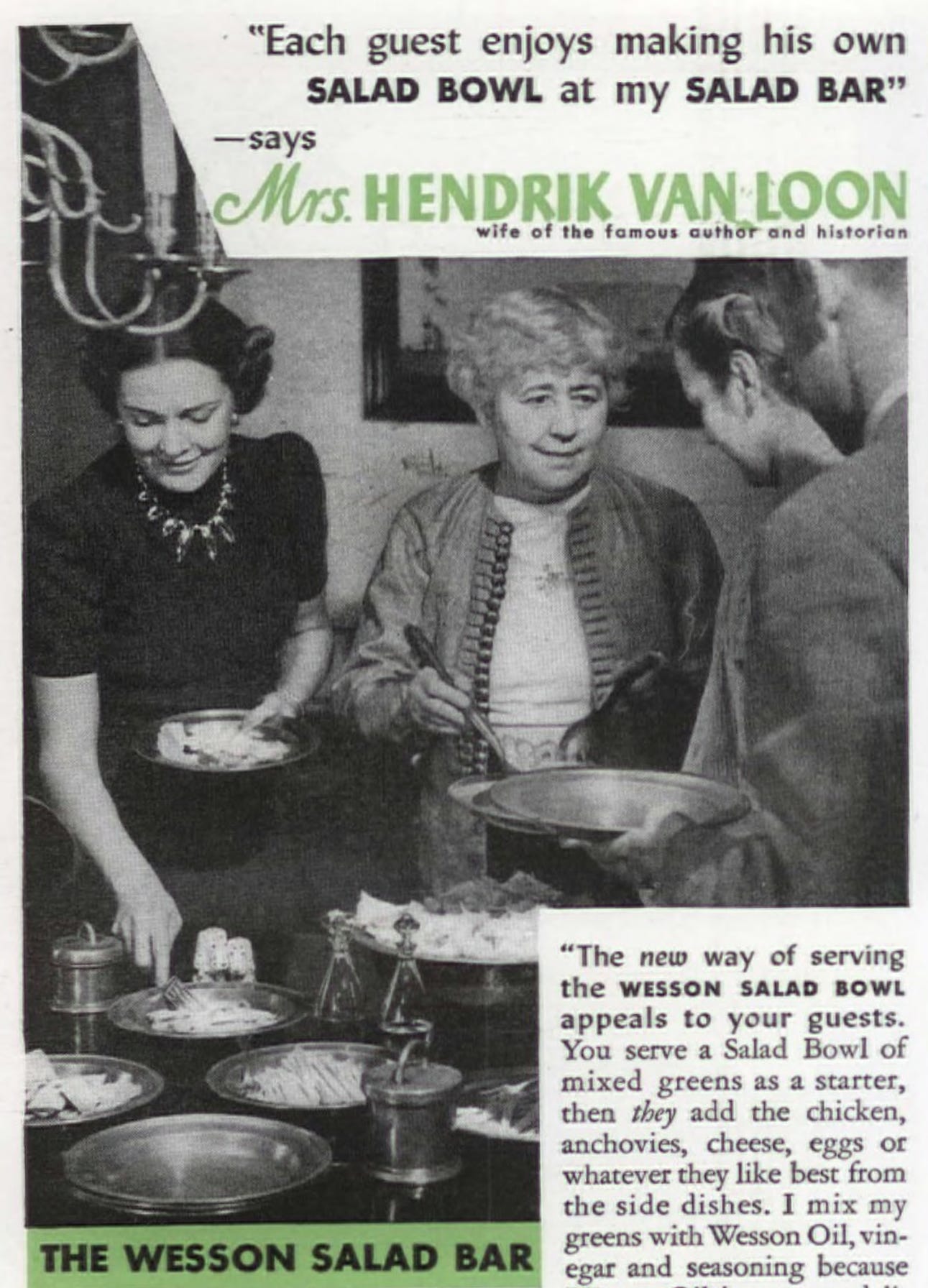
A parade of noted hosts and hostesses appeared in the ads to give their imprimatur to the concept. “Guests declare I really have a ‘live one’ in this gay new idea,” says Mrs. Frank Buck, wife of famed African hunter Frank Buck. “I serve the greens from a large, old bowl of African teak.” To a one, these hospitality experts wax effusive about the merits of Wesson Oil: “so pure, delicious and healthful,” as Mrs. Hendrik van Loon puts it.
“A strictly feminine repast”
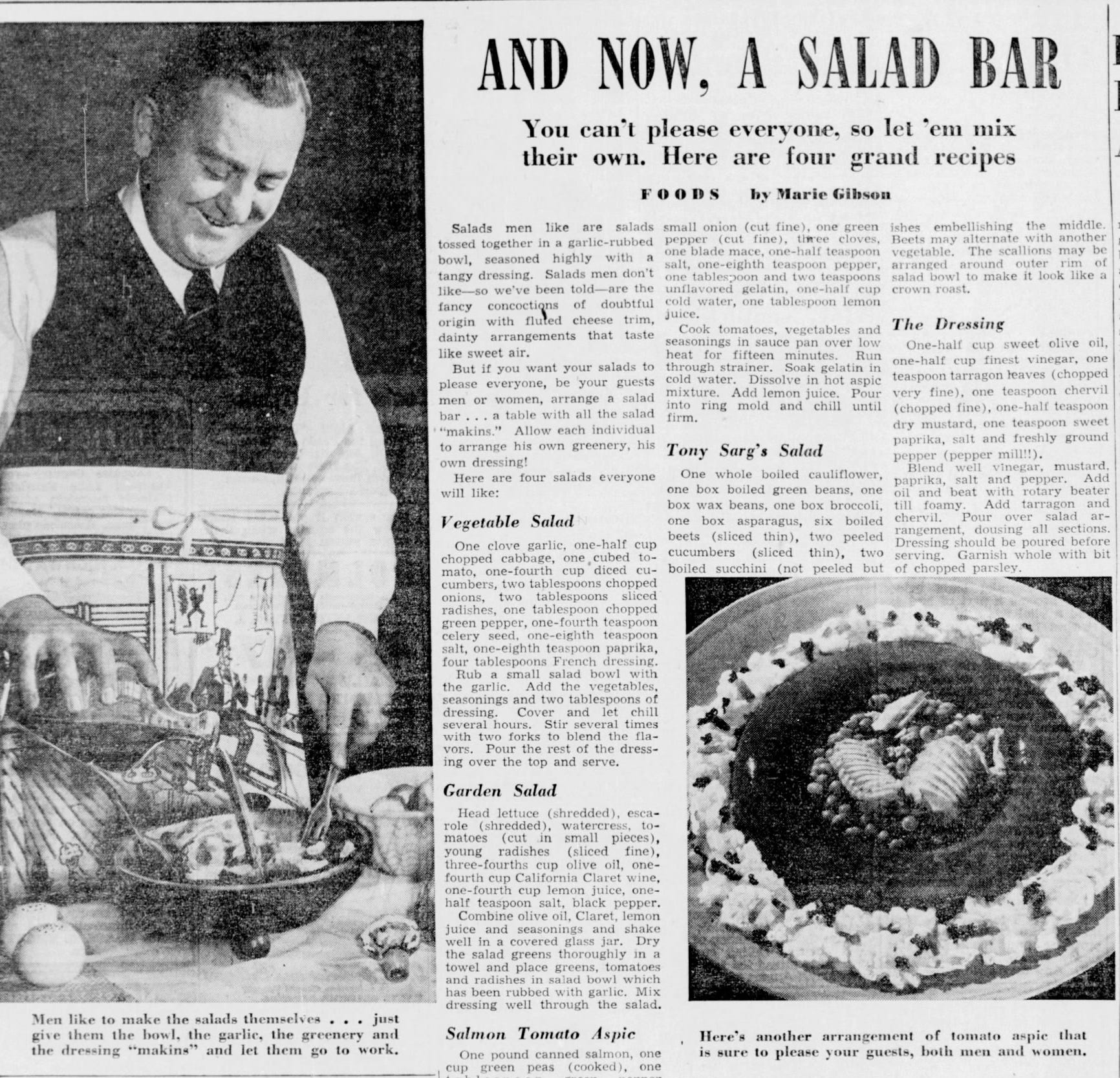
But whatever its origins, food editors at newspapers around the country took to the new idea for its ease, novelty, and ability to satisfy a wide range of diners. “Forget allergies when planning this party,” said the Duluth News Tribune. “No longer will you have to leave out the onions for fear that some prefer not to eat them, omit cucumbers because some of your guests may have ideas that they don’t agree with them or alter your bowl because of an allergy of one of the diners.” (I’m getting the feeling the unnamed writer had a bad experience with an allergic dinner guest.)
The salad bar solved two drawbacks of any dinner party by giving the guests something to do, and the hostess a little less to do. “In this do-it-yourself era, let your guests help themselves at a ‘make-your-own salad’ bar,” wrote the Vancouver, Washington Columbian. “Everybody will be happy arranging plates according to personal preferences, and entertaining in this casual manner means you can be the hostess and still enjoy yourself.”
The informal sociability of the salad bar, and its whiff of exciting newness, made it a natural format for fundraisers, socials, and other group functions. “One of the most charming events of the summer was the ‘salad bar’ luncheon yesterday at the Neptunian clubhouse in Manhattan Beach,” reported the Alameda, California Daily Breeze in 1941. Attendee Mrs. Walter Mace told the paper that “The attractive array of salads was most tempting and delicious. A different idea and it was received with great enthusiasm.”
A 1951 Lutheran church salad bar in Indiana was described as “a strictly feminine repast” by the Vidette-Messenger of Porter County. “The tables were luxuriant with bowls of pink cherry blossoms, and a welcome sun shone warmly on quaint little colonial doll centerpieces.”
The salad bar goes pro
The easy preparation and wide appeal that made salad bars useful for hostesses also caught the eye of restaurateurs. That’s where passions start to run high. The self-proclaimed “Home of the first EVER Salad Bar” is the Sky Club Supper Club in Plover, Wisconsin. Their claim rests on a reasonably well-attested story that they were the first to come up with the ice-filled tables that keep salad ingredients cool enough to be served bar-style, in 1950.
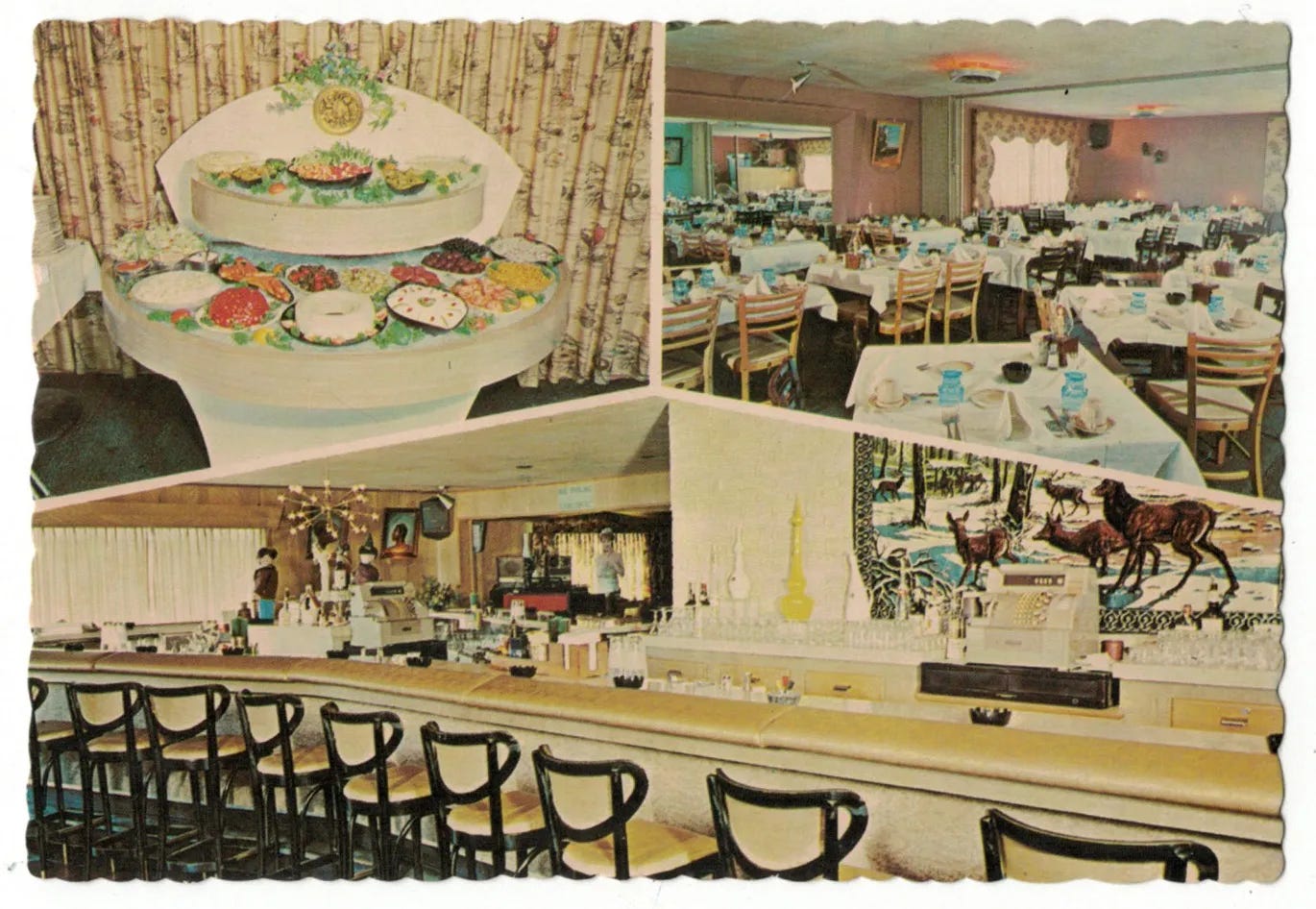
Thing is, there’s evidence that other restaurants were also offering something called a salad bar at least as early as 1950. I found a restaurant in Honolulu called Gam’s advertising its salad bar in June of that year. The previous month, Gam’s was mentioned in a Vancouver Sun travel column: “never, never, never shall I forget the gastronomical bliss of that Gam’s salad bar at the hotel in which I stayed in Honolulu”, implying that the visit was even earlier. Hawaii seems to have been a hotbed - no pun intended - of salad bardom. Even the famous demimonde nightspot the Waikiki Tavern, an early hub of the local gay scene, mentioned a salad bar in its nightlife listing.
Another claimant to the throne, the Chicago steakhouse Judd’s, was advertising its salad bar as early as 1952, offering more than 30 options from the usual cucumbers and olives to sliced beef tongue and herring fillets in wine sauce. Fortunately for the Sky Club Supper Club, all of these other establishments went out of business long ago, leaving nobody to contest the claim. At the very least, Sky Club deserves the undisputed title of America’s longest-running salad bar.
But whoever first brought it from the home kitchens and church basements of America into the restaurant, there was no stopping the salad bar. By 1976 it was so ubiquitous that the cookbook Parties for All Seasons suggested “Perhaps you’d like to borrow [a] restaurant idea. Set up a salad bar with all the fixings, and let the guests serve themselves.” Hey, good idea. We said the women invented it, didn’t we?
My trick with a salad bar is to realize there’s no rule you have to make a salad. Skip the lettuce entirely and you can fill up on the tastier (and pricier) stuff, making a smorgasboard of olives, cheese, and nuts. What’re your favorite salad bar or other -bar tips and tricks? Let’s chat in this week’s Shoddy Goods chat.
—Dave (and the rest of Meh)
Grab a plate and serve yourself these previous Shoddy Goods stories:
And if you like Shoddy Goods, don’t miss Jason’s other newsletter, Gnomenclature. Every week he digs into the 178-year-history of Hammacher Schlemmer, America’s oddest retailer. It gets weird!
Fascinating article. I remember the pre-sneezeguard days; coming up: the tip jar. 😉
Hendrik isn't a woman's name, it's her husband's. As seen in several other women quoted (Mrs Frank Buck, Mrs Walter Mace) most women were referred to, in print at least, by their husband's names.
In Chicago, legend has it that RJ Grunts was the first salad bar in the city. The restaurant is still open, and is still a slice of the 70s.