

It’s funny. When I watch live TV, I hate hate HATE commercials and do whatever I can to escape them. But if I’m watching some old TV show on YouTube and the original commercials are included, they’re the most interesting part. Jason Toon here with Shoddy Goods, the newsletter from Meh about consumer culture. This story is about the earliest attempt to mute ads, from the heyday of the very first mass broadcast medium.
“Ad blocking is a threat to the whole advertising industry. It’s essential people understand that online content isn’t free.” - David Frew of the Internet Advertising Bureau on ad blockers, 2015
“No advertiser will pay $500,000 for a 30-second spot on Friends if it gets to the point where everybody is skipping over the commercials. And if advertising revenue dries up, who’s going to pay to create the product?” - Garth Ancier of Turner Broadcasting on TiVo, 2003
“Fast-forward modes and TV sets with remote control are the biggest threats to TV advertising today.” - Richard Kostyra of J. Walter Thompson on VCRs and mute buttons, 1984
It’s gone back and forth for decades. Audiences naturally want to avoid obnoxious, intrusive advertising. Innovators come up with technology that gives them that control. Publishers, broadcasters, and advertisers warn that it could mean the end of the very entertainment or news the audience wants. Everybody’s got a point. Advertisers get more clever about slipping in ads (like this sneaky plug for today’s Meh deal) and viewers get more savvy about avoiding them. As today’s story shows, this dynamic isn’t going anywhere. And it’s a lot older than the VCR.
“Born to be robbed”
“Lee de Forest is a roué, a cad, a thief,” says historian Susan Douglas in the 1992 Ken Burns documentary Empire of the Air, “and yet, probably the man most responsible for bringing radio broadcasting to the American public.” Lee de Forest’s self-defeating antics could fill a book, and in fact, they have: the documentary was based on a book of the same name by Tom Lewis, from which I’ve cribbed much of the following overview.
From an early age, de Forest was the prototypical brooding geek: socially awkward, convinced of his own genius, rejected by his peers who called him “monkey face”, contemptuous toward his intellectual inferiors, the “hayseeds, farmers, ignorant, uncouth, rough fellows.” Around 1900, in his late 20s, doctorate from Yale newly in hand, de Forest became convinced his destiny lie in “wireless telegraphy”, or what we would call radio.
This destiny would express itself in a pattern of stolen ideas, grandiose claims, financial chicanery, and bitterly broken partnerships for the rest of his life. De Forest had a penchant for stumbling across the inventions of others, making inferior copies, and taking credit himself. When he showed one of his early stolen ideas at the 1904 St. Louis World’s Fair, he erected a 30-foot tower with DE FOREST spelled out on it.
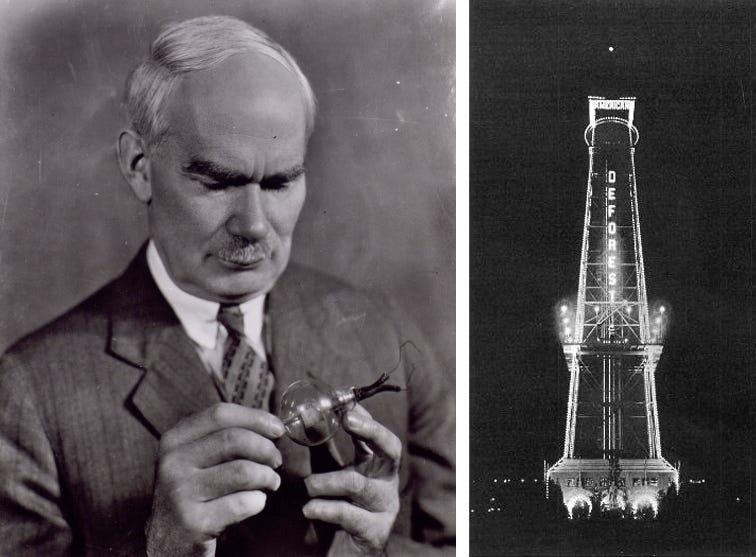
This ruthlessness didn’t help his fortunes, with one business partnership after another falling apart in the most acrimonious ways. In one case, his partner cheated de Forest out of all the company funds and patents; in another, he narrowly avoided conviction after a lengthy fraud trial in which his partners were found guilty. “I was born to be robbed... robbed of opportunities to invent... robbed of the fruits of my years of toil,” he wailed in his diary. There was little room in his self-pity for any examination of his own intellectual pilfering.
His judgment was no better in his personal affairs. In 1908, de Forest married Nora Blatch, daughter of one of the most prominent suffragettes, and the first woman engineering graduate of Cornell - and then insisted she give up her career, leading her to divorce him after four years. Later, he would marry his fourth wife before getting around to divorcing his third.
And yet, de Forest’s accidental perfection of the vacuum tube (even he didn’t understand quite why it worked at first) laid the technological foundation for radio, and later television, and still later, the computer. He also did some of the very first radio broadcasts - the predominant idea at the time was that radio would be used to send messages over the air, as implied by the name “wireless telegraphy”, but he was thinking bigger. Infuriating though he could be, de Forest was without doubt one of the most significant figures in the most significant communication advance of his time.
Not that it did him much good. By 1930, radio was flourishing, bringing broadcast media into millions of homes worldwide for the first time - and de Forest was shut out of the bonanza, having sold all his radio interests and then lost his fortune in the stock market crash. When he turned an ear to what was being done with “his” invention, he did not like what he heard.
“Terminating the awful caterwaul”
“One tires of continually getting up from his easy-chair every little while and going over to the dial, shutting off the set, or tuning it to another station as soon as the music of a program ceases and the blatant advertiser begins to announce his wares, “ de Forest wrote in a 1930 article in the Radio News. “What the long-suffering radio user needs is a simple wireless device whereby he can instantly assassinate the advertising announcer and allow the set to resume its musical outpourings when the story of the tooth-paste or furniture salesman is terminated.”
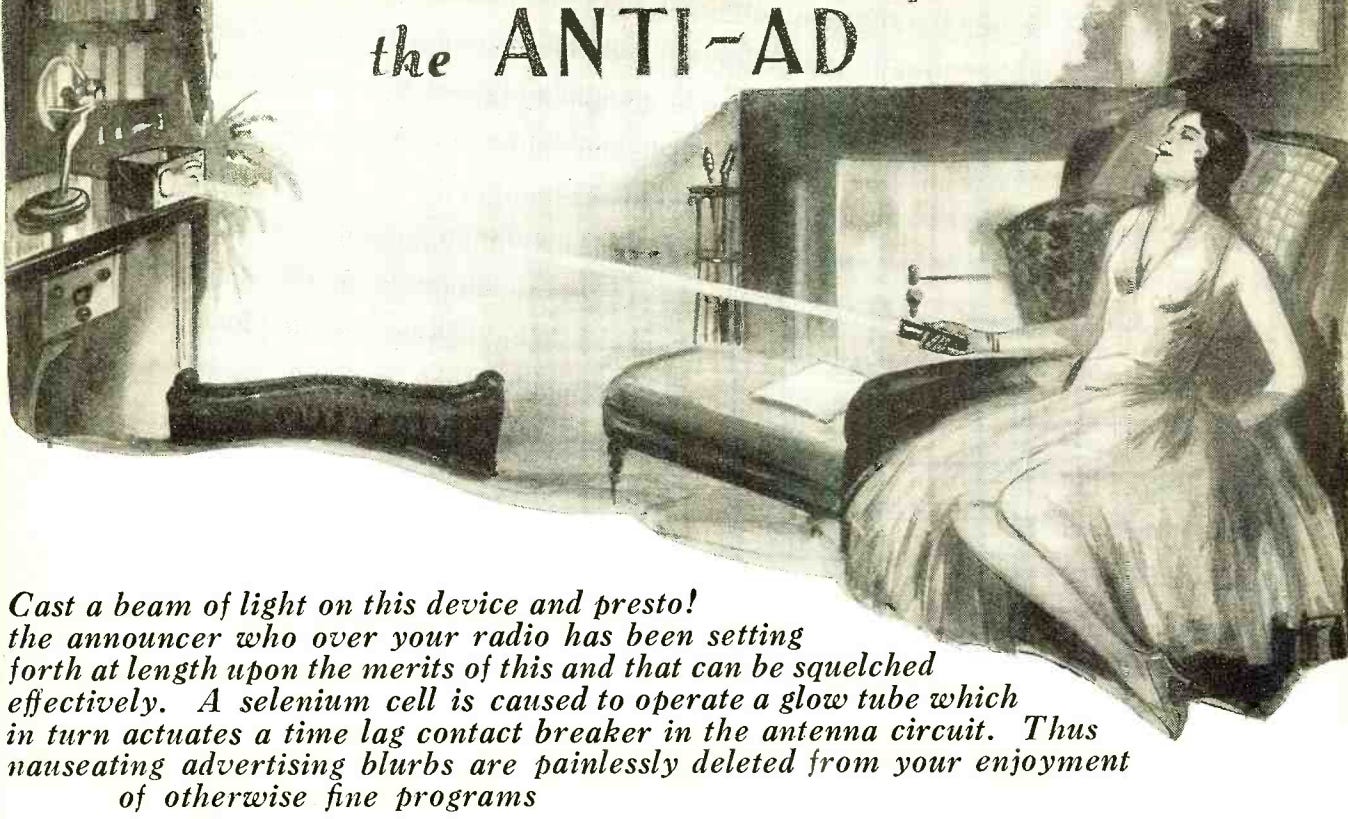
OK, so he was no prose stylist. But de Forest was expressing an exasperation still as fresh as the latest pop-up ad you irritatedly X’ed away. Unlike most of us, he did something about it. As explained in the article, the Anti-Ad was a set-top box that would let you mute the radio for a pre-set amount of time, simply by shining a standard flashlight at it.
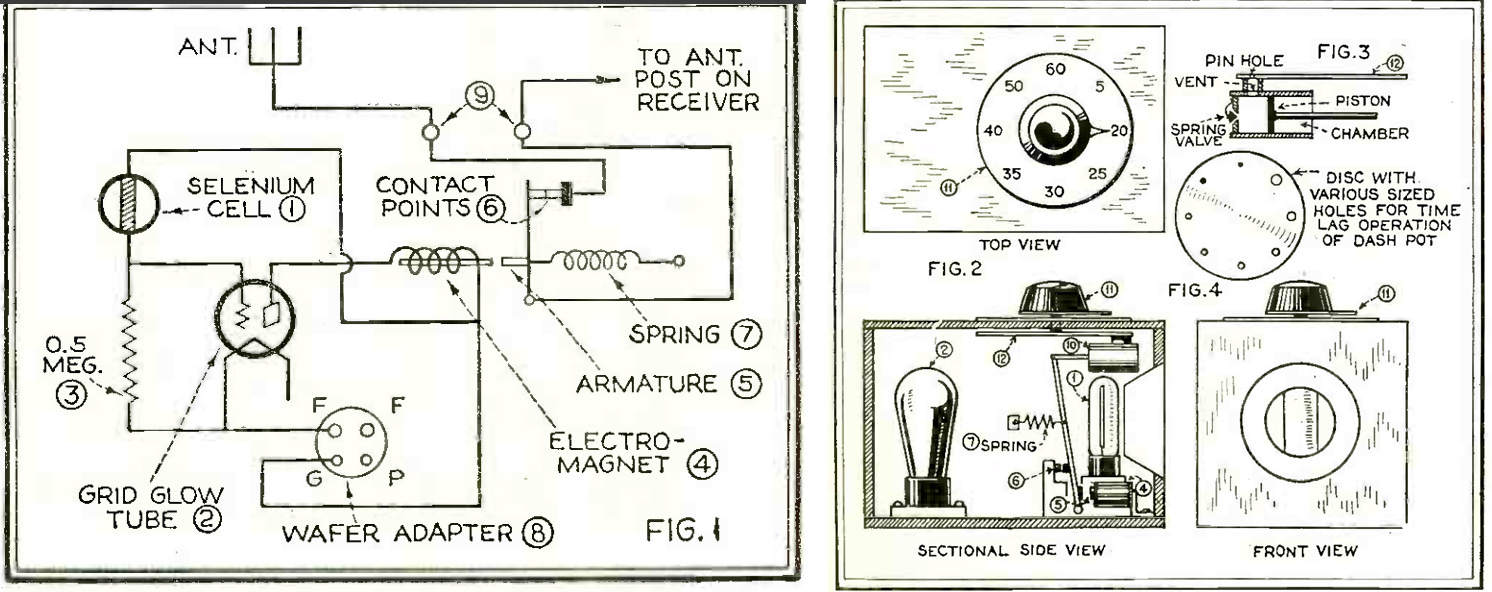
“When the musical program ends and the advertising agony begins, she merely picks up this flashlight, presses the button, aims this spot at the shadow-box on the Anti-Ad and presto! the relay operates, the antenna is cut off and our friend Mr. Radio Advertiser is talking into empty space, as he should be,” de Forest sniped. “One experiences a new joy not unlike that which one would experience in shooting a noisy tom-cat on the top of a back fence on a moonlight night and thus terminating the awful caterwaul.”
After “20 or 30 or 45 seconds” - whatever time the user set - the show would resume. I have no expertise to say whether de Forest’s invention would have worked, but presumably the editors of Radio News did, and found it plausible enough to publish.
So why then didn’t we all grow up with the Anti-Ad? Blame the financial imperatives of commercial broadcasting, with an assist from the inventor’s personality. Commercial radio broadcasting was initially conceived as a way to sell radios. By 1930 the ad model was firmly entrenched and growing, and the connections between radio manufacturers and radio broadcasters were still there. Little wonder that the captains of an industry didn’t build a device that would sabotage their own profits for the sake of a man they considered an abrasive crank when they thought about him at all.
Indeed, there’s no evidence the Anti-Ad ever went further than this one article and a smattering of newspaper coverage. Neither Lewis’s book nor de Forest’s own self-important 1950 autobiography, Father of Radio, even mentions it. Having gotten it out of his system, De Forest quickly moved on to other fruitless attempts to recapture his earlier success. He never stopped raging against the advertising machine - “Louder and more strident became the shrieks of [the] zealous announcers, more insistent, impudent, and repetitious [the] demands that listeners rush out forthwith to buy his merchandise, his nostrum, his laxative,” he wrote in his autobiography - before dying in relative penury in 1961.
No doubt, de Forest would not be at the top my barbecue invite list. But credit where it’s due, for how ahead of its time de Forest’s quickly forgotten invention seems now. In one swoop, it presaged the remote control, the mute button, commercial-skipping, and ad blockers. It would take decades, but eventually the rest of us would get tired enough of obnoxious ads to do something about it, too.
I think if there was a system where I’d only ever see an ad one time, I probably would actually enjoy watching ads. It’s the repetition, especially of terrible ads, that’s so painful and makes me want to block everything. I still have fond memories of the most bizarre local ads, furniture stores, carpet & tile stores, the Tik-Tok shop (whatever that was). Got any favorite quirky local ads? Let’s hear ’em (or even see ’em if you can find a YouTube link) in this week’s Shoddy Goods chat.
—Dave (and the rest of Meh)
These previous Shoddy Goods stories will not impudently shriek that readers rush out forthwith to purchase our laxative:
And if you like Shoddy Goods, don’t miss Jason’s new other newsletter, Gnomenclature. Every week he digs into the 178-year-history of Hammacher Schlemmer, America’s oddest retailer. It’s gonna get weird!
"I think if there was a system where I’d only ever see an ad one time, I probably would actually enjoy watching ads. "
That has actually happened; there was a toilet paper commercial some years ago; I have forgotten the brand name (The tag line of the brand is 'it's quilted' if that helps, and is relevant) that featured some animated 'quilters' working on the toilet paper...with knitting needles.
This was in the years BAI (before AI)
Some advertising agency greenlit said animation and no one in any part of the decision chain of ad agency and clients even noticed until the general public started making fun of it (quilters versus knitters is a potent and sometimes heated rivalry!) and the commercial was quickly recut to feature actual quilting.
But no one believes me because it aired only a few times....
Ads can cover the cost of programming.
Or we can pay a subscription fee.
Either way is fine with me
until they start cramming ads into my subscribed, paid programs.
That's stercus taurinum, to use the scientific name.