

I’m Jason Toon and one of the things I love about history is how it reminds me not to get too smug about how much smarter we are than our forebears. I found myself shocked by the credulity of the people in this Shoddy Goods, the newsletter from Meh about consumer culture - then I wondered what we don’t know that would shock future generations.
Life is tiring. Science is complicated. So when some strange new substance comes along that promises to restore your step’s lost pep, a weary nation opens its wallets - and, unfortunately, mouths, digestive systems, and bloodstreams. If other people are doing it, how bad can it be?
Unfortunately, every miracle reinvigorizer turns out to have its downside. Some are fairly benign, like Red Bull. Some are disastrous, like cocaine. But the worst has to be a miracle tonic that enjoyed a widespread vogue during the 1910s and 1920s: radium.
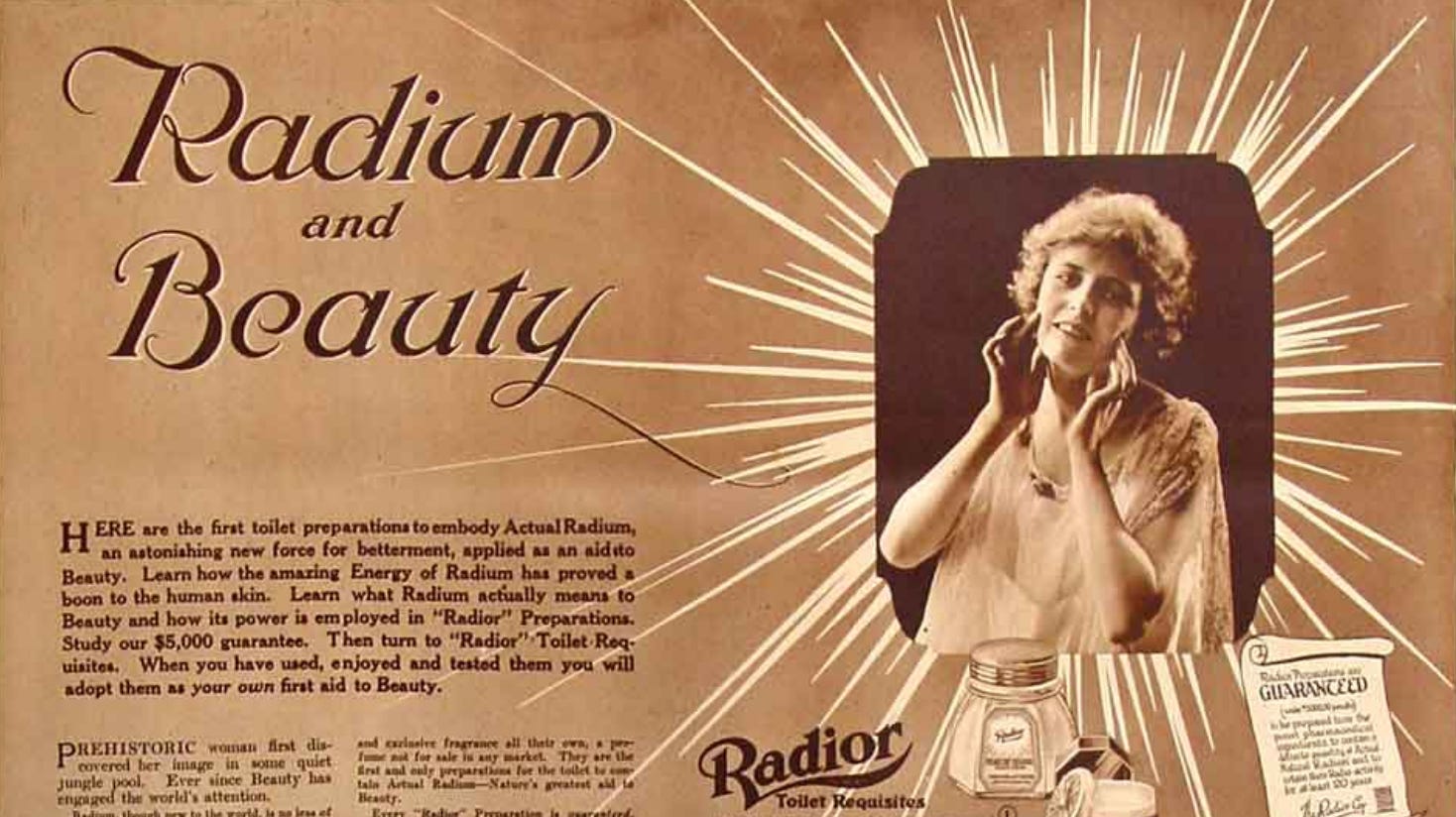
Yes, that radium. Before regulators finally acted, radium was sold as the magic ingredient in elixirs, cosmetics, kitchenware, food, and even, ahem, marital aids. It went about as well as you’d think.
“Power far beyond our wildest dreams”
When Marie and Pierre Curie isolated radium from pitchblende in 1898, they didn’t just discover a new element. They discovered radioactivity, the release of high amounts of energy from decaying atomic nuclei. But it would be a while before science understood that radiation destroyed human tissue and DNA at the atomic level - or that radium was among the most unstable of elements, and thus the most radioactive and toxic.
A little knowledge is a dangerous thing. News of radium’s discovery made it a celebrity among metals, a strange new symbol of the future. Some early studies seemed to show that it had a positive effect on cancer and overall health; “radium wards” opened across Europe and the US, mostly to treat benign skin conditions where surgery would have been disfiguring. The average American had seen dizzying advances in technology in their lifetimes. Why doubt this one?
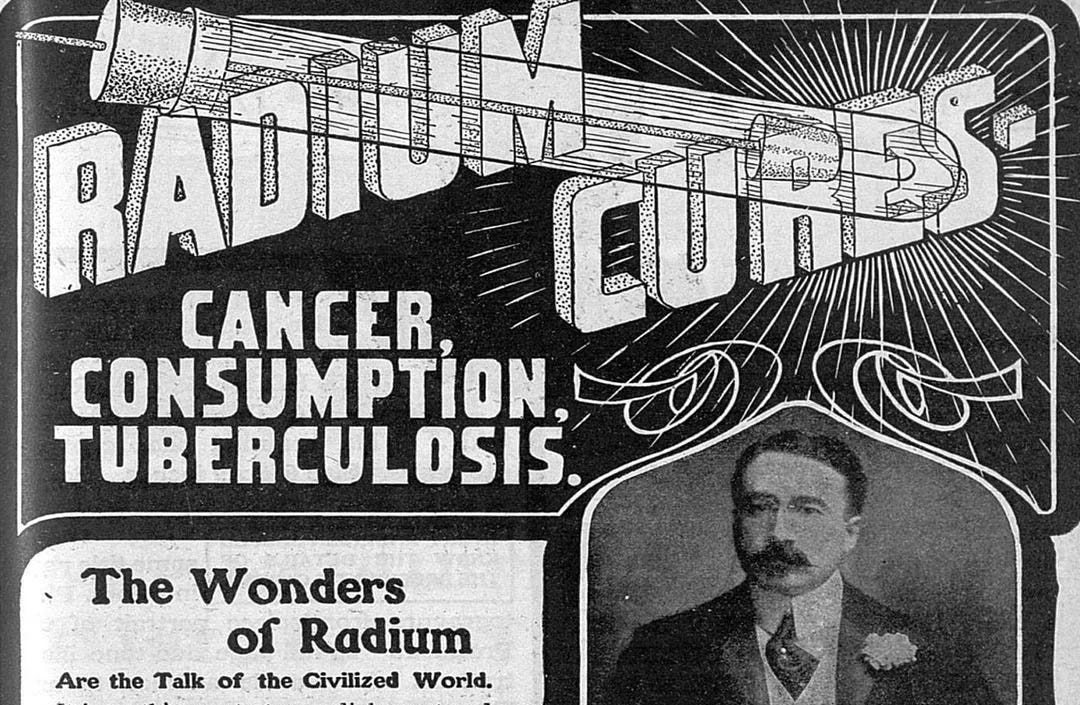
“Only a few years ago, we thought the automobile was a toy; to telephone without wires was ridiculous; to fly in the air was a crazy notion,” as a 1921 advertorial put it. “In Radium and Radio-Activity the scientists believe we have a power far beyond our wildest dreams.” The ad was hawking a device called Degnen’s Radio-Active Solar Pad. When worn “day and night, receiving the Radio-Active Rays continuously into your system”, this miracle advancement “will benefit about 95 per cent of all human ills”.
You may have noticed that that didn’t happen. Radium was great for the health of the snake-oil industry, though. Like “atomic” and “cyber” in future years, just dropping the name added a scientific modern sheen to the same old patent medicines that were still being hustled on the backroads of early industrial America. “Radium, having occupied the public mind and excited the public fancy,” wrote Samuel Hopkins Adams in a series of articles for Collier’s magazine in 1906, “has furnished material for the lively commercial imagination of the quacks.”
“There’s money in ‘em if they’re pushed right”
The flood of radium-branded products that arose in the early 1900s didn’t abate for some thirty years. Radium suppositorites. Radium bath salts. Radium chocolate, cigarettes, toothpaste, jewelry, razor blades. A radioactive jockstrap called the Testone that promised to “restore your sex power”. The Revigator, a radium-treated water jug that let you make your own irradiated water, like a nuclear Sodastream. Lingerie made of “Radium Silk”. Radium was especially popular in cosmetics and hair treatments in Europe, which gave the trend extra cache in the US.
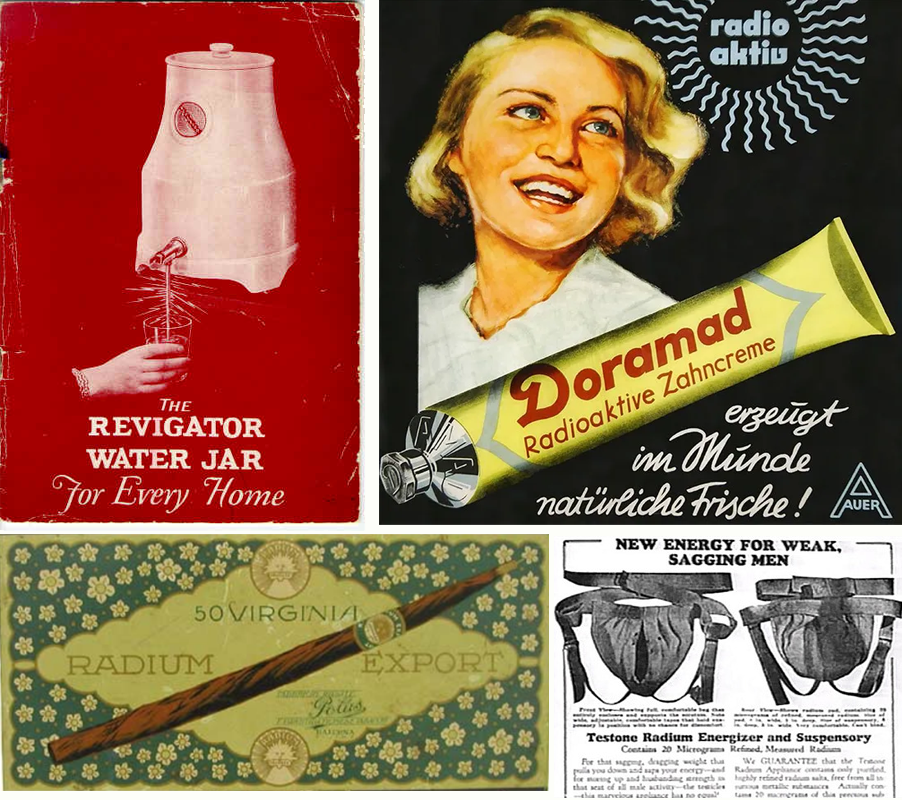
Consumer advocates were outraged… but only because most of these products didn’t contain radium. The worldwide supply of radium at this point could be measured in ounces. Even the minuscule amounts needed to actually have an effect were extremely expensive. But using “Radium” in your product’s name was free and, at the time, unregulated. Adams writes of questioning the president of “Dr. Warner Medical Company”, makers of “Radium Rings”, if there was anything in them at all: “Yes, there is… There’s money in ‘em if they’re pushed right.” There was no Dr. Warner, either.
In 1923, the Physics Department at the University of Illinois launched a study of supposedly radium-enriched skin creams, but again, only to ferret out the fakes. “The presence of a radium compound would no doubt be beneficial to the skin,” said Professor S.C. Knipp in a quote that hasn’t aged well. “However it is not likely that any radium will be found, since the price of such a cream would be prohibitive.”
Of course, the customers who merely wasted their money on phony radium products got off easy. The skeptics should have worried more about the products that were accurately labeled.
“Perpetual sunshine”
Foremost among them was Radithor. This “radium water” sold for the princely sum of $1 a half-ounce vial (about $20 today). Unlike the fraudulent nostrums, this one actually contained at least 1 microcurie each of two radium isotopes, Ra-226 and Ra-228.
“Radithor - Perpetual Sunshine,” ran one ad. “Just a tiny bottle of apparently lifeless, colorless and tasteless water is all that the eye can see or the tongue can detect, yet in this bottle there reposes the greatest therapeutic force known to mankind - radioactivity.”
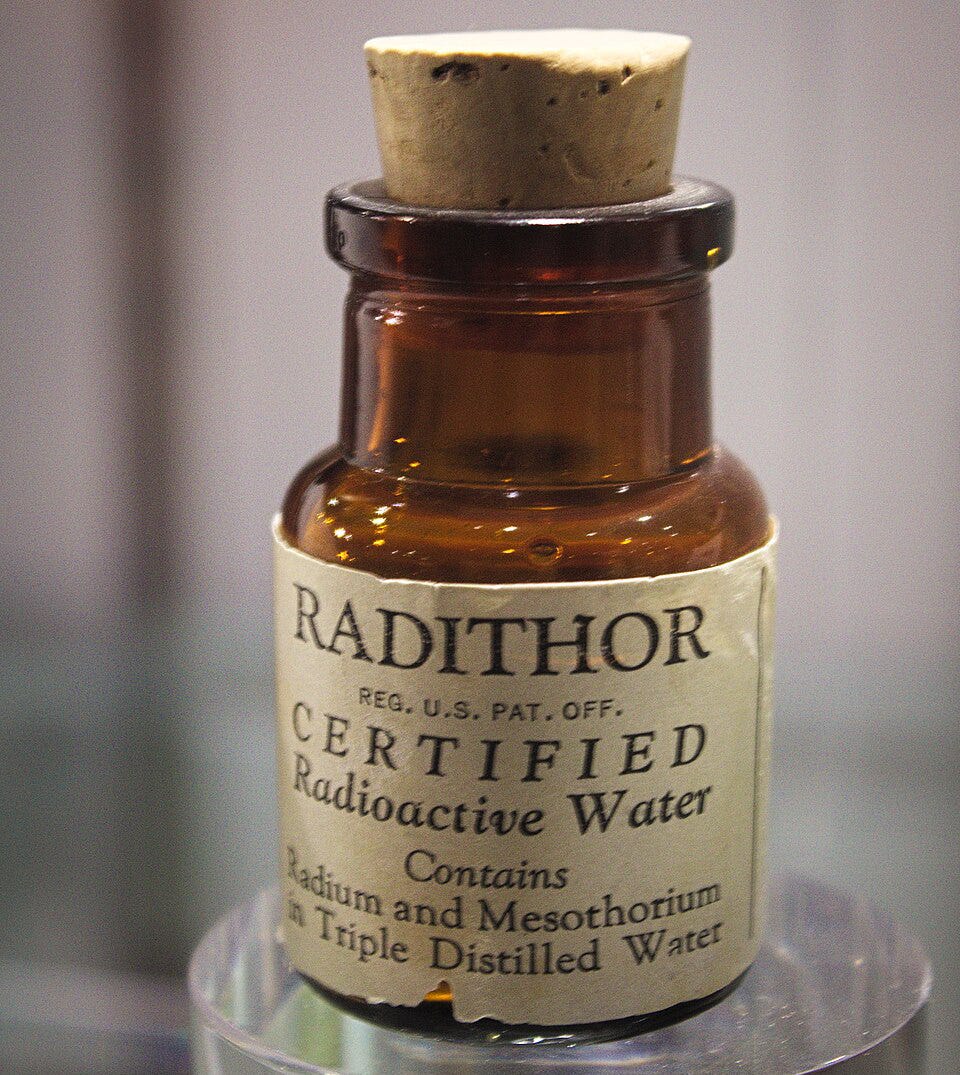
But if Radithor’s connection to radium was more legitimate, its creator wasn’t. William J.A. Bailey had served time in 1915 for collecting deposits for a new model of car he had no intention of building. In 1918, he was fined for promoting a supposed aphrodisiac whose primary ingredient was actually strychnine.
Bailey joined the wave of radium hustlers in the wake of Marie Curie’s celebrated visit to the US in 1921. Fancying himself a scientist, complete with a fake doctorate from the University of Vienna, he wrote and lectured on his theory that “the energy lost through ineffective metabolism could be replenished using the power of radium’s alpha particles,” according to a 1990 JAMA article by Roger M. Macklis. I barely passed high school biology, but even I can catch the stench of bullshit there.
“Doctor” Bailey then spun his cockamamie musings into an extensive range of stuff people could buy. Macklis lists names like the Radioendocrinator, the Thoronator, the Bioray (”a radioactive paperweight”), and the Adrenoray (”a cure for impotence that consisted basically of a radioactive belt clip”). But Radithor made his fortune, selling some 400,000 bottles around the world from 1925 to 1930.
This empire would all be undone by one of Raidthor’s best customers, who would pay a much higher price than Bailey ever would.
Radium silence
If Eben Byers hadn’t existed, F. Scott Fitzgerald would have had to invent him. Yale big man on campus. National amateur golf champion in 1906. Young chairman of his father’s steel company. The very model of a Jazz Age international playboy. Then, in 1927, he fell from a sleeping berth on a train and injured his arm. When the pain just wouldn’t go away, and the normally vigorous Byers couldn’t shake the blahs, his doctor suggested Radithor.
Bingo! Byers reported immediately feeling like his old hard-charging self. Along with drinking several bottles a day himself, he gave Radithor away as gifts and recommended it to his likewise type-A friends. He wasn’t just a satisfied customer, he was an evangelist.
But it didn’t last. Does it ever? After a couple of years, Byers told his doctor he felt worse than when he started taking Radithor. He went from losing weight and having headaches to his teeth falling out. His doctors were stumped - until a radiologist realized that the bony lesions in Byers’s jaw reminded him of another prominent radium case that had been in the news.
Another early, tragically misguided commercial use of radium was to make clock dials glow in the dark. Women who were employed painting these dials at three different factories from 1917 to 1926 were told to roll their brushes into a fine point using their mouths rather than water or rags, which would have cost the companies money. They soon developed horrific lesions, ulcers, and necrosis around their jaws, with many of them rapidly dying. Of course the companies denied that the Radium Girls, as they were known, were in any way hurt by the radium paint. Their lawsuits against the companies, and the resulting media coverage, would lay the groundwork for occupational health regulation for decades to come.
And their story would point Byers’s medical team to what was wrong with him: radium poisoning. By then, though, it was too late. By 1931, almost his entire jaw had been removed, and holes were opening up in his skull. He died on March 31, 1932 at age 51 of radium poisoning.
Stunningly, the Food and Drug Administration found that Radithor hadn’t broken any laws, since it said it was radioactive right on the package. It took a headline-making Federal Trade Commission investigation to finally spur the government into banning, at least, the advertising of Radithor. Byers’ death marked both the legal and cultural end of the radium craze.
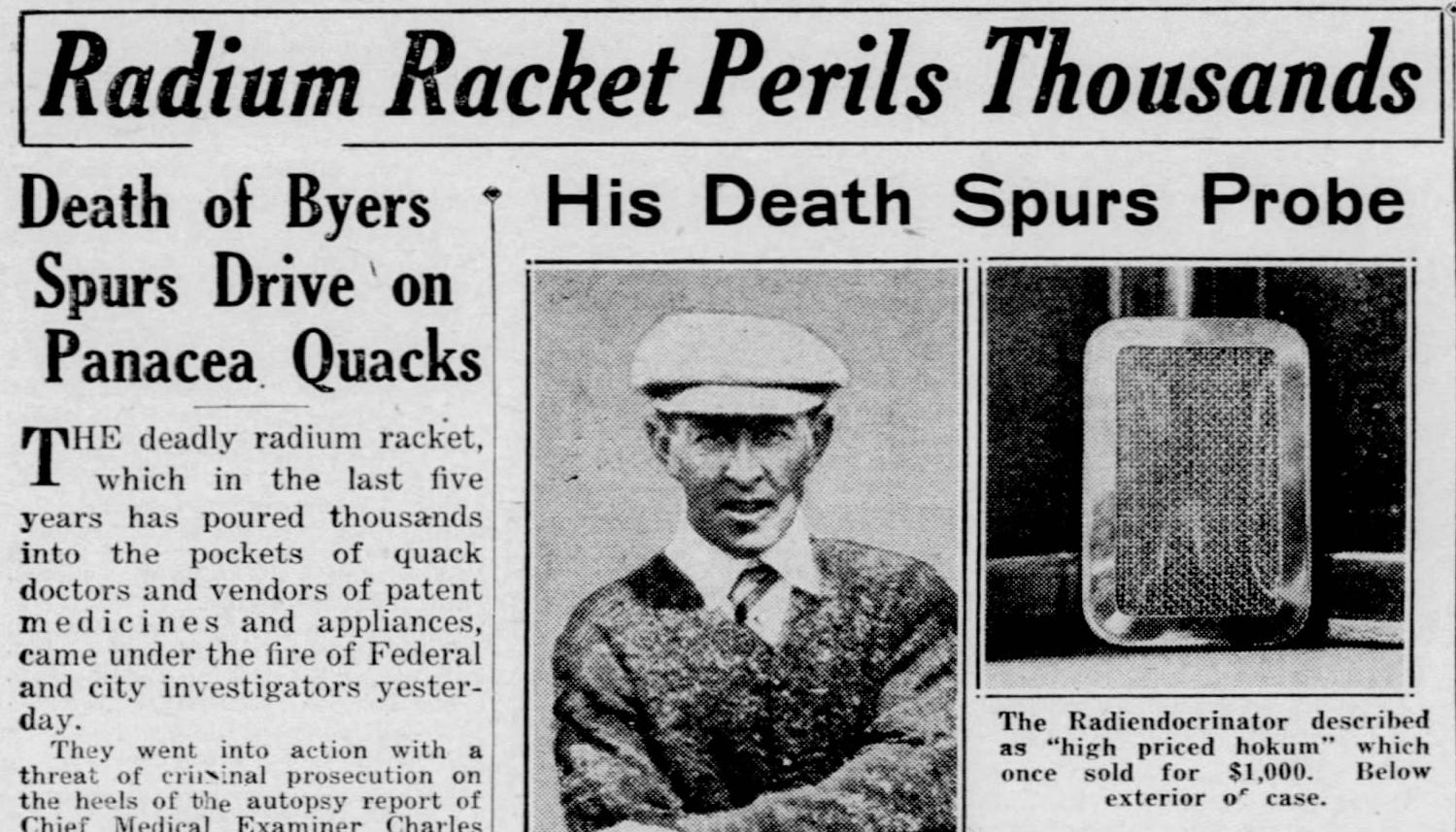
Bailey put up a brief defense in the press, claiming “I have drunk more radium water than any man alive, and I have never suffered any ill effects”. The court of public opinion was the only court he’d ever see over Radithor. After fading quietly into private life, Bailey died of bladder cancer in 1949 at age 62. Did the radium kill him? In 1968, his remains were disinterred for an MIT study into radium physiology. His bones showed extensive radiation effects and “were still quite radioactive”, Macklis writes.
Which is more than we know about anyone else whose lives were shortened by the radioactive hustles of “Doctor” Bailey and his ilk. Like Byers and the Radium Girls, those nameless victims paid a high price for trusting the authorities at the moment when snake-oil quackery overlapped with the atomic age.
Ok, vulnerability time - I’m extremely skeptical that any advertising works on me anywhere…except Instagram. I don’t know what it is about their algorithm tied to my likes and scrolling habits, but they’ve got my number. So far, the few things I’ve bought have actually not been total crap, but I’m just waiting to get a brick in the mail or something purporting to be steel that’s clearly cardboard. Have you ever fell for any advertising you’ve later regretted? (Note: Instant Regret Kits advertise regret, so paradoxically you can’t feel tricked if you end up regretting it.) Let’s hear about your shameful ad clicks in this week’s Shoddy Goods chat.
—Dave (and the rest of Meh)
These previous Shoddy Goods stories will neither reinvigorate nor kill you:
And if you like Shoddy Goods, don’t miss Jason’s new other newsletter, Gnomenclature. Every week he digs into the 178-year-history of Hammacher Schlemmer, America’s oddest retailer. It’s gonna get weird!
Are we sure that Radium wasn't being sold by Hammacher Schlemmer? Asking for a friend.
An article on the Radon removal craze of the 90's and early 00's would be interesting. People paying thousands to have Radon removed from their basements. Was it necessary? Was the threat real?