

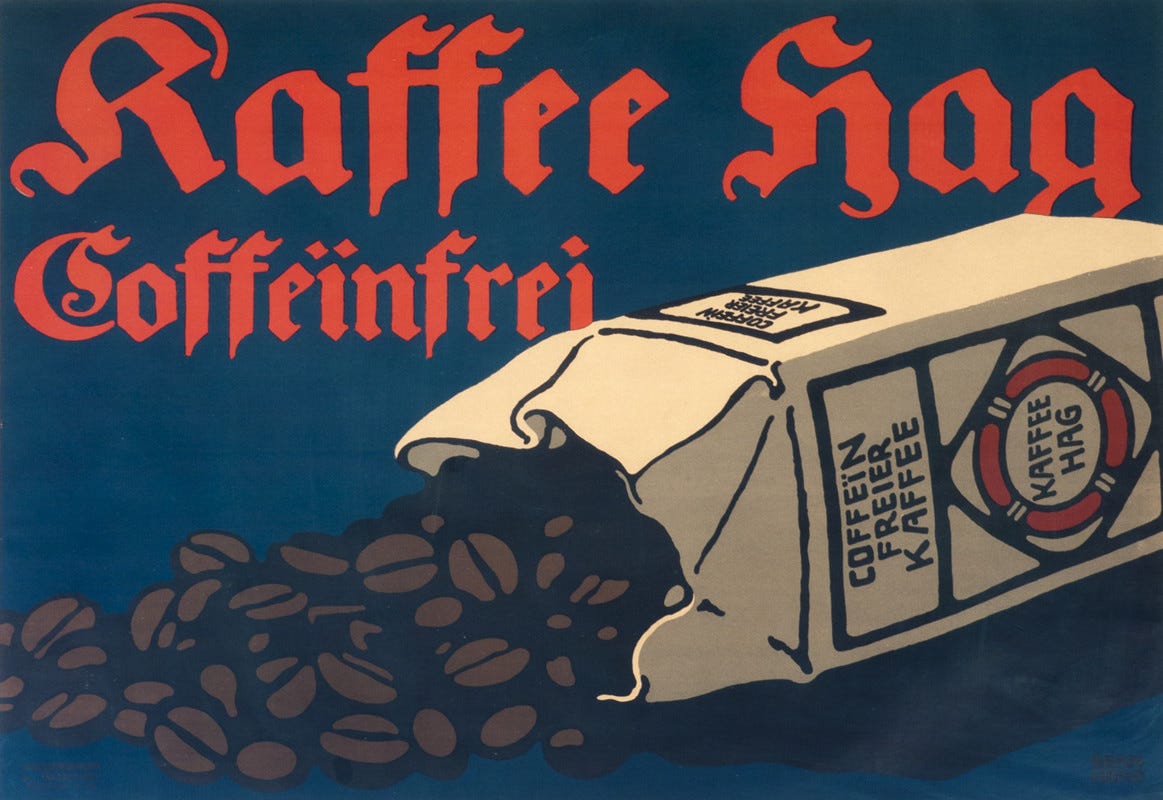
Hey, Jason Toon here with a new Shoddy Goods, the newsletter from Meh about consumer culture. I was surprised when I saw an ad for decaf coffee in a digitized magazine from the 1920s - I’d always assumed it was a more recent invention - but not as surprised as when I stumbled across the odd tangents in decaf’s origin story.
Some 26 million Americans will have at least one cup of decaf today, and that number is growing by 5% every year. Yet none of that ocean of coffee will be branded with the name of the first decaffeinated coffee to hit our shores - and, indeed, the first in the world, founded by the guy credited with originating commercial-scale decaffeination. What happened? The 20th century.
“Always harmless! Always wholesome!”
The story goes that in 1903, a coffee merchant in Bremen, Germany named Ludwig Roselius in the city of Bremen had a shipment of coffee beans that had been accidentally soaked in seawater. He noticed they’d been drained most of their caffeine content, but still tasted like coffee. Another legend has it that he believed that excessive caffeine had been bad for his father’s health and wanted to develop an alternative.
I can’t find anything backing either story up. What is clear is that Roselius and his partners developed an industrial-scale decaffeination process involving not only brine but benzene (now known to be basically poison). In 1906 Roselius founded a company called Kaffee-Handels-Aktiengesellschaft - Kaffee HAG for short - to produce and market this new koffeinfrei coffee, the first ever.
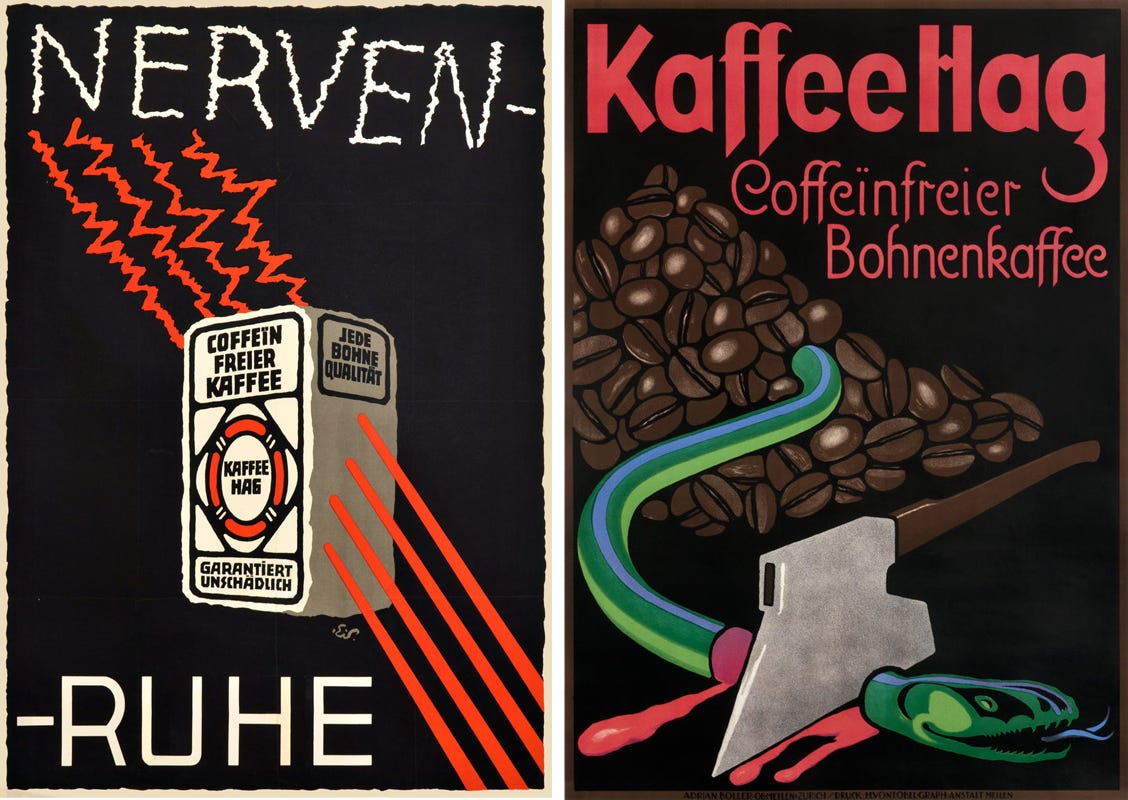
Roselius had a knack for marketing as well. Kaffee HAG was the first coffee to advertise in German cinemas and produced some of the most striking advertising posters of the time. Slogans like “Steady nerves” and “Always harmless! Always wholesome!” resonated with the public during the rapidly industrializing early 20th century.
Kaffee HAG quickly spread not only to the rest of Western Europe but the United States as well. By 1912, the Kaffee HAG Corporation had been established in the US and begun manufacturing America’s first decaf in New Brunswick, New Jersey. The sales pitch was basically the same: “Kaffee HAG agrees perfectly with everybody because the drug caffeine is removed. In short - all of the delights and none of the regrets.”
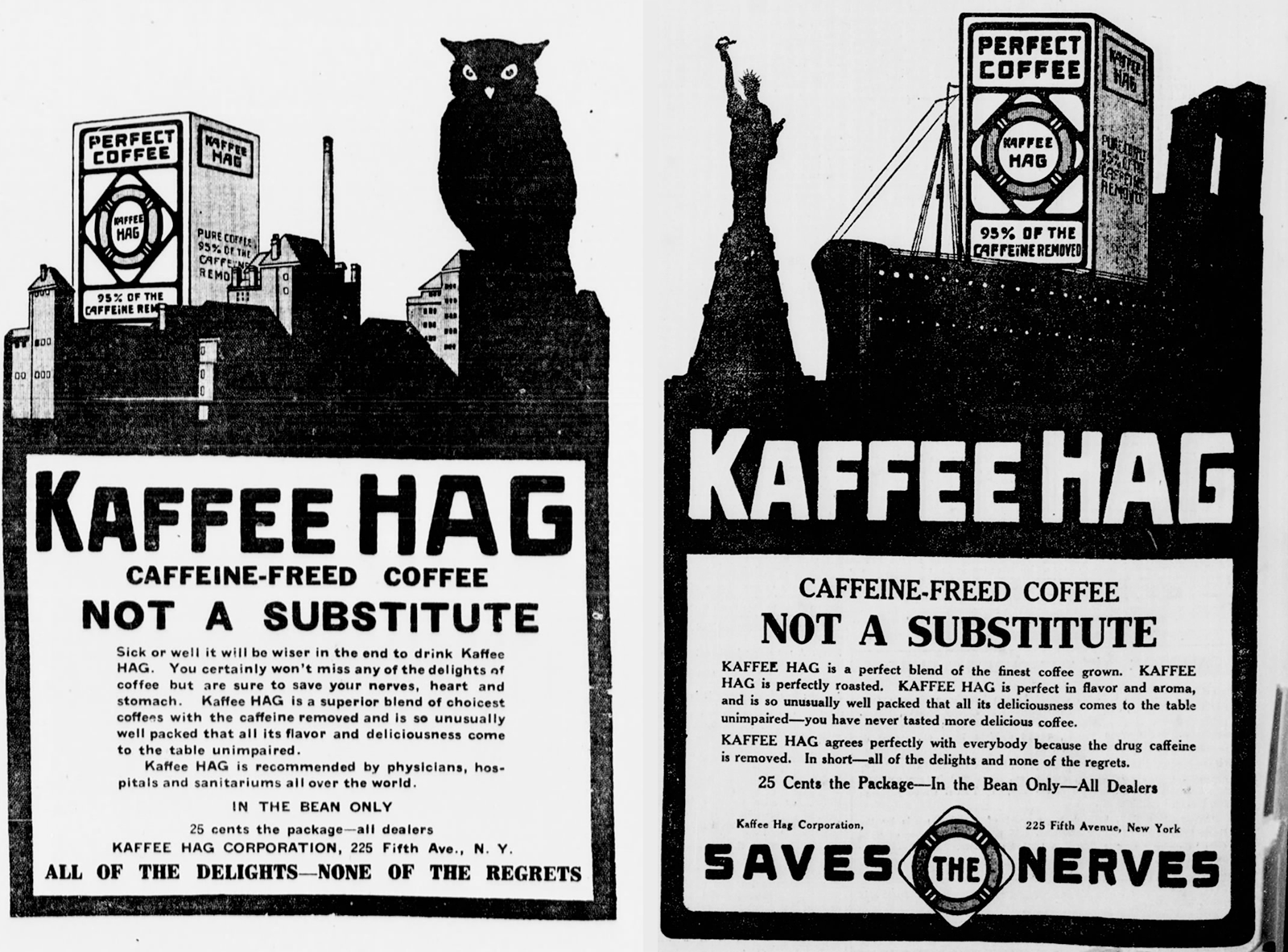
And so Kaffee HAG might have continued its steady march to the coffeepots of America, were it not for another German force marching into Belgium.
Sanka rise, Sanka set
When the U.S. entered World War One in 1917, the Kaffee HAG business in the United States was seized under the Trading with the Enemy Act. Roselius concentrated on rebuilding Kaffee HAG in war-torn Europe, at least for the moment.
In 1927, Kellogg’s purchased the severed American arm of Kaffee HAG. The cereal giant set about promoting it heavily to take market share from its rival Post’s roasted-grain hot drink, Postum. So Post, soon renamed General Foods, was who Roselius approached that same year to bring his decaffeinated coffee back to the US under a new name.
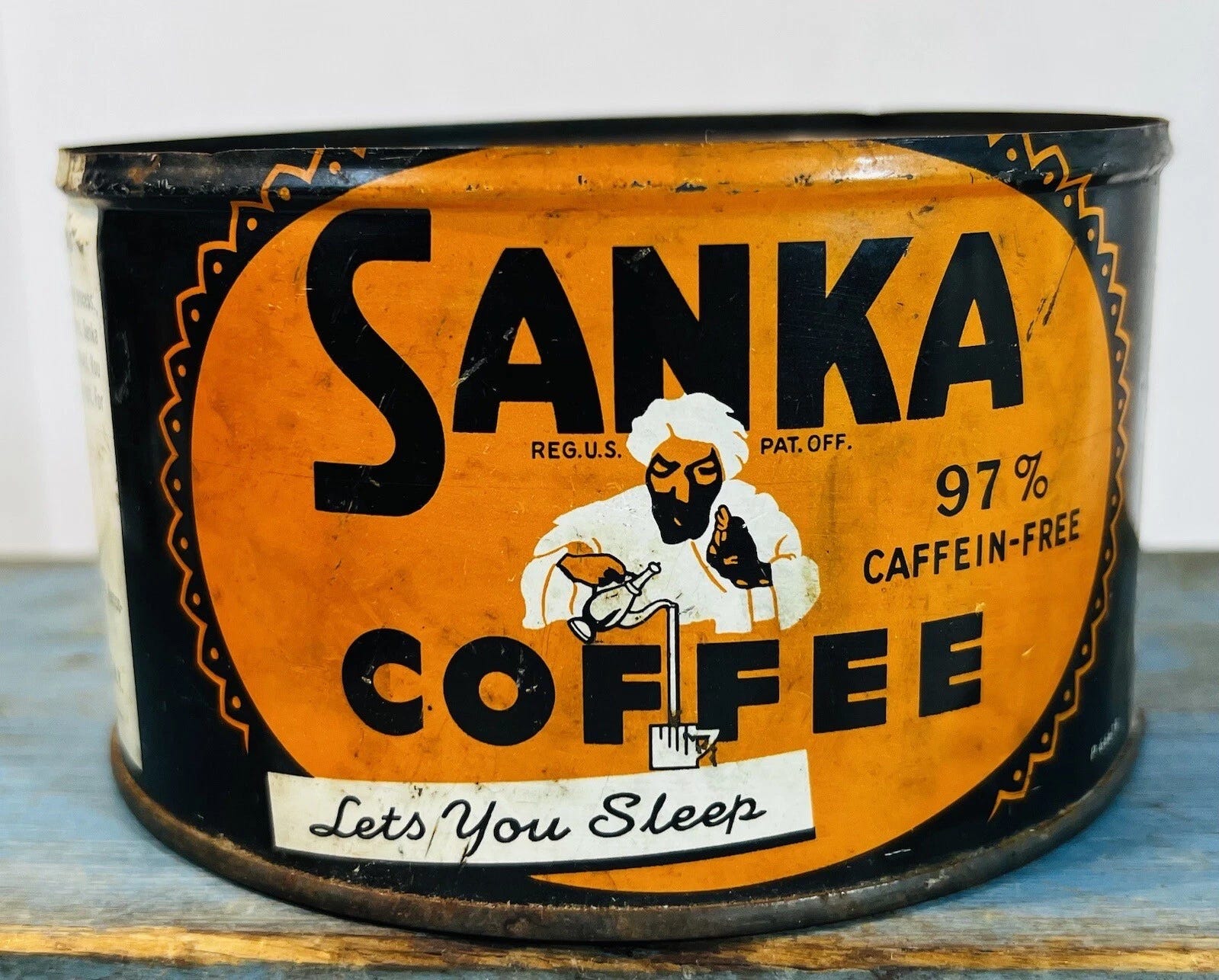
That name was an abbreviated portmanteau of “sans caffeine”: Sanka. Now General Foods had its own decaffeinated coffee to try to hang on to any Postum drinkers who might be decaf-curious. Roselius, now 58 years old, sold his share of Sanka to General Foods in 1932, to pursue other interests.
One of which, unfortunately, was Adolf Hitler, who he had first met in 1922. While Roselius was rejected for Nazi Party membership because of his suspicious tolerance for modern art, he was a “supporting member” of the SS and was appointed by Joseph Goebbels to the board of the Advertising Council of German Industry. His own crackpot racial theories differed from Hitler’s in ways that are frankly beyond my interest to parse. Roselius would come to regret his support for the Nazis before he died in 1943 - possibly strangled by Nazi agents. Lie down with dogs… anyway, if you vocal anti-decaf folks want to say decaf was invented by an actual Nazi, you wouldn’t be wrong.
In the meantime, the decaf coffee war was settled the American way: with a merger/acquisition. General Foods bought Kaffee HAG from Kellogg’s in 1937 and let the brand dwindle away, leaving Sanka the sole mass-market decaffeinated coffee in America for the next several decades. It was so dominant it became somewhat genericized, with coffee drinkers asking for “a Sanka” to mean a decaf coffee.
In turn, that success made General Foods complacent. Sanka became increasingly an instant coffee brand, its whole-bean and ground varieties disappearing. As the barista coffee market grew in the 1990s and 2000s, higher-quality coffee brands started producing their own better-tasting, less chemically treated decaf. Sanka suffered the same fate as other mass-produced instant coffee brands like Folger’s and Maxwell House. Near as I can tell, it’s now available only in institutional food-service settings in single-serve packages.
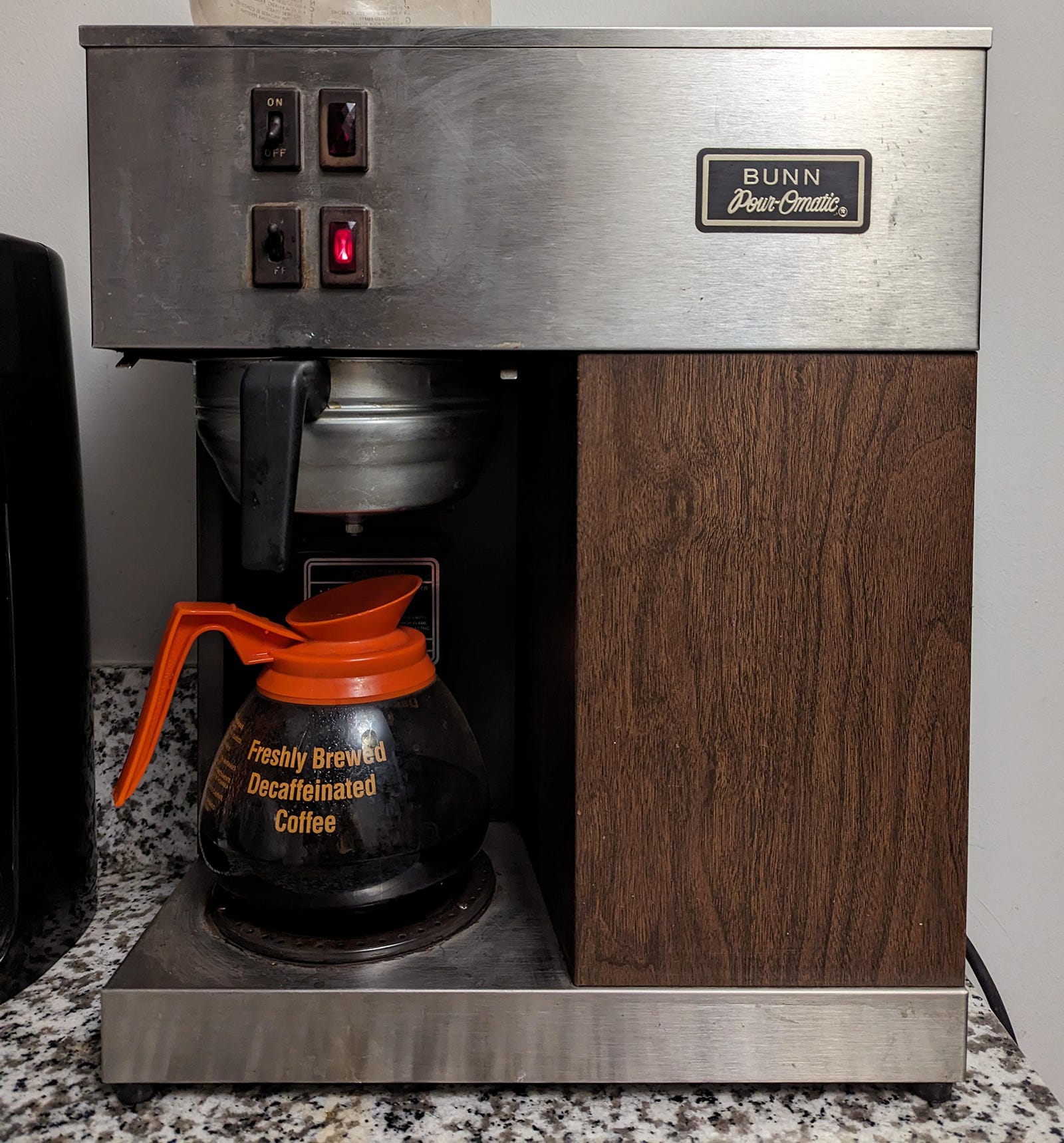
But Sanka did leave one mark on the culture. Its orange cans were so ubiquitous, for so long, that the color orange became linked in the public mind with decaf. The food-service industry started using the color to differentiate it from regular coffee. So when you see a pot of decaf coffee with an orange handle, or a carafe with an orange spout, you’re seeing the ghost of Sanka.
What’s your coffee or other morning beverage routine? I go full-caffeine, a couple cups before noon, and just black. I’m a bit fussy with a whole bean subscription and my ChemEx pour-over, but I’ve got a fondness for the cheapest cup of diner coffee I can find as well. Let’s hear what gets you up in the morning in this week’s Shoddy Goods chat.
—Dave (and the rest of Meh)
These previous Shoddy Goods stories are not a coffee substitute:
And if you like Shoddy Goods, don’t miss Jason’s new other newsletter, Gnomenclature. Every week he digs into the 178-year-history of Hammacher Schlemmer, America’s oddest retailer. It gets weird!
I learned something new! It’s funny, I’ve even heard of Sanka in coffee books, but they must have glossed over the orange connection.