

Hey, Jason Toon coming back into your life with Shoddy Goods, the newsletter from Meh about consumer culture. I’m pretty laissez-faire when it comes to hobbies, but sometimes the “we juggled knives and we turned out fine” myths about the past ignore the fact that not everybody, in fact, turned out fine.
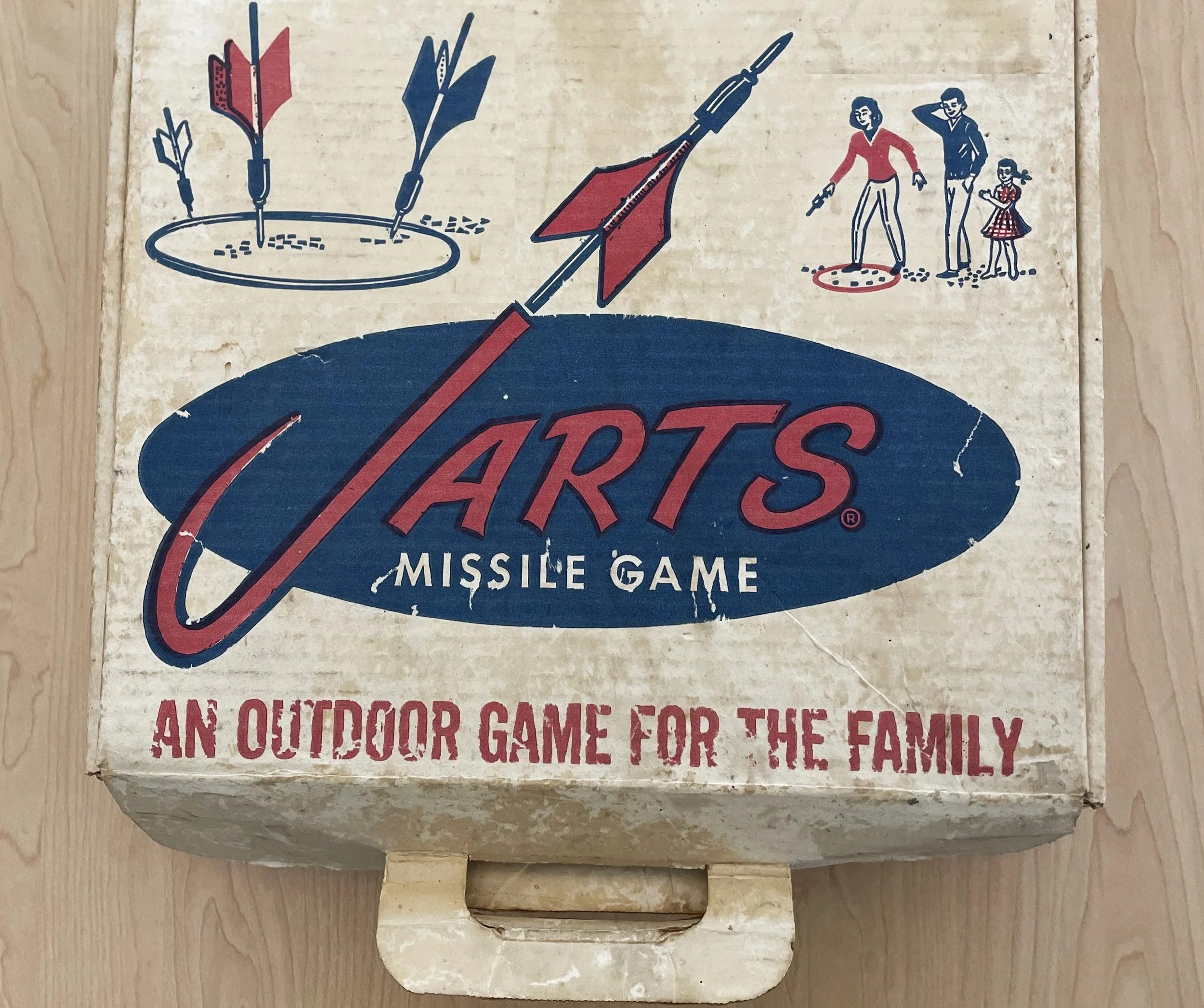
I grew up in a Jarts family. Whenever we all got together, the grownups would set up the two white rings at either end of my Grandma’s little backyard. The darts would fly, the beer would flow, and the adrenaline of competition was spiked with the need for constant vigilance to keep us kids out of the way. And there were a lot of us kids. Every few turns, a cry of “wait! stop!” went up to keep one of us from wandering into the flight path. We escaped the ‘80s without serious injury, but hoo boy, there were some close calls.
The 1988 banning of metal-tipped lawn darts - widely known as Jarts, after the leading brand - is up there with the McDonald’s coffee lawsuit as a folk legend about frivolous consumer-safety overreach. As I would discover when I started digging into it, like the McDonald’s case, the Jarts ban was much more justified than the popular myth would have it. To me, the question isn’t whether they should have been banned, but how they were ever sold in the first place.
“For adults” or “family fun”?
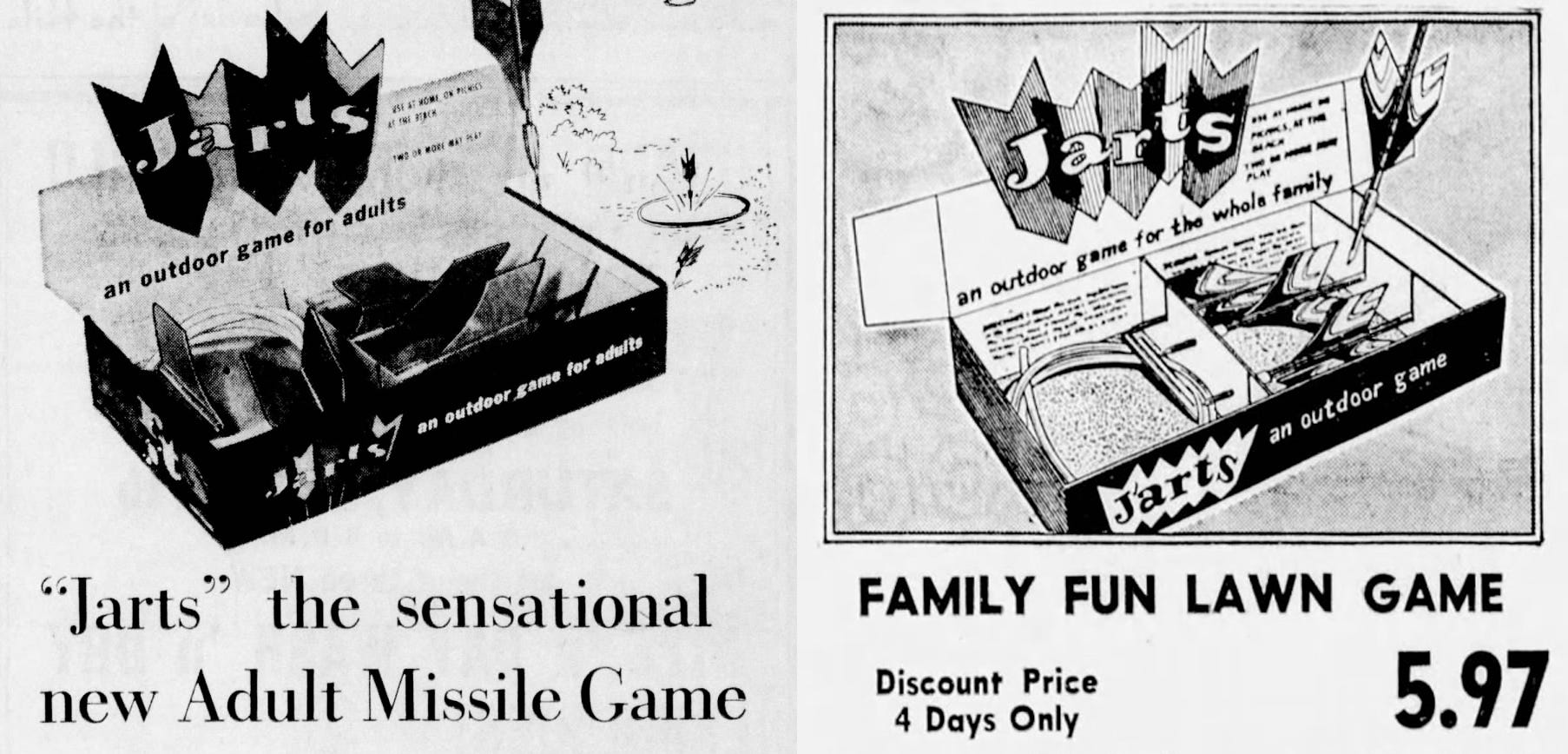
Inventor Lawrence Barnett named his 12-inch-long, weighted, spear-tipped creations “Jarts” as a portmanteau of “javelin” and “darts”, and gave the same name to the company that made them. The earliest Jarts ads I can find, from 1958, show that they were marketed as “an outdoor game for adults”. It said so right on the box, and in ad copy like “a barrel of fun for grown-ups“ and “the sensational new Adult Missile Game“.
But even then, the messages were mixed. The very same ads would also use phrases like “fun and excitement for the whole family” and “fun for everyone, young or old.” Some of the figures in the illustrations were ambiguously kid-like, too. Still, it was clear at this point that someone at Jarts had realized that they might get into some trouble if kids played with these playthings and got hurt, so they covered themselves with the “for adults” label.
By the end of the ‘60s, Jarts resolved that ambiguity by throwing any hesitancy out the window and marketing Jarts at kids, too. The box now read “an outdoor game for the family” and unmistakable kids were added to the illustrations.
This was too much for the Food and Drug Administration (FDA), who classified lawn darts as a “mechanical hazard” in 1970. This required them to be packaged with warnings to parents to keep them out of the reach of children, and barred them from being sold in toy departments of stores. The Consumer Union and the Children’s Foundation wanted the government to go further, and unsuccessfully sued the Department of Health, Education, and Welfare (HEW) to ban Jarts outright. Meanwhile, Paul Robinson of Ravenna, Ohio, filed a $1 million suit against the manufacturer after his 12-year-old stepson was blinded in one eye by a flying Jart.
Of course, Robert Barnett, now president of the renamed RB Jarts Company, pleaded innocence on the usual grounds: once a Jarts set was sold, it wasn’t the company’s fault what people did with them, and anyway, who ever said life was risk-free? “It’s a game for adults, a family game if they want their older children to use it under supervision,” he told the Associated Press. “If they can put a ban on a game like this, they should ban everything there is - football, baseball, every sport there is. How far can this thing go?”
“Whipping Jarts as high in the air as possible”
The bad publicity, and the FDA requirements, didn’t seem to slow Jarts down. The ‘70s and ‘80s were an extended boom time for lawn darts. The sporting goods brand Regent took over production of the official Jarts, and dozen other manufacturers cranked up production of their own knockoffs. They became a fixture at backyard barbecues like my family’s, and by some reckonings, the most popular backyard game in the USA. Despite the “adults only” fig leaf, youth Jarts competitions started appearing at field days and school picnics.
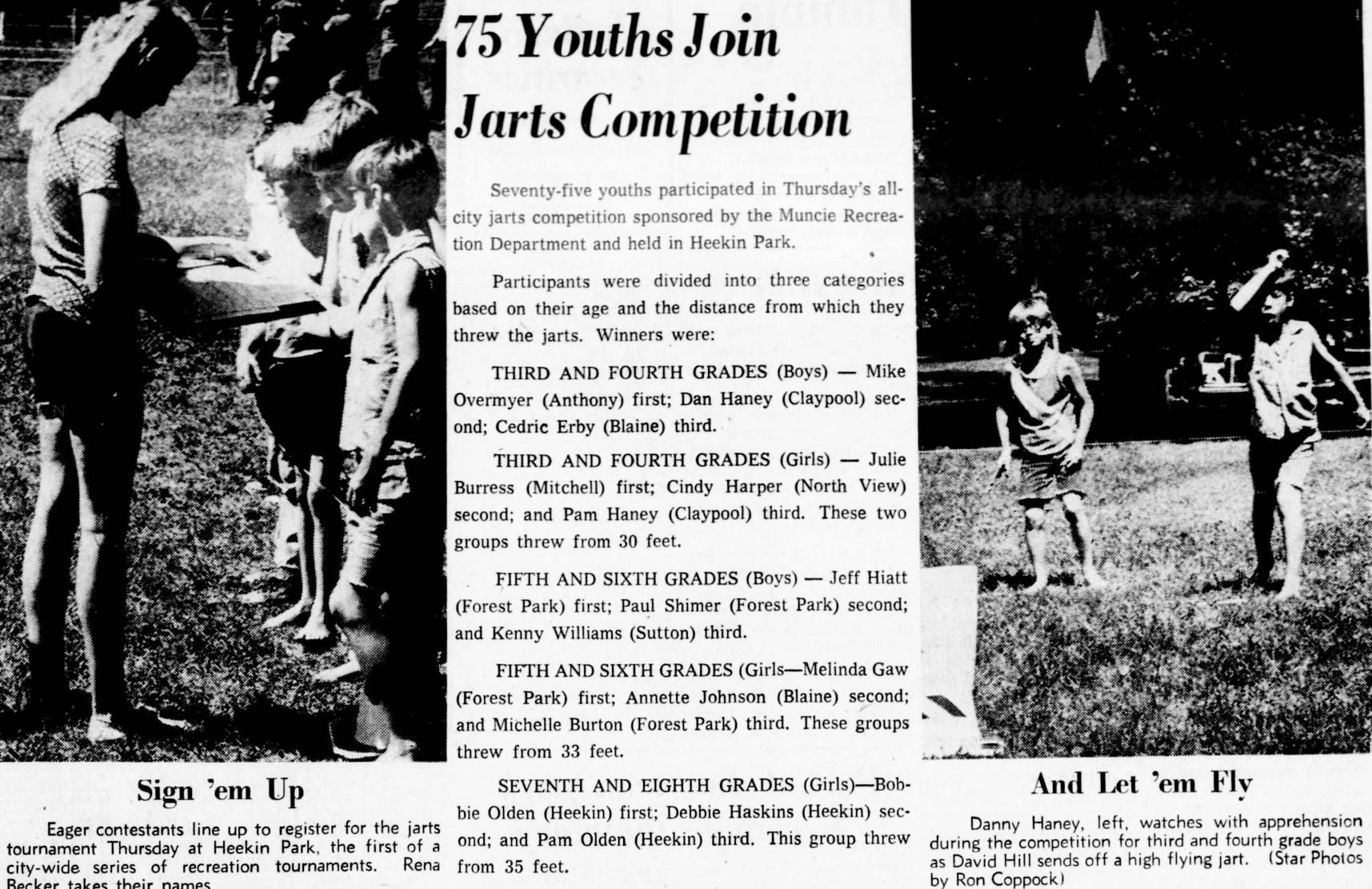
Of course, more Jarts meant more injuries. Kids will be kids. If they get their hands on a colorful piece of plastic designed to fly, they’re going to throw it first and think about safety later, if at all. This child randomly flinging Jarts into the air at a picnic in 1982 could have been me or any other kid I knew. Dodging a falling Jart even became a game in itself. “As soon as my dad was out of sight,” wrote newspaper columnist Steve Lange, “we would be whipping Jarts as high in the air as possible, then sprinting out of the way as the giant darts fell toward us at 32 feet per second squared.”
No wonder more than 6,000 Americans went to the hospital for lawn dart injuries from 1978 to 1986, half of them age 10 or younger, and another 30 percent between 11 and 15. At least three of those kids never came home from the ER. David Snow of Riverside, California, bought an “outdoor games” set because he wanted the volleyball net. Fatefully, it included a set of lawn darts. “I never even heard about lawn darts,” he told the San Bernardino County Sun in 1989.
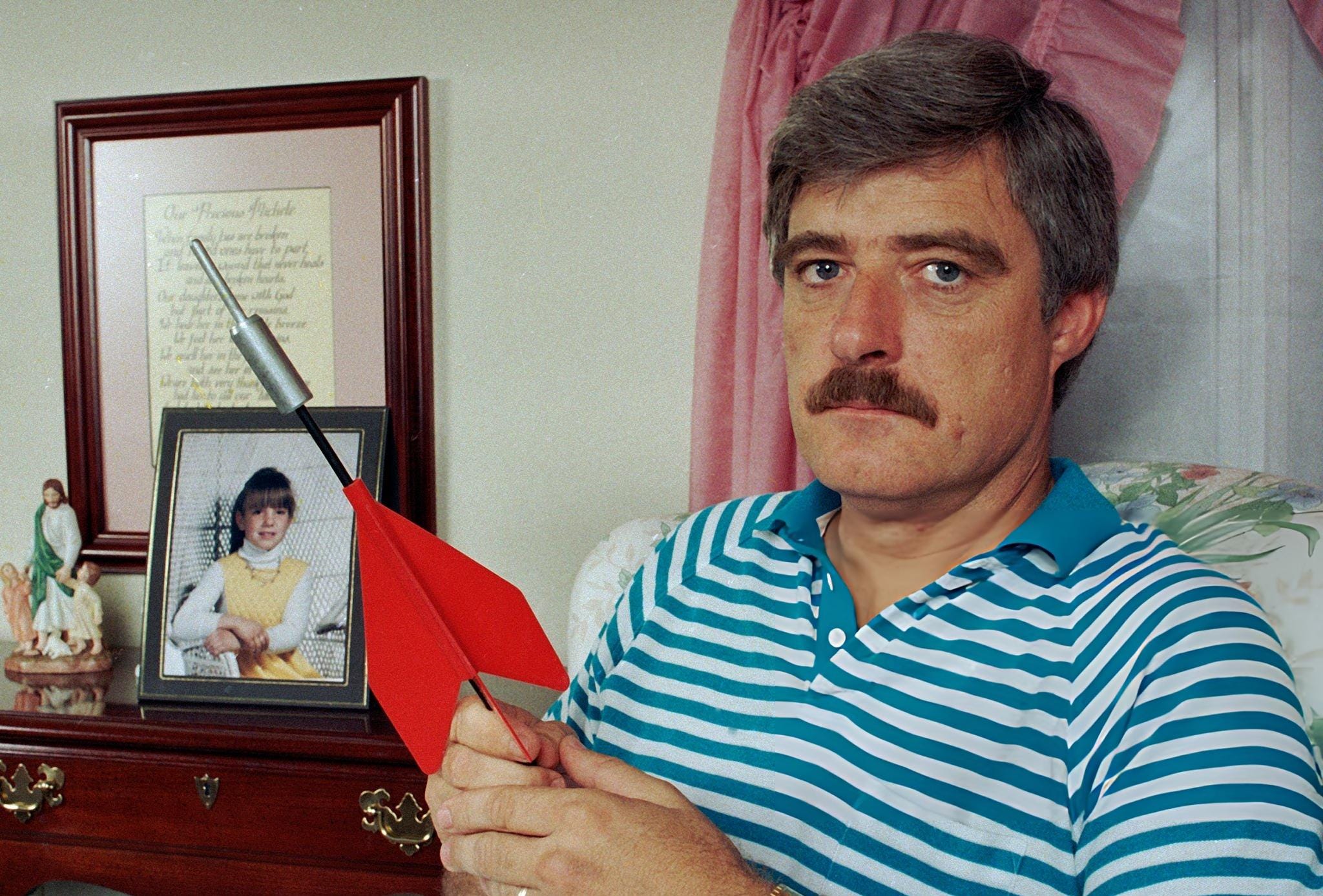
Not long after, on the afternoon of April 5, 1987, his son and some friends found the lawn darts in Snow’s garage and started playing with them in their backyard. One sailed over the fence into the front yard where his 7-year-old daughter Michele was playing. It struck her in the head with an estimated force of 23,000 PSI, about the same as a bullet from a .22 rifle. Michele died a few days later.
For David Snow, that was the beginning of a crusade. An aerospace engineer for Hughes Aircraft, he’d never been political before. But now, he said, “I stood over my daughter’s grave and promised her the toy who took her life would never kill another child.”
“Lining their Gucci suits with dollar bills”
He had a daunting task ahead. The Reagan administration had been elected twice on a platform of deregulation, and by now Reagan appointees made up majorities on bodies like the Consumer Product Safety Commission (CPSC). But Snow would not be daunted. He spent his life savings on his Michele Snow Foundation, and did the first public speaking in his life when he testified to Congress.
“We’re talking about [lawn dart] importers lining their Gucci suits with dollar bills,” Snow told Congress. His blunt speaking, obvious passion, endless stamina, and heartbreaking story attracted attention up to and including a segment on 60 Minutes. Against the prevailing current of deregulation, it worked. Congress and the CPSC banned steel-tipped lawn darts in October 1988.
Ever since, the ban on Jarts has gone down in folklore as a hysterical overreaction to a non-issue. A Reddit user who I’ll allow to remain nameless sums up the argument: “The fact that it is still banned because of a girl dying 35 years ago is embarrassing to this great country. You don’t need to ban things because some people are idiots.”
We’re all idiots when we’re kids, though. Is that something we, or other kids, should die for? Yes, there’s lots of pointy, heavy, dangerous stuff in the world. That doesn’t mean a weighted steel spike that falls with the same speed as a bullet should look and be treated like a toy.
The widespread affection for Jarts notwithstanding, most of America shrugged and moved on to such nonlethal backyard fling-offs as cornhole and ladder toss. As for my family, we took up the classic St. Louis DIY game of washers. It might not be pleasant to get hit with one, but it wouldn’t send you to the hospital. That sounds like more fun to me.

I’ve already mentioned the throwing stars that got banned, but somehow it seemed like every kid in our neighborhood had bb guns or pellet guns or various other weapons that they could snipe kids who dared to ride the street in front of their house. What’d you or friends have that eventually got banned, or that you think probably should have been? Let’s hear about ’em in this week’s Shoddy Goods chat.
—Dave (and the rest of Meh)
These previous Shoddy Goods stories are fun for the whole family, if you’ve got a super-nerdy family:
And if you like Shoddy Goods, don’t miss Jason’s new other newsletter, Gnomenclature. Every week he digs into the 178-year-history of Hammacher Schlemmer, America’s oddest retailer. It gets weird!
I was married to a LatinX woman, and when we used to have birthday parties for the little kids, we would do the Pinata. I feel like the Pinata is the same issue - except we have little kids waving a bat, or stick around, with a blindfold on, with other little kids nearby. WTF?
My mom bought a non-lethal version of lawn darts recently. This is probably what they should have been in the first place.