

Like it or not, it’s Jason Toon back with yet another Shoddy Goods, the newsletter from Meh about consumer culture. I’ve always lived in old houses, and I’ve always loved the odd archaic features left over from earlier eras, like phone nooks, coal chutes, TV antenna cranks, and most of all, home intercoms.
Parents of teenagers, you get it. Especially if you’re as lazy as I am. You need to communicate some essential information or ask a crucial question of an adolescent located inconveniently in another room. You call out at a volume you know can be heard from that distance. Silence. They’re holed up with headphones or something. Again.
So, to avoid a laborious trek down the hallway, you (meaning I) pick up your (my) phone and text them. Or call, if it’s really serious. To send a message twenty feet, you bounce it off a cellular tower a mile away. Am I the only one who feels a pang of guilt over the WALL-E-like sloth and decadence of this digital convenience?
20th-century technology once offered another solution to this predicament: the home intercom system. It wasn’t quite as ridiculous - but still a little too ridiculous to really change The Way We Lived.
“Standard equipment in the home of tomorrow”
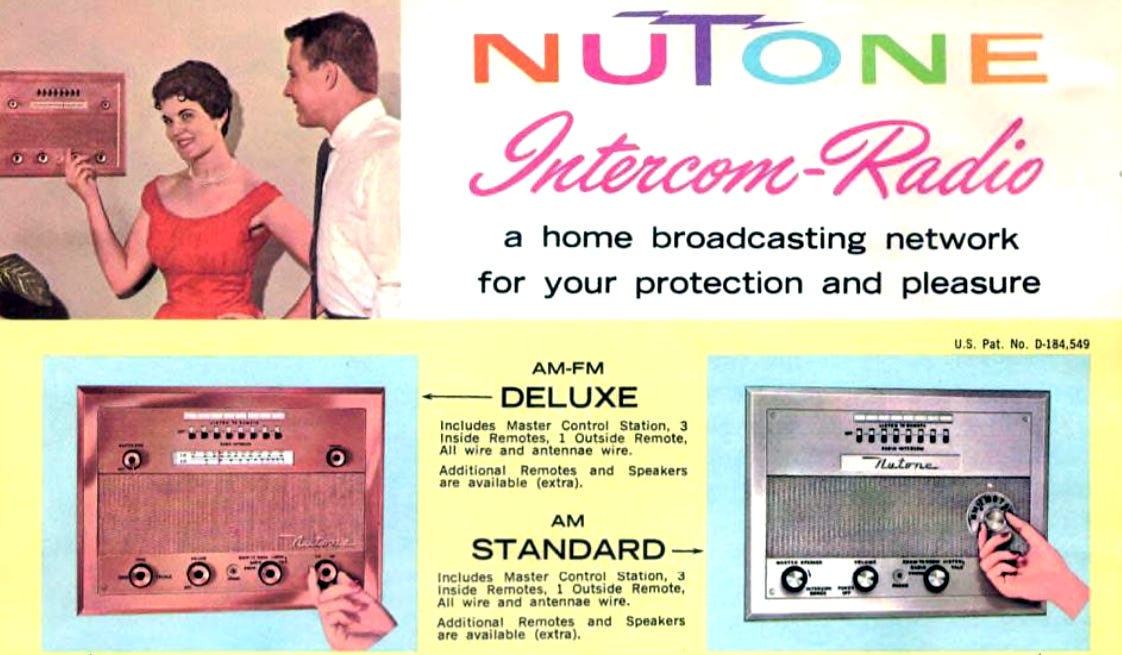
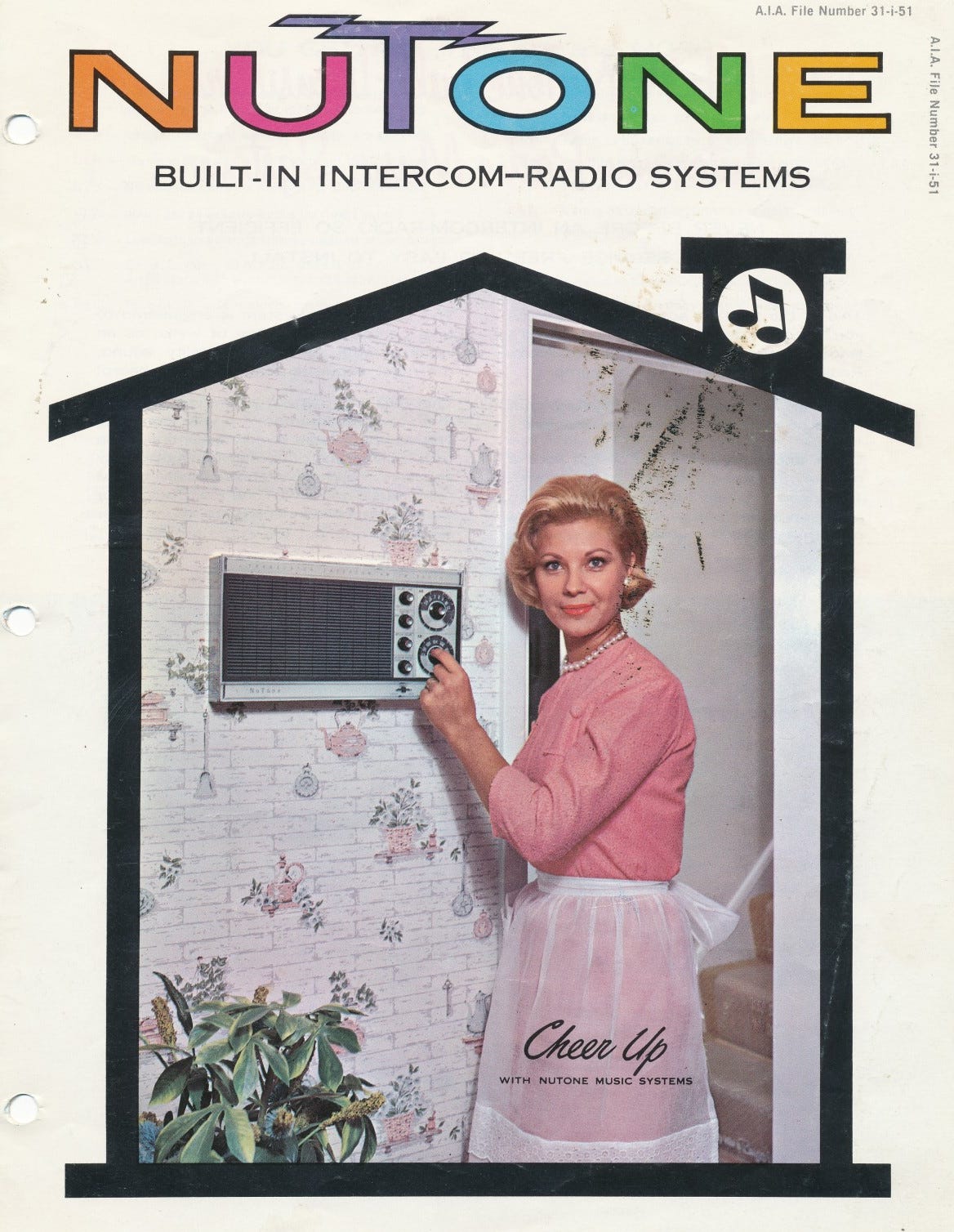
“A ‘Sound Investment’ for Every Home! A Blessing for a Busy Mother,” says a 1958 brochure for NuTone built-in home intercom systems. “She speaks softly… and yet is heard in every corner of the house.”
For companies like NuTone, hopes were high that the age of intra-home radio had come. The postwar building boom saw more than 1 million new homes built in 1946, climbing to 1.95 million in 1950 and staying well above a million annually thereafter.
Those homes were filling up with modern conveniences, too. In 1941, only 45% of US homes had an electric refrigerator; by 1957, that figure had doubled to 90%. Before the war, only 55% of American homes had complete plumbing (hot and cold running water, a bathtub or shower, and a flush toilet). By 1960, that number would be up to 83%. Telephones, too, spread rapidly after the war: from 45% of homes in 1945 to 75% by 1957.
Homes were starting to get bigger. The size of the average new home built in 1950 was 983 square feet, while in 1960, it was 1,289 square feet - in other words, the average home grew by 31% through the decade.
The millions of families stretching out in these spacious, modern new homes would need to talk to each other, right? What better way than the friendly old radio? And what better time to build a home intercom system than right along with the rest of the new house?
As a 1953 newspaper story put it, “Many experts say that such systems will be standard equipment in the so-called ‘home of tomorrow’.”
Home Communo-phone Systems
“We feel any new house that costs from $18,000 and up is a potential market,” said L.H. Bogen of the Bogen electronic company in 1953, when that price was about the median for new homes. “The cost of the average installation is not expensive - about $300 (about $3750 today), but the small house owner just wouldn’t have as much need for it.” He said his company had sold 6,000 “home communo-phone systems” over the previous two years.
Another manufacturer that same year said “Mother may not be a broadcaster, but she knows her needs as a homemaker. So the intercom units are designed to fit her needs for simple operation.”
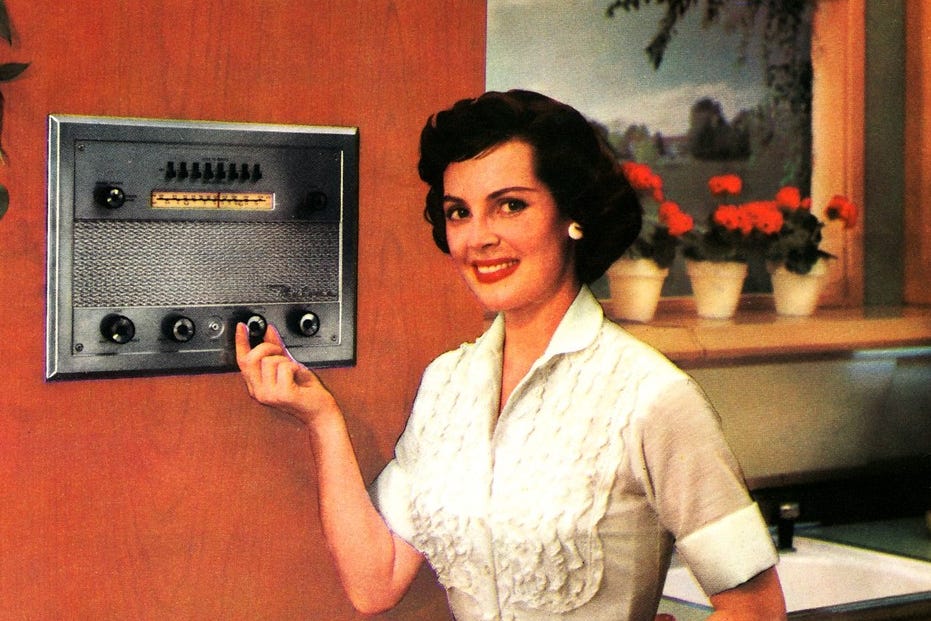
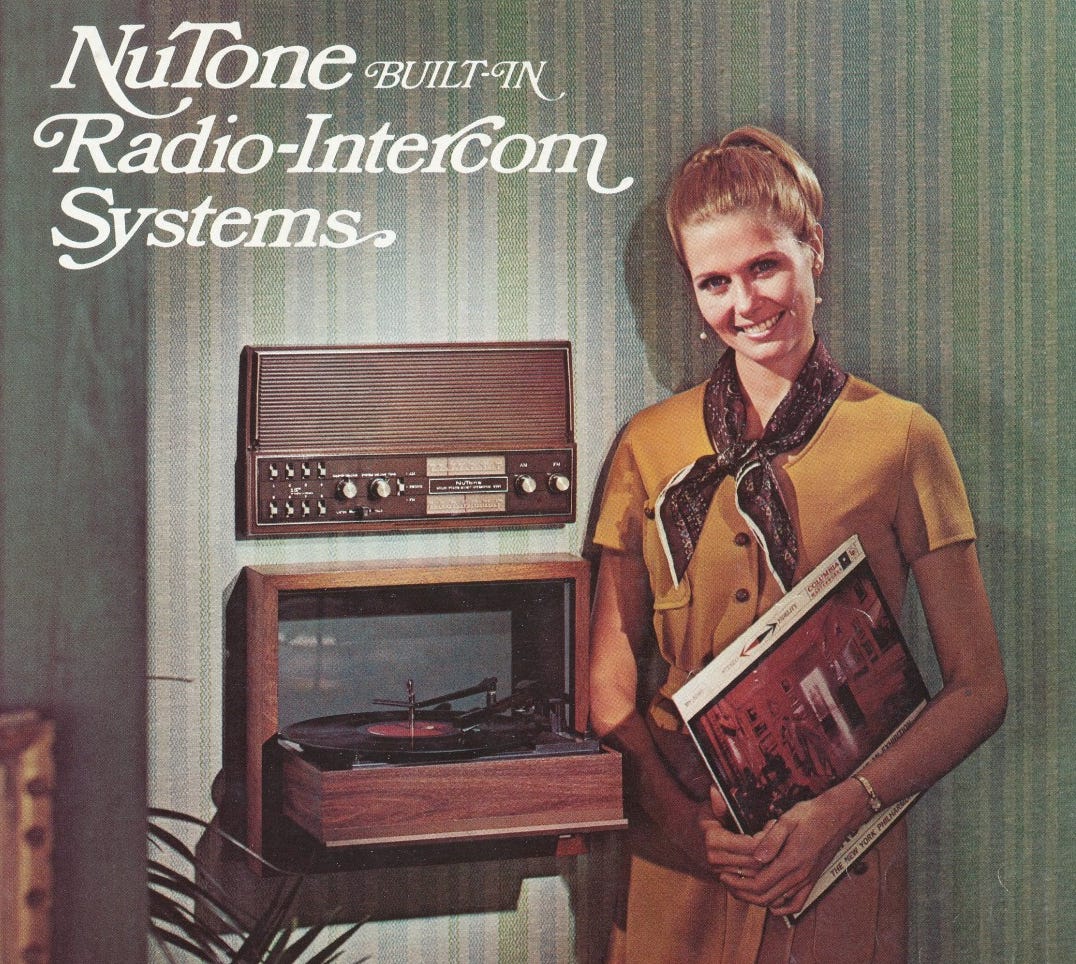
Their design model was radio. These units, set flush into a wall at about head height, had a familiar configuration: mostly speaker, with a set of dials and a switch or two. A bigger base unit, generally shown in the kitchen, connected to smaller “remotes” throughout the house.
While the functionality varied, home intercoms generally allowed two-way communication, or whole-house announcements, or eavesdropping on a particular room, like a baby monitor. Most included AM/FM radio that could be piped throughout the system, so Mother the non-broadcaster could listen from room to room.
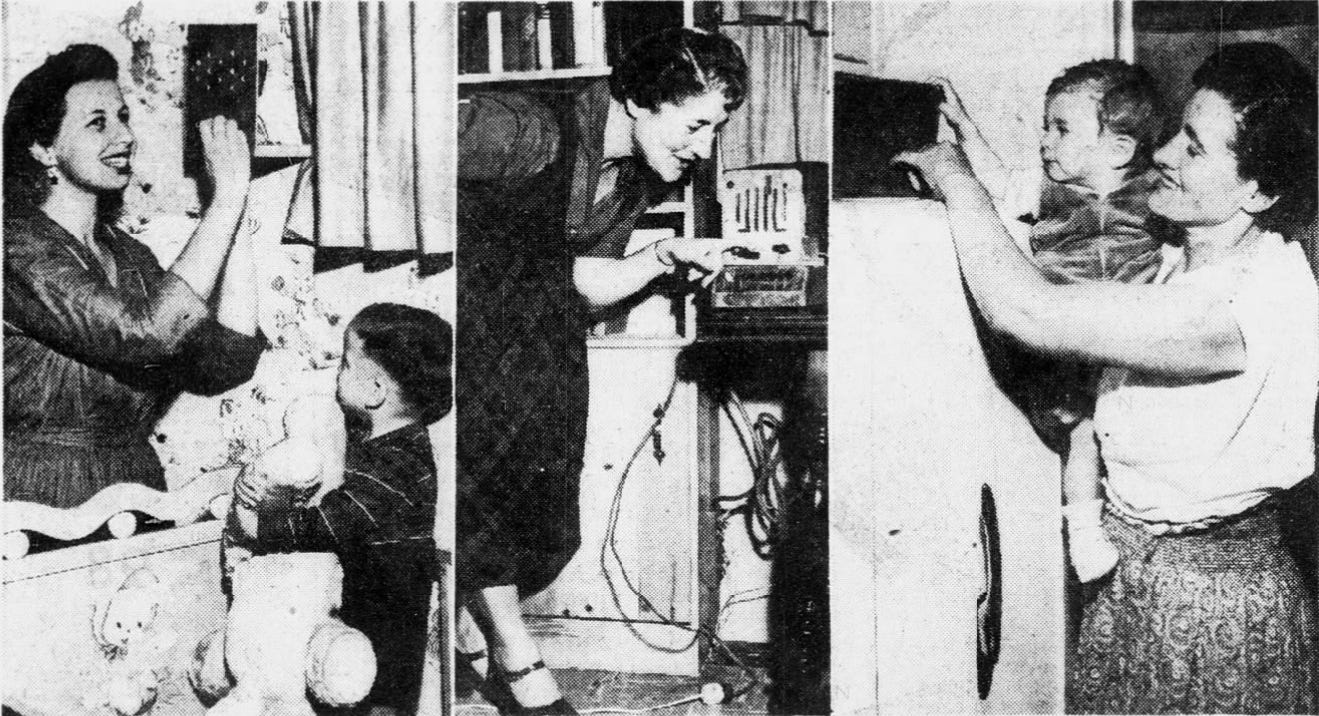
The novelty of hearing a familiar voice coming from the “radio”, and the feeling of being in a science fiction future, sparked a wave of excitement over home intercoms. Newspapers ran stories like this one from Arizona, about three neighbors who connected their homes with an intercom system set up by one of their teenage sons. They could chat while each were doing their chores, and mingle in each other’s homes freely while keeping an ear out for the kids.
It was practical, it was futuristic, it was kind of fun. So why did home intercoms never really catch on?
“Hated that thing so much”
Statistics are hard to come by, but wired home intercoms never made the leap that TVs and telephones did, from luxury to essential. Anecdotally, they’re remembered mainly as either something only rich people had, or as a little-used, troublesome white elephant. “What a waste of money that was, we never used it,” said one Facebook user.
“We used it as a baby monitor,” said Redditor Xyzzydude. “That required a bunch of switch flipping at the central station to figure out. They weren’t exactly flexible or user friendly… That was the only practical use we got out [of] it in over 40 years.”
“Our intercom system caught fire when I was a teenager,” another Redditor, FireWaterSquaw, said. “My brother and I hated that thing so much. Our parents would abuse it to wake us up for school.”
It’s a classic case of “features vs. benefits”. Yeah, home intercoms could do something. But that something just didn’t improve people’s lives enough to be worth the expense and effort of using it. Once the novelty wore off, an expensive, hard-wired, finicky unitasker was a tough sell.
Dedicated home intercom systems lingered for a few decades, gradually made redundant by other devices that were either more multifunctional or simpler. First came portable “wireless” intercoms that plugged into any outlet and carried sound on the home’s electrical wiring. Then, in the 1970s, some phone systems allowed you to dial to other extensions in the same house. The mid-’80s saw the first cordless phones with simple page and intercom functions between handsets, while simple wireless baby monitors made it easy to keep an ear on your kids.
Smart phones and smart speakers would seem to have finished the home intercom off for good. But they also affirm its basic use case, like every time I call my daughter two rooms away. With concern growing about data security, and a mood drift toward simpler “dumb” technology, the time may have come for the dedicated home intercom to make a comeback.
New systems like the Hosmart Ultraspeak and the Wuloo S600 might just be the first of a new generation of unconnected, cloud-free, wireless home intercoms. And you probably don’t need to worry about them catching on fire.
My childhood home (built in 1973) totally had these intercom systems in every bedroom, though I can't remember ever using them. Possibly for the crappy radio they had before I got my own. How about you, ever had these in your house or seen them in any others? Have anything quirky installed in your place that future residents will wonder about and/or gripe about having to uninstall? (I'm guessing my 'smart' thermostats will not be appreciated in the future.) Let's hear about 'em in this week's Shoddy Goods chat.
—Dave (and the rest of Meh)
Tune into these previous Shoddy Goods stories wherever fine infotainment is narrowcasted:
And if you like Shoddy Goods, don’t miss Jason’s new other newsletter, Gnomenclature. Every week he digs into the 178-year-history of Hammacher Schlemmer, America’s oddest retailer. It’s gonna get weird!
I have a NuTone system in the house I just bought! It was built in 1969 and has a lot of outdated "luxuries." It's been painted over and obviously doesn't work but there's a loose panel in the basement hooking it all together. It's on the list of items to fix but it requires a lot of wall repair in various formats. We probably need an electrician to rip all the wiring out as well. I wish there was something practical to creatively reuse it though.
My childhood friend had one of these!! I considered anyone who had stairs in their home to be living in the lap of luxury, and she had stairs, as well as this home intercom system and even a sauna room. Her dad worked for a home builder company, so maybe that had something to do with it lol. Anyway, I thought the home intercom was SO incredible. I don't think it actually worked very well though...