

Here’s mud in your eye! Jason Toon here with a new Shoddy Goods, the newsletter from Meh about consumer culture. This week we’re looking at a path not taken that could have changed American brewing, if not American masculinity.
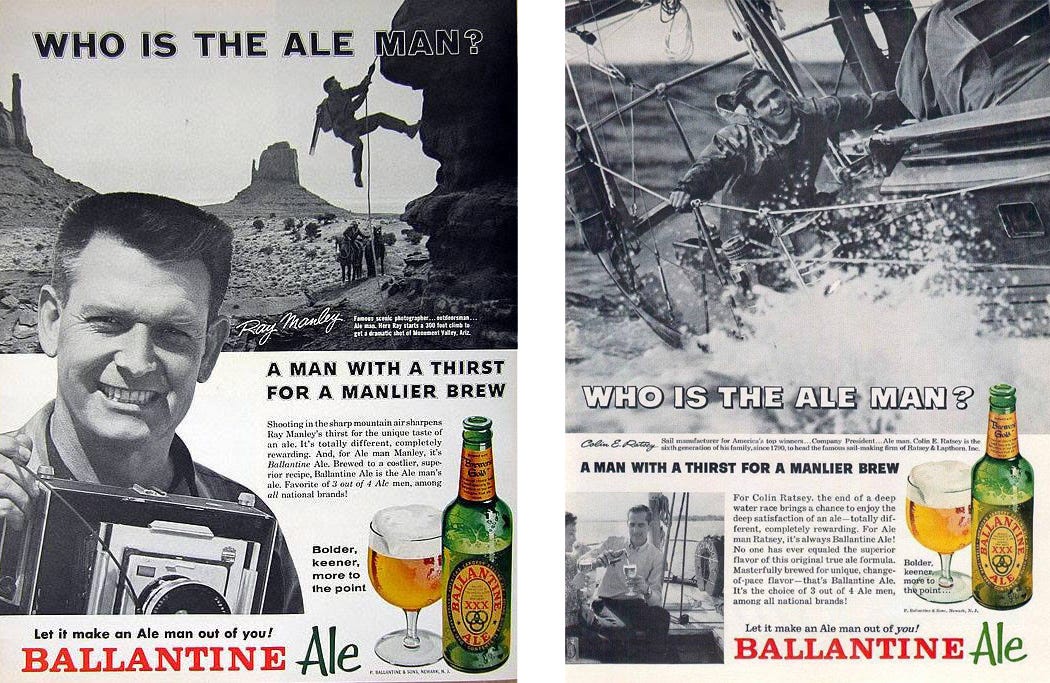
Maybe he’s a renowned author who unwinds by scuba diving, like Eugene Burdick. Maybe he’s a photographer who scales cliffs to get the perfect shot, like Ray Manley. Maybe he’s a yacht racer who runs the family sail-making business, like Colin Ratsey. He’s a man of intellect and action, of exertion and indulgence. His jaw is square, his shirts are crisp, and he’s got “a thirst for a manlier brew”: Ballantine Ale.
“Not beer?” one of his TV commercial companions invariably asks.
The Ale Man scoffs. “It’s time you graduated from beer.”
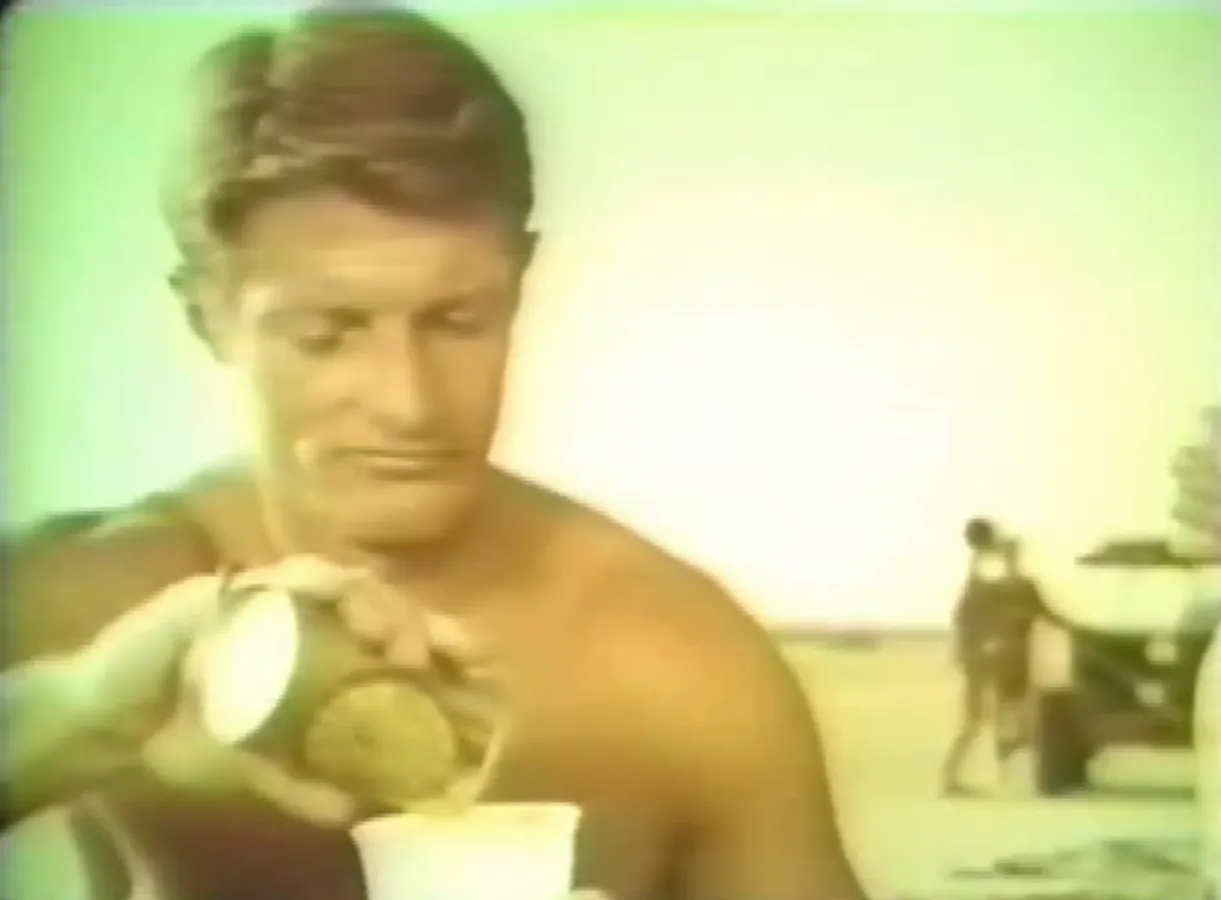
In a series of ad campaigns in the 1960s, F. Ballantine & Sons hawked ale as “beer’s big brother”, the tastier, brawnier, more mature choice for the Atomic Age man’s man. Against the prevailing trends, it was an attempt to claim space in the mainstream mass market for a more traditional brew. Was it behind the times, or ahead of them? Or both?
Of malts and men
First things first: yes, ale is a kind of beer. Originally, in medieval times, the two were distinguished by the fact that beer contained hops and ale did not. But by the late 1500s, that distinction had broken down. No less an authority than beer historian Michael Jackson (not that one), in his definitive New World Guide to Beer, refers to all ales as styles of beer. The similarly exhaustive Oxford Companion to Beer defines ale as “a broad class of beers brewed using the top-fermenting yeast Saccharomyces cerevisiae.”
But if you’re a beer connoisseur who’s ever offered an IPA to a visiting relative only to be asked if you have any “normal beer”, you know that “beer” as it was generally understood by 20th-century Americans is a more specific thing. Pale, golden, watery, mass-produced lagers like Budweiser, Miller, and Schlitz became so dominant after World War II that eventually a whole microbrewing revolution was necessary just to restore the diversity of pre-Prohibition American beer styles.
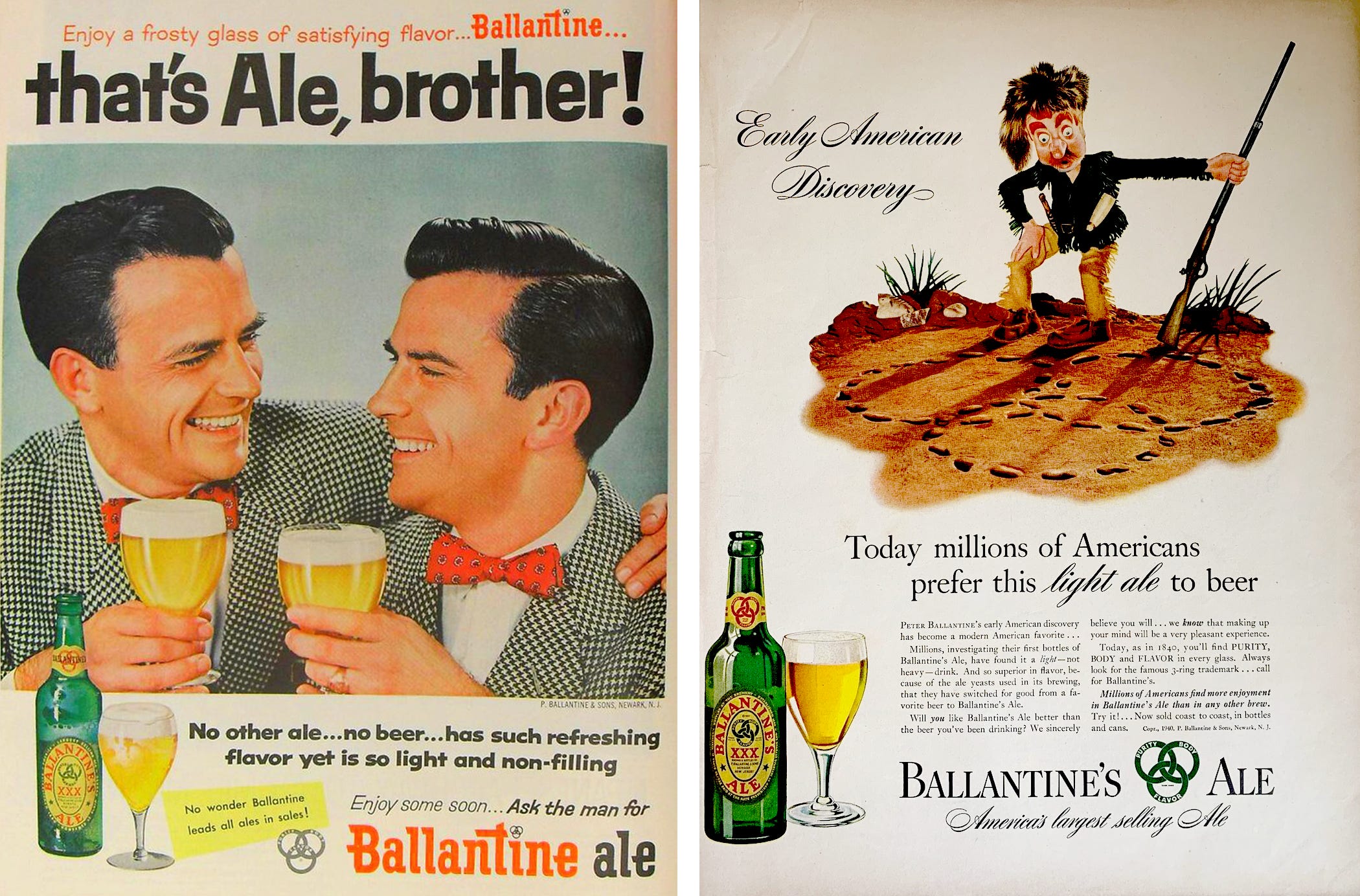
Ballantine, founded in 1845 in New Jersey, produced a lager in the mainstream postwar style, and promoted it heavily with the same celebrity endorsements and baseball sponsorships that other brewers used. But unlike the other major brewers, they weren’t ready to jettison the XXX Ale that had been their flagship, or their then-unique India Pale Ale (IPA), one of the only such offerings in America through most of the century. Ballantine’s initial attemps at carving out a distinct profile for ale were tentative. Was it more “crisp” and “refreshing” than beer? More “American”? More “moderate”? Or just “better”?
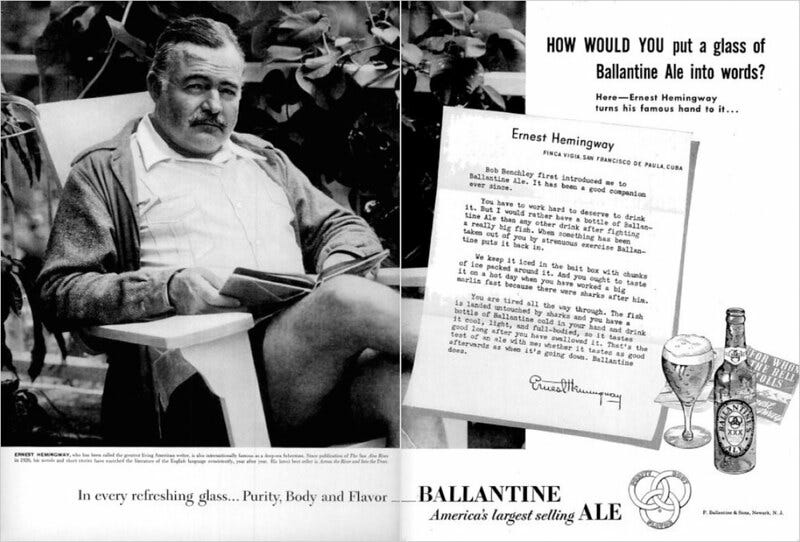
One 1950s campaign had famous authors “put a glass of Ballantine Ale into words.” John Steinbeck penned a mini-epic set in the desert, culminating with “Well, first, you take a big swallow to cut the crust, and suddenly you can taste again. Then you let cold Ballantine Ale rill into your parched throat like a spring rain on the desert.” Ernest Hemingway‘s paean recalled a deep-sea fishing trip: “You ought to taste it on a hot day when you have worked a big marlin fast because there were sharks after him... cool, light, and full-bodied, so it tastes good long after you have swallowed it.”
These hairy-chested, two-fisted literary exploits led Ballantine to the angle that they’d ride to the end: that ale was manlier. First with the agency William Esty Company and then, split off from the beer account in 1965, with Sullivan, Stauffer, Colwell & Bayles, they set out to make the Ale Man an American archetype.
“A man’s taste grows up when he does”
The print campaign started with the aforementioned polymaths (the scuba-diving author, the rock-climbing photographer, etc.), each one an actual person. Despite their varied interests, these bold individualists show a remarkable unanimity of opinion about the “totally different, completely rewarding” flavor of Ballantine Ale.
Before long Ballantine ran out of real guys - how many like this could there be? - and had to invent new Ale Men for the radio and TV commercials. The young executive who surfs. The rocket scientist who plays hockey. The defense attorney with a yen for skeet shooting. Between nagging refrains of the “Who is the Ale Man?” jingle, these were the “young men, blazing new trails to the future” who proved “a man’s taste grows up when he does.”
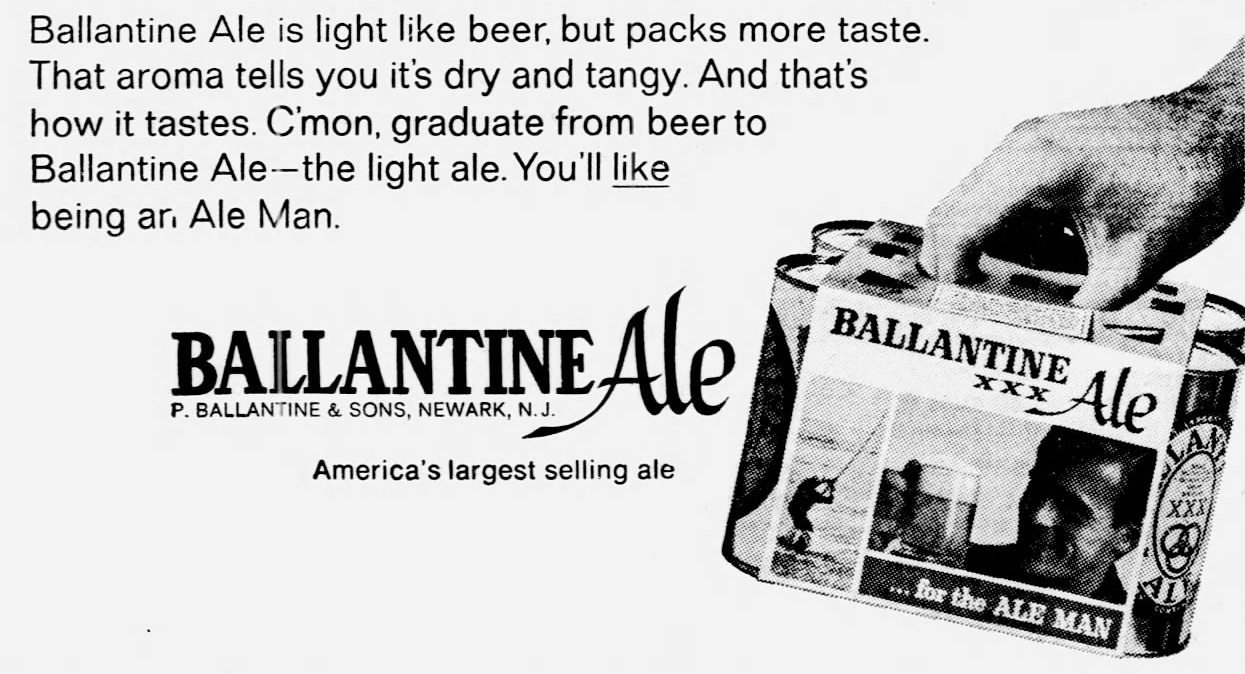
At the end of another hard-charging day, the Ale Man’s friends are always skeptical, but he patiently explains “It’s light like beer, but what a difference. Smell that aroma. That’ll tell you.” One sniff later, the ale-curious pals are convinced: “Hey, real tangy!”
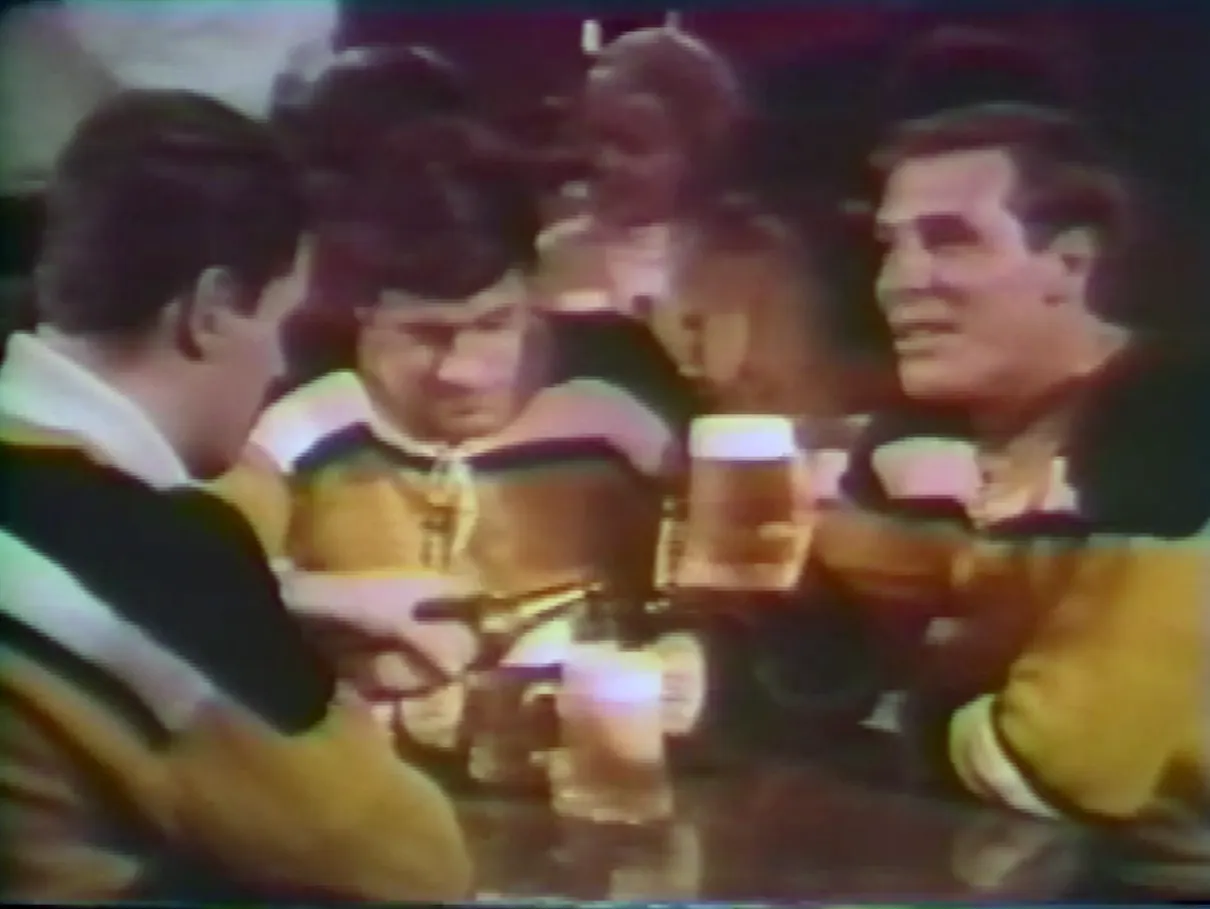
If the Ale Man ads seem ridiculous today, their over-the-top overachievers and impossibly vigorous masculinity drew their share of mockery back then, too. In a parodic Sherlock Holmes story for the New York Times, humorist Russell Baker has the sleuth and Watson try to answer the campaign’s titular question. Holmes’s incisive conclusion: “Clearly, [the Ale Man] is an American who feels so insecure that he must advertise his taste as European.”
Columnist John P. McLaughlin of the Trenton Evening Times bewailed the realization that he’d never be an Ale Man: “I am not a sail manufacturer who sails racing sloops. I don’t publish eight national magazines and I have never played handball. What right, then, have I to try the bolder, keener taste of the manlier brew?” I suspect Ballantine welcomed any and all such commentary, according to the time-honored principle “don’t read your publicity, weigh it.”
Ale fellow well met
Unfortunately for Ale Men everywhere, asserting the value of flavorful beer wasn’t the only way Ballantine didn’t move with the times. They also never opened another bottling plant further west than their original New Jersey facility, so their distribution fizzled out past Chicago - a critical limitation in an era of big brewers getting bigger.
In the wave of mergers and acquisitions that swept brewing in the 1970s, if you weren’t a buyer, you were bought. Falstaff Brewing acquired the struggling Ballantine in 1972, and in turn was acquired by Pabst in 1985. The range of American beers was growing ever smaller during these years. The Newark brewery was closed, with Ballantine production shifting to Pabst facilities. Eventually only a watered-down version of Ballantine XXX Ale survived, largely in the 40-ounce bottles associated with street drunks. Oh, how the Ale Man had fallen.
In the 2010s, Pabst attempted to revive both the Ballantine IPA and the label’s once-premium reputation. By now it was just one of many (perhaps too many) in a crowded craft beer scene. But for a few years back in the 1960s, Ballantine was a lone voice for an older brewing tradition and a more complex style. It was a doomed quest, but a bold one - what else would you expect from an Ale Man?
I used to hate coffee, beer, and asparagus, and now I’d love as much of all three as my health could take. But celery’s still out. What acquired tastes have you acquired, and what do you expect you’ll never acquire? Let’s talk in this week’s Shoddy Goods chat.
—Dave (and the rest of Meh)
Got a thirst for a nerdier read? Graduate to the crisp, tangy flavor of these previous Shoddy Goods stories:
Why is alcohol-free beer just as expensive as the real thing?
War, fate, and orange coffee pots: the strange saga of decaf
And if you like Shoddy Goods, don’t miss Jason’s new other newsletter, Gnomenclature. Every week he digs into the 178-year-history of Hammacher Schlemmer, America’s oddest retailer. It gets weird!
The history of beer in the US is a pretty interesting story. There’s a great book called “Beer Blast: The Inside Story of the Brewing Industry's Bizarre Battles for Your Money“ that covers all that weird stuff that happened in the ‘80’s and ‘90s. https://www.goodreads.com/en/book/show/745119.Beer_Blast
I thought for sure I'd had Ballantine until I read they'd shut down when I was a toddler.
But wait! "Eventually only a watered-down version of Ballantine XXX Ale survived, largely in the 40-ounce bottles associated with street drunks."
Ah right, that's how I know it.